
This guide explains how crude oil trading works in India: the Crude Oil and Crude Oil Mini contracts, what a lot is worth and how much margin it needs, what moves the price, the trading day in Indian time, four rule-based strategies with model numbers per lot, a worked week, gaps and the April 2020 negative settlement, sizing, costs, options on crude, backtesting, and how to run the rules as an algo in QuantPower.
Crude oil trading at a glance
| Feature | Crude oil on MCX |
|---|---|
| Exchange | Multi Commodity Exchange of India (MCX) |
| Contracts | Crude Oil (100 barrels) and Crude Oil Mini (10 barrels), as futures and as options on those futures |
| Price | Rupees per barrel, following NYMEX WTI crude and the rupee-dollar rate |
| Tick | ₹1 a barrel: ₹100 per standard lot, ₹10 per Mini lot |
| Trading hours | 9:00 am to 11:30 pm while the US is on daylight saving time, 11:55 pm for the rest of the year |
| Expiry | Futures monthly, around the 19th; options two business days before their futures |
| Settlement | Futures settle in cash at a rate based on the NYMEX settlement price; options in the money at expiry become futures positions |
| Margin | About 31% of contract value in September 2026, or about ₹26,900 per Mini lot at ₹8,600 |
| Busiest hours | The evening, when US markets are open |
| Main risks | Overnight and weekend gaps, spikes around US events, margin increases and leverage |
Key takeaways
- Each ₹1 change in the price per barrel moves a Mini lot by ₹10 and a standard lot by ₹100. At a model volatility of 35% a year, a typical day's move is about ₹190 a barrel: ₹1,900 per Mini lot and ₹19,000 per standard lot.
- MCX crude moves with WTI and with the rupee. At $89 a barrel and ₹96.70 to the dollar, a $1 rise in WTI adds ₹967 to a Mini lot, and a 50-paise fall in the rupee adds ₹445.
- Margin is high: about 31% of contract value in September 2026, or about ₹2.69 lakh for a standard lot. Size from the stop, then check that margin takes no more than about half your capital.
- A round trip costs about ₹62 on a Mini lot and ₹195 on a standard lot. Per barrel the Mini costs three times as much, which matters for strategies with small targets.
- In the worked week, two winning trades and one loss on the evening breakout made ₹570 before costs and ₹384 after: costs took a third of the profit.
- Crude can gap. In the example, a 3% gap at the open turned a swing trade's locked-in ₹528 profit into a ₹1,422 loss, and in April 2020 MCX settled its expiring contract at minus ₹2,884 a barrel.
How crude oil trading works in India
Crude oil trades in India as derivatives on MCX: futures, and options on those futures. No barrels change hands. MCX settles its crude futures in cash on expiry, at a due date rate based on the settlement price of the NYMEX WTI contract converted into rupees. Before expiry, the MCX price follows WTI and the rupee-dollar rate through the day.
The two contracts
| Crude Oil | Crude Oil Mini | |
|---|---|---|
| Lot size | 100 barrels | 10 barrels |
| Value of a ₹1 move per lot | ₹100 | ₹10 |
| Contract value at ₹8,600 | ₹8,60,000 | ₹86,000 |
| Margin at 31.25%, the September 2026 rate | About ₹2,68,750 | About ₹26,875 |
| Typical day's move, model | About ₹19,000 | About ₹1,900 |
| Round-trip charges, model | About ₹195 | About ₹62 |
The rules are the same for both. The Mini lets you size in smaller steps and test with less money; the standard lot costs less per barrel. The prices in this guide are illustrative and use ₹8,600 a barrel. Check the live price and margin in your broker's F&O margin calculator before trading.
Expiry and rolling
MCX lists crude futures several months ahead, but most trading is in the nearest month. The near-month contract expires around the 19th, and the exact date is in MCX's contract calendar. Strategies that hold positions for days move to the next month a few trading days before expiry, when volume moves across. Options on crude expire two business days before the futures they are based on.
Margin and leverage
MCX sets crude margins from its risk model and can add extra margin when markets are volatile. The rate has been high: an NRML margin of 31.25% of contract value in September 2026, according to broker data. That is leverage of about three times, so a 10% fall in price, ₹860 a barrel, takes about a third of the margin. Our commodity trading guide explains how margins work across MCX contracts.
What moves the price of crude oil in India
WTI and the rupee
The rupee price is roughly the dollar price of WTI multiplied by the rupee-dollar rate. At $89 a barrel and ₹96.70 to the dollar, crude is about ₹8,600 a barrel on MCX. Either part can move it:
| Change | Effect per barrel | Per Mini lot | Per standard lot |
|---|---|---|---|
| WTI up $1, rupee unchanged | +₹96.70 | +₹967 | +₹9,670 |
| WTI up 1% | +₹86 | +₹860 | +₹8,600 |
| Rupee weakens by 50 paise, WTI unchanged | +₹44.50 | +₹445 | +₹4,450 |
| WTI up $1 and rupee strengthens by 50 paise | +₹52 | +₹517 | +₹5,170 |
A weaker rupee pushes MCX crude higher even when oil is flat in dollars, so a strategy that reads only the WTI chart misses part of the move. Rules built on the MCX price itself capture both.
Supply, demand and events
- OPEC+ output decisions. OPEC+ meetings have often been held at weekends, so the reaction arrives as a gap at Monday's 9:00 am open.
- US inventories. The US Energy Information Administration (EIA) publishes weekly crude stock figures on Wednesdays at 10:30 am New York time: 8:00 pm in India while the US is on daylight saving time and 9:00 pm in winter. The release moves later in weeks with a US public holiday. An industry estimate from the American Petroleum Institute comes out on Tuesday afternoon in New York, after MCX has closed, so it shows up at Wednesday's open.
- US economic data and the Federal Reserve. Inflation and jobs reports come out at 8:30 am New York time, 6:00 pm in India in summer, and move the dollar and expectations for demand. Fed decisions come at 2:00 pm New York time, which is 11:30 pm in India in summer, right at the MCX close.
- Geopolitics affecting producers and shipping routes.
- The global economy, especially demand from China and the US.
The crude oil trading day in Indian time

| Time in India, US summer | In winter | What happens | What it means for a strategy |
|---|---|---|---|
| 9:00 am | 9:00 am | MCX opens; overnight news shows up as a gap | Check open positions against their stops; avoid entries in the first minutes |
| 9:00 am to 5:00 pm | Same | Morning session, usually quieter, with Asian and European trading | Mean-reversion rules on days without news |
| From about 5:30 pm | From about 6:30 pm | US traders become active (8:00 am New York) | Breakout and trend rules |
| 6:00 pm | 7:00 pm | US inflation and jobs reports, on their release days | No new entries for 10 minutes either side |
| 8:00 pm, Wednesday | 9:00 pm | EIA weekly petroleum report | No new entries for 15 minutes either side |
| 11:30 pm | 11:55 pm | MCX closes | Intraday positions closed before your broker's square-off time |
| 11:30 pm on Fed decision days | 12:30 am | US Federal Reserve decision | Positions held overnight take the reaction at the next open |
The morning session runs from 9:00 am to 5:00 pm and the evening session from 5:00 pm to the close. The MCX market timings page lists holidays and the dates of the seasonal change.
How far crude oil moves
Model values at ₹8,600 a barrel and 35% annual volatility:
| Period | Typical move (one standard deviation) | Per Mini lot | Per standard lot |
|---|---|---|---|
| One day | ₹190 (2.2%) | ₹1,896 | ₹18,961 |
| One week | ₹424 (4.9%) | ₹4,240 | ₹42,399 |
| One month | ₹869 (10.1%) | ₹8,689 | ₹86,891 |
The examples below assume that on an active evening a 15-minute candle covers about ₹28 on average, measured by the average true range (ATR) over 14 candles: ₹280 per Mini lot. Two points matter for risk. Large moves happen more often in crude than a normal distribution suggests, especially around OPEC+ decisions and supply shocks. And a stop placed for a 15-minute candle is small against a day's move, so overnight positions need wider stops and smaller size.
Crude oil trading strategies for each market
| Market | Strategy | Timeframe | Main risk |
|---|---|---|---|
| A move that starts when US traders arrive | Evening range breakout | 15-minute candles, intraday | False breakouts and spikes around events |
| A trend lasting several days | Trend following with Supertrend | 30-minute candles, held overnight | Gaps, and repeated small losses in sideways markets |
| A quiet day with no scheduled news | Mean reversion to VWAP | 15-minute candles, intraday | A quiet day that turns into a trend |
| Days with US data or OPEC+ news | Event filter, added to the others | Any | Missing some good moves |
| A view with a fixed maximum loss | Buying options | Days to weeks | High implied volatility and time decay |
Strategy 1: Evening range breakout
Crude often drifts in the afternoon and moves once US traders arrive. This strategy trades the first move out of the early evening range.
| Rule | Setting |
|---|---|
| Contract | Crude Oil Mini, near month; switch to the next month three trading days before expiry |
| Range | High and low of the 5:00 to 6:00 pm candles |
| Range filter | Skip the day if the range is wider than 1.5 times its 20-day average |
| Entry | A stop order one tick above the range high or below the range low, live from 6:05 to 9:30 pm |
| Stop | The other side of the range or 1 × ATR(14) of 15-minute candles, whichever is closer |
| Target | Twice the stop distance |
| Time exit | 11:00 pm |
| Limit | One trade a day |
| Events | No new entries 10 minutes either side of US data and 15 minutes either side of the EIA report |
Example. The range is ₹8,560 to ₹8,620, about its usual width. At 6:40 pm crude trades through ₹8,621 and the buy order fills a tick higher, at ₹8,622. The ATR is ₹28 and the range low is ₹62 away, so the stop goes ₹28 below the entry, at ₹8,594, a risk of ₹280 per Mini lot. The target is ₹56 above the entry, at ₹8,678.
Strategy 2: Trend following with Supertrend
For traders who prefer fewer, longer trades.
| Rule | Setting |
|---|---|
| Chart | 30-minute candles |
| Entry | Buy when Supertrend (10, 3) turns up; sell when it turns down |
| Exit | A 30-minute close beyond the Supertrend line, which works as a trailing stop |
| Overnight | Positions can be held, with a cap on the number of lots carried overnight |
| Roll | Exit or roll to the next month three trading days before expiry |
| Events | No new entries on OPEC+ decision days |
Example. On Tuesday at 9:00 pm, Supertrend turns up and the strategy buys one Mini lot at ₹8,481, with the line at ₹8,410: a risk of ₹710. The trend runs for three days and the line rises behind it. On Friday at 10:30 pm a candle closes below the line and the strategy sells at ₹8,688: +207 points, ₹2,070 before costs and ₹2,008 after ₹62 of charges.
The same trade with a gap. On Wednesday night crude closes at ₹8,610 with the line at ₹8,540, so the trade has about ₹590 locked in. If news overnight sends crude 3% lower at Thursday's open, to ₹8,352, the first 30-minute close is below the line and the strategy sells at ₹8,345: a loss of ₹1,422 after charges instead of a gain of ₹528. A stop protects against moves during the session, not against prices that open beyond it.

Trend rules lose small amounts often in sideways markets and make most of their money in a few long trends, so test them over several years, including flat ones.
Strategy 3: Mean reversion to VWAP on quiet days
On days without scheduled news, crude often drifts back towards its average price after a sharp move.
| Rule | Setting |
|---|---|
| Chart | 15-minute candles with VWAP from the 9:00 am open |
| Entry | Sell when price is 2 × ATR above VWAP; buy when it is 2 × ATR below |
| Exit | At VWAP |
| Stop | 3 × ATR from VWAP |
| Window | Entries from 11:00 am to 4:50 pm only |
| Filter | Only on days without an EIA report or major US data, and not on the day after an OPEC+ decision |
Example. In the afternoon VWAP is ₹8,600 and the ATR is ₹18, smaller than in the evening. Crude rises to ₹8,636, two ATRs above VWAP, and the strategy sells one Mini lot, with a stop at ₹8,654. Crude slips back, and the position closes at VWAP, which has drifted to ₹8,604: +32 points, ₹320 before costs and ₹258 after.

Mean reversion fails on trending days, which is why the filter and the hard stop matter.
Strategy 4: The event filter
Crude reacts sharply to scheduled releases. These rules sit on top of the strategies above.
| Event | Time in India, US summer (winter) | Rule |
|---|---|---|
| EIA weekly petroleum report | Wednesday 8:00 pm (9:00 pm) | No new entries from 15 minutes before to 15 minutes after |
| US inflation and jobs reports | 6:00 pm (7:00 pm) on release days | No new entries from 10 minutes before to 10 minutes after |
| US Federal Reserve decision | 11:30 pm (12:30 am) | Cut overnight positions to half their usual size |
| OPEC+ meetings | Varies, often at weekends | Halve position size or skip the day; cut positions held over the weekend |
Existing positions keep their stops; the filter only blocks new entries while spreads widen and prices jump.
A worked week on one Mini lot
Here is the evening breakout over one week on one Mini lot. Prices are model prices, entries fill one tick beyond the stop order, and stops fill two ticks beyond the trigger. It illustrates the mechanics and is not a record of results.
- Monday, 6:00 pmThe range is ₹8,560 to ₹8,620, a normal width.
- Monday, 6:40 pmBuy at ₹8,622. Stop ₹8,594, target ₹8,678.
- Monday, 8:55 pmThe target fills: +56 points, ₹498 after ₹62 of charges.
- Tuesday, 7:20 pmThe range was ₹8,640 to ₹8,690. Sell at ₹8,638 on the break below. Stop ₹8,666, target ₹8,582.
- Tuesday, 7:50 pmCrude turns back up through the stop, which fills at ₹8,668: −30 points, −₹362 after charges.
- Wednesday, 6:00 pmThe range is ₹100 wide, 1.8 times its 20-day average, with the EIA report due at 8:00 pm. No trade.
- Thursday, 6:20 pmThe range was ₹8,580 to ₹8,615. Buy at ₹8,617. Stop ₹8,589, target ₹8,673.
- Thursday, 11:00 pmCrude has drifted up but not reached the target. The time exit sells at ₹8,648: +31 points, ₹248 after charges.
- Friday, 9:30 pmUS jobs data at 6:00 pm, and crude stays inside the range all evening. No trade.
| Monday | Tuesday | Wednesday | Thursday | Friday | The week | |
|---|---|---|---|---|---|---|
| Exit | Target | Stop | No trade | Time exit | No trade | |
| Points | +56 | −30 | +31 | +57 | ||
| P&L before charges | +₹560 | −₹300 | +₹310 | +₹570 | ||
| Charges | ₹62 | ₹62 | ₹62 | ₹186 | ||
| Net P&L | +₹498 | −₹362 | +₹248 | +₹384 |
Three points stand out. Costs took ₹186 of the ₹570 profit, a third, because the Mini's brokerage is the same per order as the standard lot's. The same trades on one standard lot would have made ₹5,700 before costs and ₹5,115 after, but with about ₹2,800 at risk per trade and ₹2.69 lakh of margin per lot, which under the sizing rules below suits an account of at least ₹5.4 lakh. And the two days without a trade were the filters working: a wide range on an inventory day and no breakout on a data day.
Gaps, spikes and the April 2020 settlement
Gaps at the open
MCX is closed from the late-evening close to 9:00 am, while news keeps coming. US Federal Reserve decisions, OPEC+ meetings and events in producing countries can all arrive while MCX is shut. A stop order does not protect against a price that opens beyond it, as the Supertrend example showed. Weekends add two days of news. Rules that hold positions overnight should cap the number of lots carried and assume a gap of several percent in the stress test.
Spikes around releases
In the minutes after the EIA report or US data, crude can move further in one minute than in a normal 15-minute candle, and the spread widens. A stop triggered then can fill several ticks away. The event filter keeps new entries out of those minutes, and the backtest should assume extra slippage on stops around them.
The April 2020 negative settlement
On 20 April 2020, the NYMEX WTI May contract settled at minus $37.63 a barrel. MCX's April crude contract expired the same day, and MCX settled it at minus ₹2,884 a barrel: the NYMEX price converted at the RBI reference rate. Holders of long positions lost the whole purchase price and also had to pay ₹2,884 a barrel, about ₹2.88 lakh per standard lot. Challenges in court failed: in 2026 the Bombay High Court dismissed the petitions, holding that traders were bound by the contract terms.
The lesson for rule-based traders is practical. Contracts settle at the NYMEX-linked rate however unusual it is, rare events can exceed any stop, and positions held into expiry carry settlement risk. Most strategies exit or roll several days before expiry and cap the size carried overnight.
Sizing a crude oil position
Size from the loss, then check margin. For the evening breakout, the risk per Mini lot is the ₹280 stop plus ₹62 of charges and two ticks of slippage, about ₹362. For the Supertrend example, with a ₹710 stop, it is about ₹792.
| Trading capital | 1% risk per trade | Mini lots by risk (breakout) | Margin for those lots | Lots if margin is capped at half the capital |
|---|---|---|---|---|
| ₹2 lakh | ₹2,000 | 5 | ₹1,34,375 (67% of capital) | 3 |
| ₹5 lakh | ₹5,000 | 13 | ₹3,49,375 (70%) | 9 |
| ₹10 lakh | ₹10,000 | 27 | ₹7,25,625 (73%) | 18 |
With a tight intraday stop, margin is the limit that binds in crude, not risk. Keep headroom, because MCX can raise margins quickly: at a 40% rate, nine Mini lots would need ₹3.10 lakh instead of ₹2.42 lakh. Add a daily MTM stop loss for the account, for example 2% of capital, so a run of losses or a gap stops the day. The position size calculator does these sums for any stop.
Costs per round trip
At ₹8,600 a barrel, with brokerage of ₹20 per order:
| Charge | Crude Oil Mini | Crude Oil |
|---|---|---|
| Brokerage, ₹20 per order | ₹40.00 | ₹40.00 |
| CTT, 0.01% of the sale value | ₹8.60 | ₹86.00 |
| MCX transaction charges, about 0.0021% of turnover | ₹3.61 | ₹36.12 |
| SEBI fee, ₹10 per crore | ₹0.17 | ₹1.72 |
| Stamp duty, 0.002% of the purchase | ₹1.72 | ₹17.20 |
| GST, 18% of brokerage and charges | ₹7.88 | ₹14.01 |
| Total | ₹61.98 | ₹195.05 |
| Per barrel | ₹6.20 | ₹1.95 |
| In ticks | About 6 | About 2 |
A Mini strategy aiming for 10 ticks gives up more than half of each winner to costs before the spread, so small targets rarely work on the Mini. The brokerage calculator shows charges by broker. Profits from commodity derivatives are generally taxed as non-speculative business income.
Trading crude oil options
MCX's crude options are options on the futures. Strikes are ₹50 apart, the premium is quoted per barrel, the lots match the futures (100 barrels, or 10 for options on the Mini), and the options expire two business days before their futures. Exercise is automatic: a call that is in the money at expiry becomes a long futures position and a put becomes a short one, so brokers ask for futures margin in the days before expiry and may close positions that lack it.
Model prices with the futures at ₹8,600, 10 days to the options' expiry and implied volatility (IV) of 35%:
| Call strike | Premium | Per Mini lot | Delta | Decay on a flat day, per Mini lot | Break-even at expiry |
|---|---|---|---|---|---|
| 8,400 (in the money) | ₹311.84 | ₹3,118 | 0.67 | ₹92 | ₹8,712 |
| 8,600 (at the money) | ₹198.38 | ₹1,984 | 0.51 | ₹101 | ₹8,798 (+2.3%) |
| 8,800 (out of the money) | ₹116.46 | ₹1,165 | 0.36 | ₹95 | ₹8,916 (+3.7%) |
At an IV of 50%, which crude reaches around big events, the at-the-money call costs ₹283.36, or ₹2,834 per Mini lot, loses ₹145 a day and needs crude at ₹8,883 to break even at expiry. A round trip in one Mini lot of options costs about ₹50, mostly brokerage, which is five points of premium.
What this means in practice:
- Buyers get a fixed maximum loss through events and gaps, but pay for the high IV and lose to decay every day. The rules from option buying strategies apply: strikes near the money, short holding periods and a time stop.
- Sellers collect that decay but carry gap risk, margin and the devolvement into futures at expiry.
- Futures traders can use a bought option as a hedge for a position carried over a weekend or an OPEC+ meeting.
Backtesting a crude oil strategy
- Use the right session times. MCX's close and the US events in Indian time shift twice a year. A test that uses summer times all year puts the EIA filter in the wrong place for half the data.
- Test each contract with the roll rule. Joining contracts into one adjusted series hides the cost and timing of each roll.
- Add slippage: at least one tick on entries, two on stops, and more around releases.
- Test event days separately, and check that the filter removes them.
- Size with historical margin. Margin rates have changed, and a strategy sized for one rate may not fit another.
- Cover several years, including 2020, a strong trend and a long sideways stretch.
- Paper trade through at least two EIA Wednesdays and one US jobs Friday before going live.
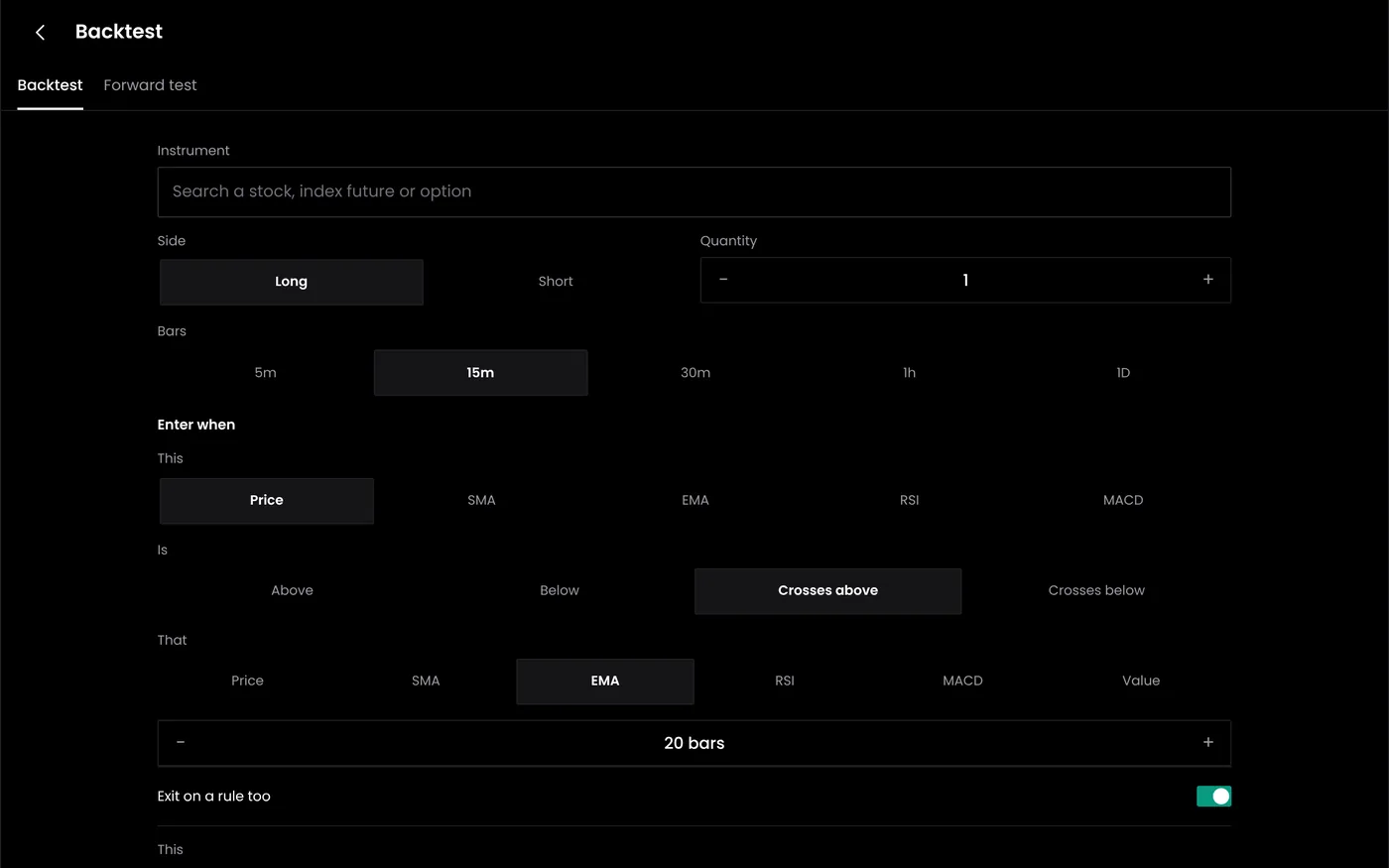
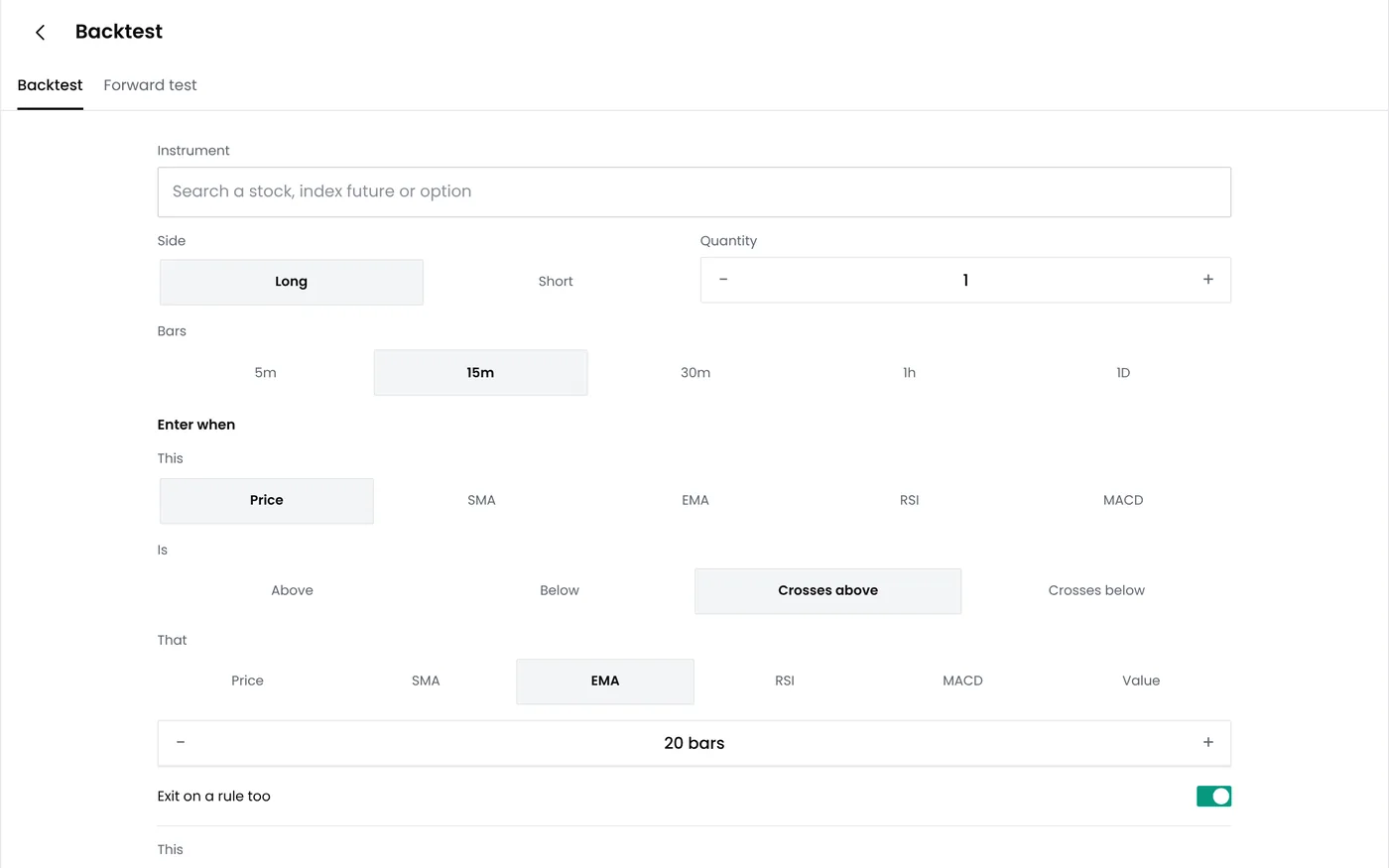
Our guides on how to backtest trading strategies and avoiding overfitting cover the method, and the backtesting engine runs the rules with costs included.
Setting up a crude oil algo strategy in QuantPower
The evening breakout runs in the evening and depends on exact times, which suits automation. A sample setup:
| Rule | Example setting |
|---|---|
| Instrument | Crude Oil Mini futures, near month |
| Session | 9:00 am to 11:30 pm, or 11:55 pm in winter |
| Range | High and low of the 5:00 to 6:00 pm candles |
| Range filter | Skip if the range is wider than 1.5 times its 20-day average |
| Entry | Stop orders one tick beyond the range, live from 6:05 to 9:30 pm |
| Stop loss | The other side of the range or 1 × ATR(14) of 15-minute candles, whichever is closer |
| Target | Twice the stop distance |
| Event windows | No entries 5:50 to 6:10 pm on US data days; 7:45 to 8:15 pm on Wednesdays |
| Time exit | 11:00 pm |
| Trades per day | One |
| Roll | Three trading days before expiry |
| Account limit | Daily MTM loss limit |
Step 1. Build the rules
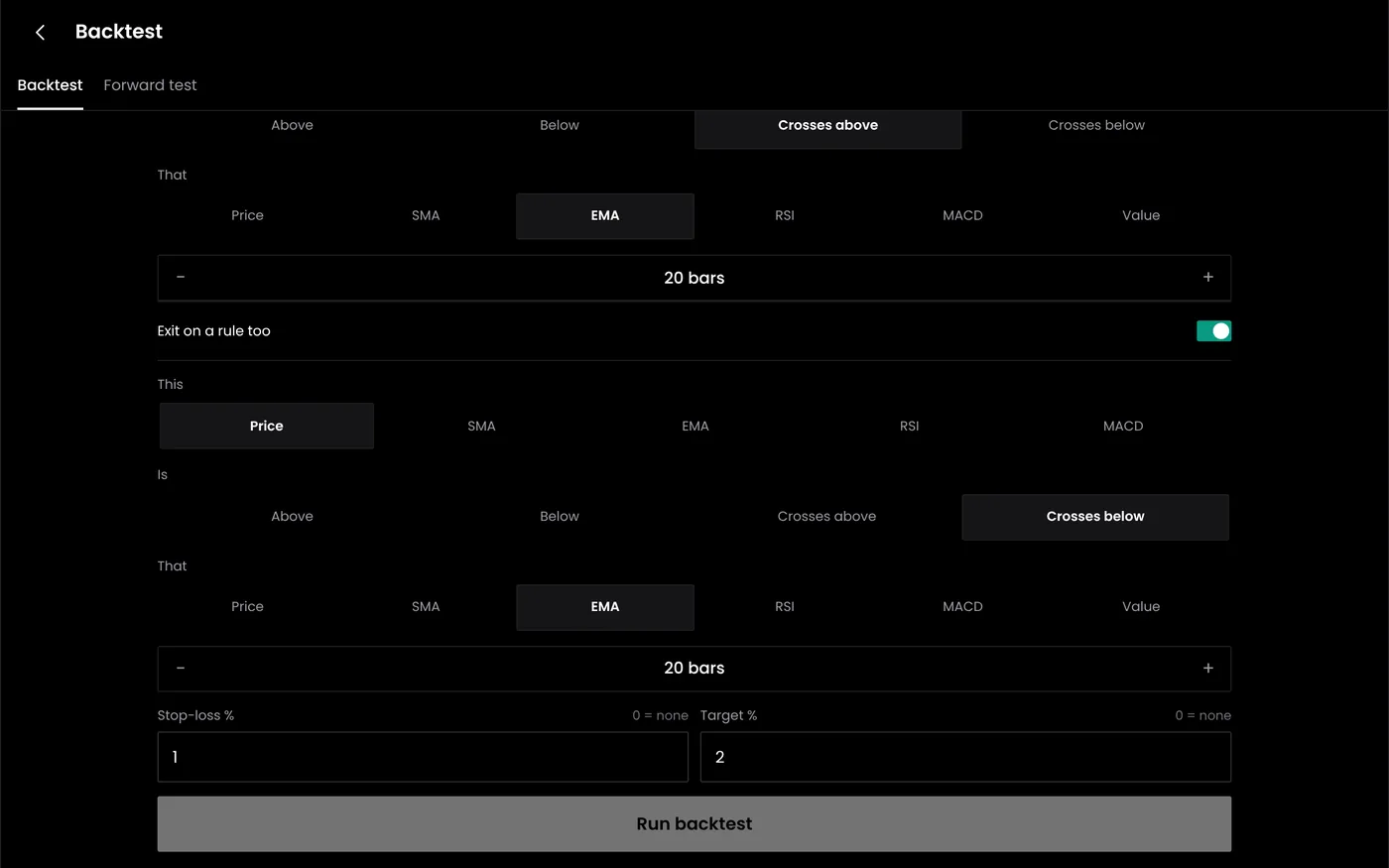
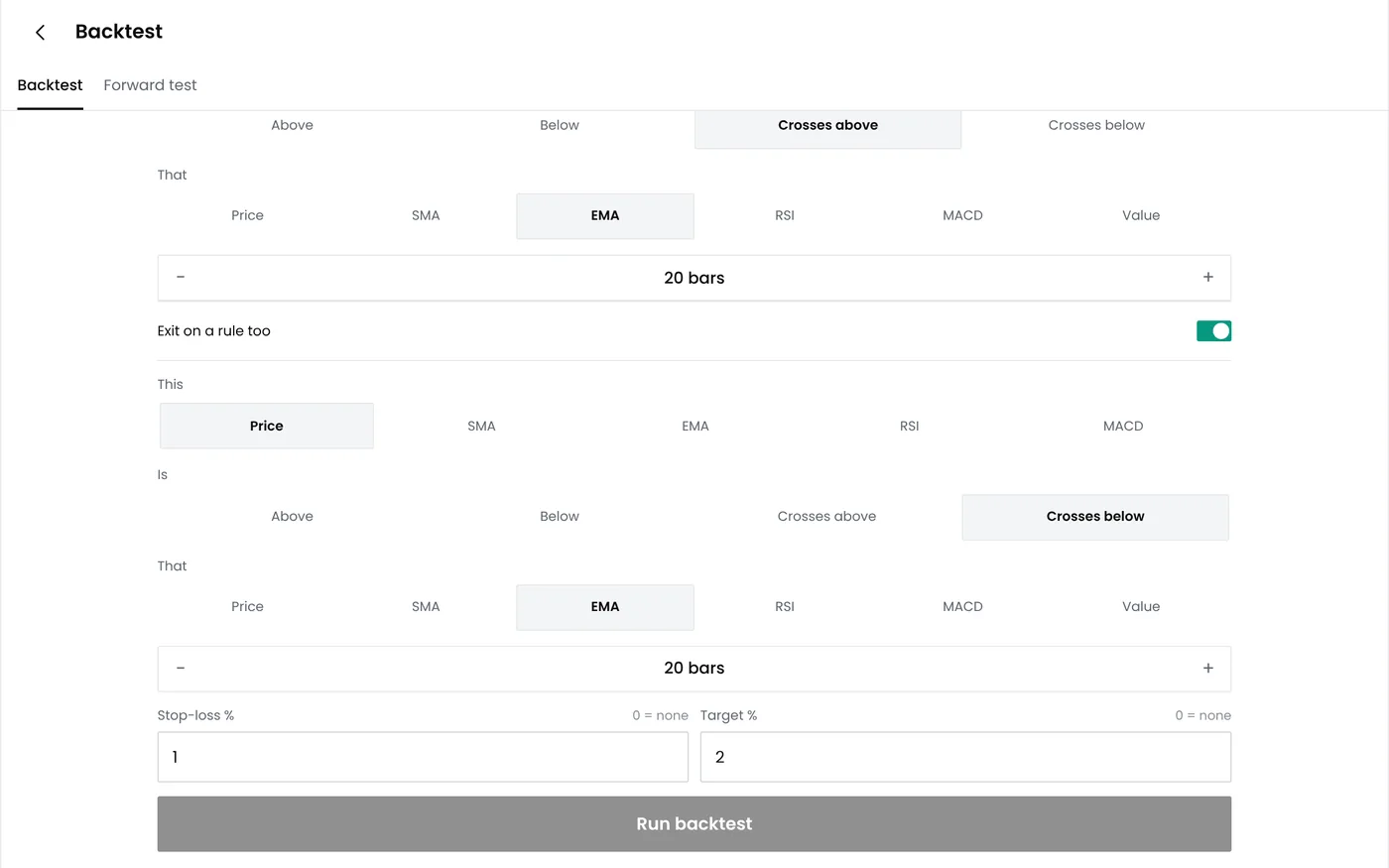
In the strategy builder, choose Crude Oil Mini futures, set the session times, then add the range, the range filter and the entry orders.
Step 2. Set the exits, event windows and limits
Add the stop, the target, the 11:00 pm exit, the event windows and the one-trade limit. In winter, move the event windows an hour later.
Step 3. Backtest it
Run the rules over past contracts with slippage and costs on, with summer and winter times set correctly. Change one setting at a time, such as the range filter or the target, and check how many trades each exit closed.
Step 4. Paper trade it
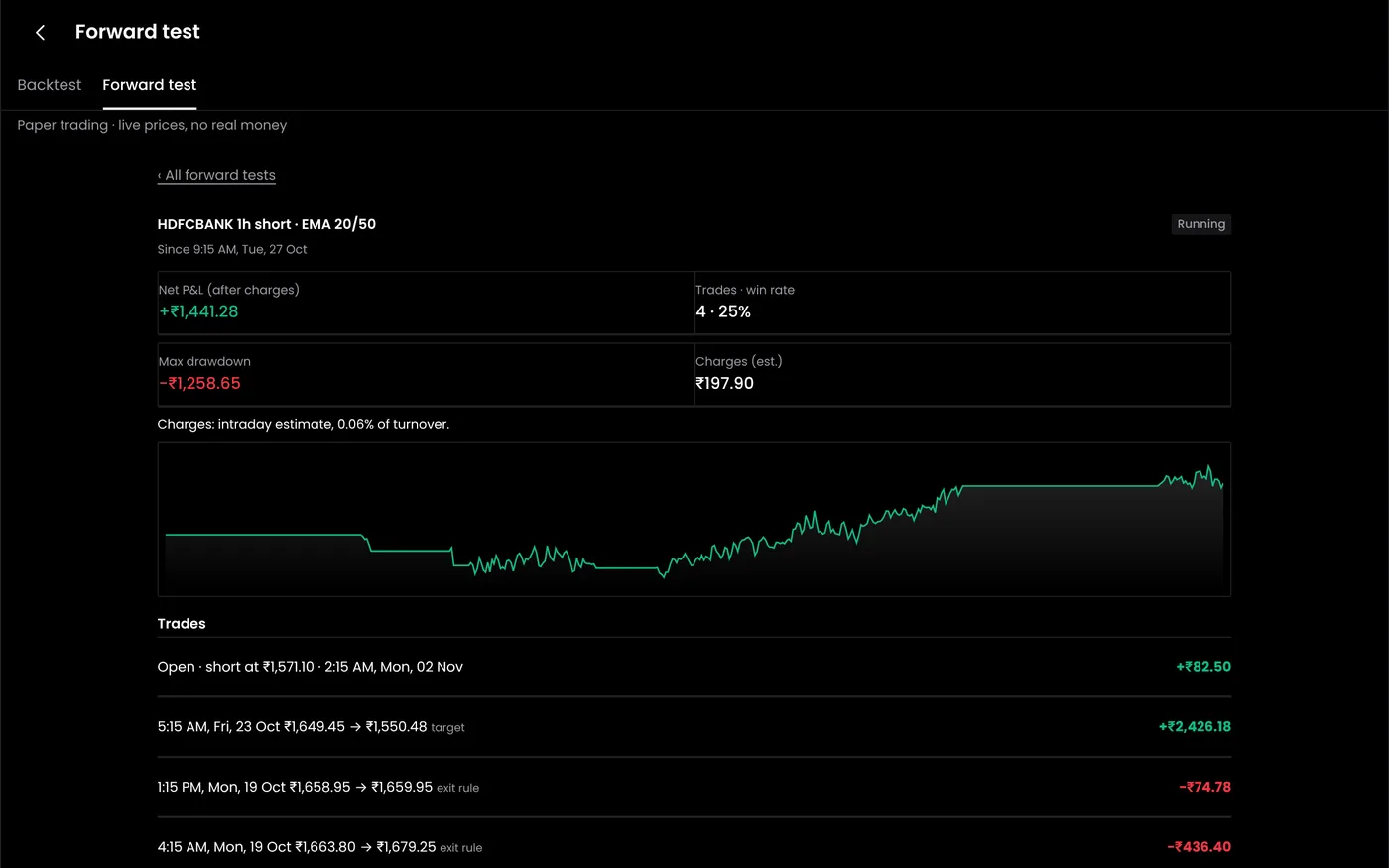
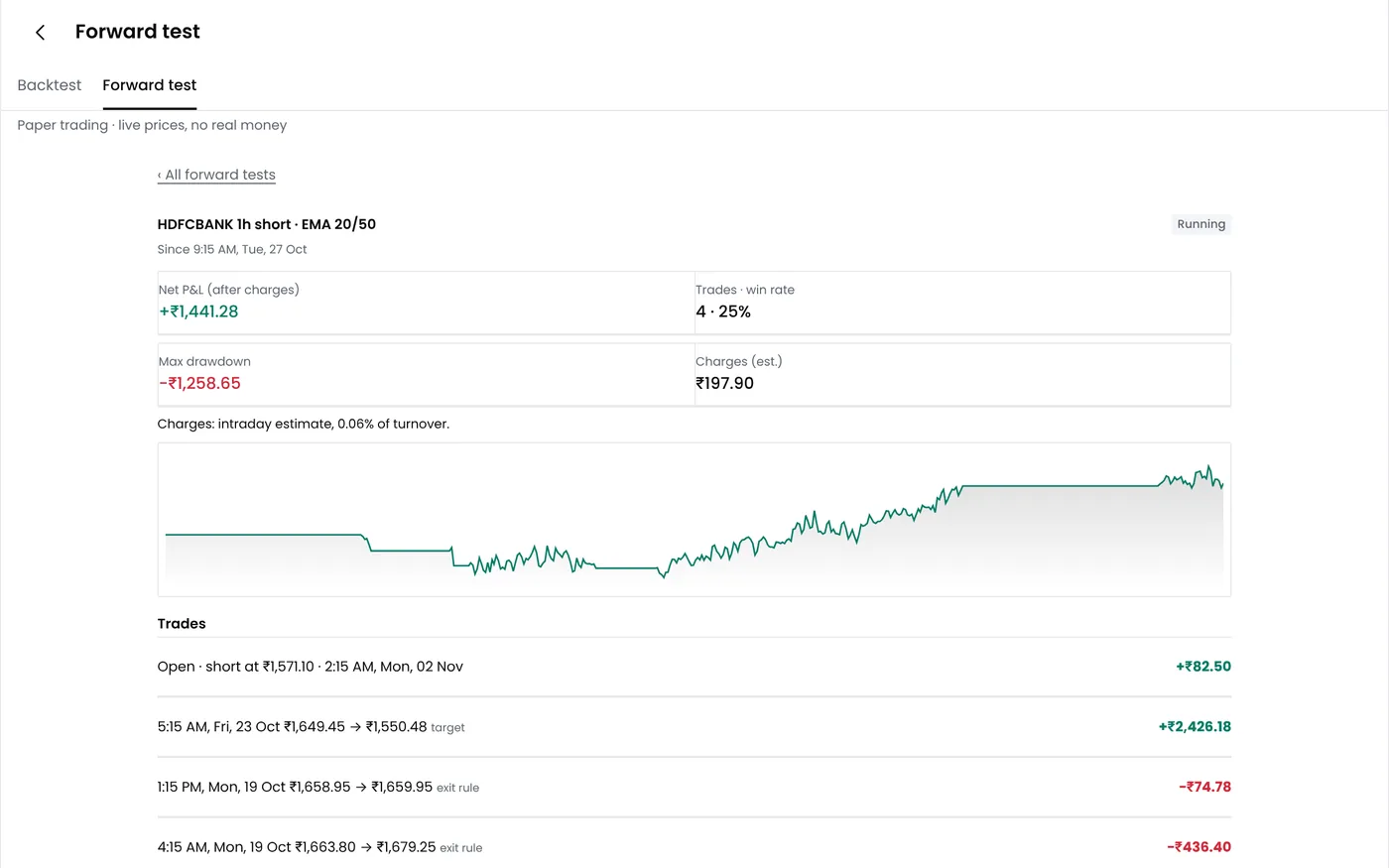
Run the strategy on live prices with virtual money for a few weeks, including inventory and jobs report days, and compare each fill with the backtest's assumption.
Step 5. Set the account limit
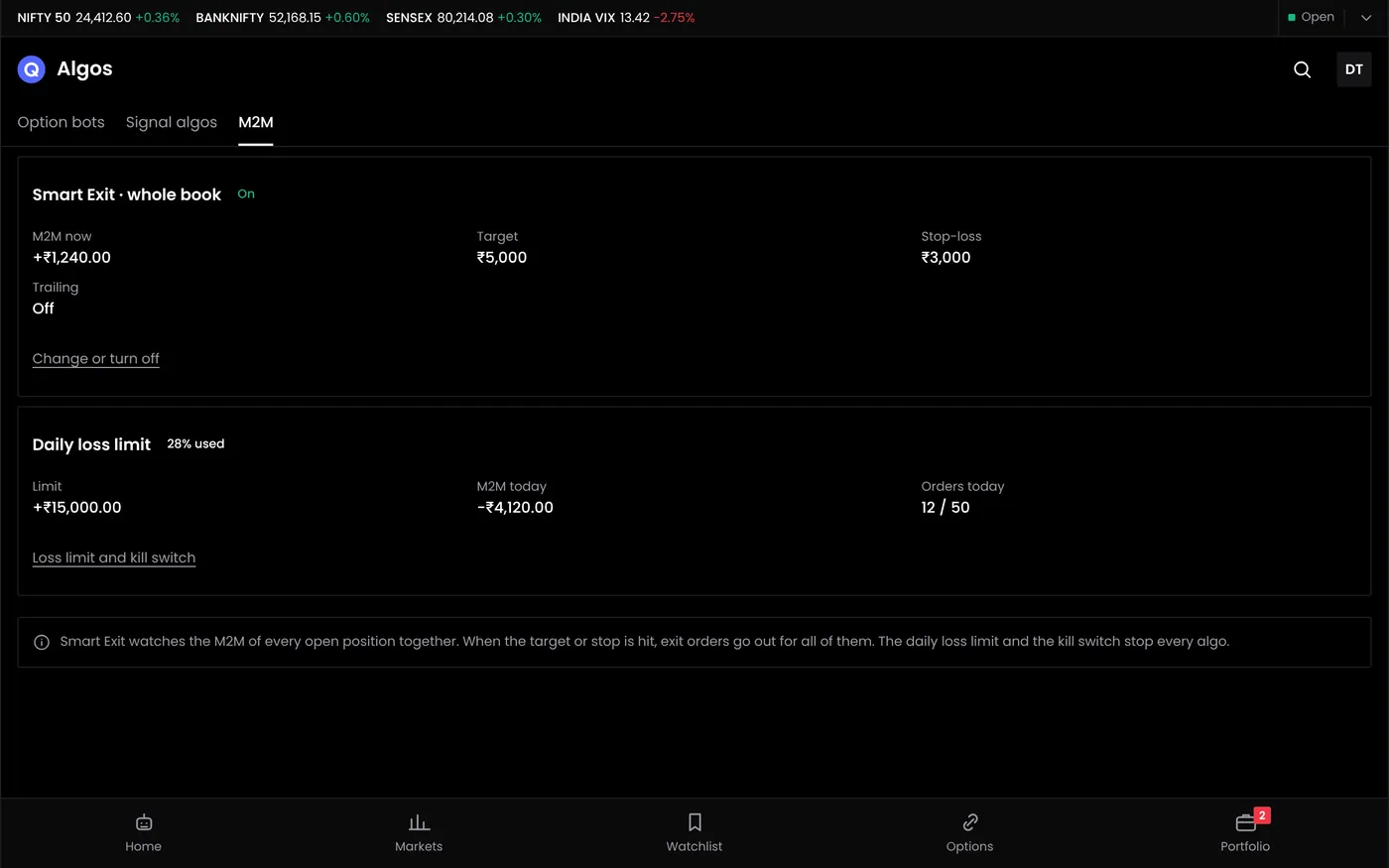
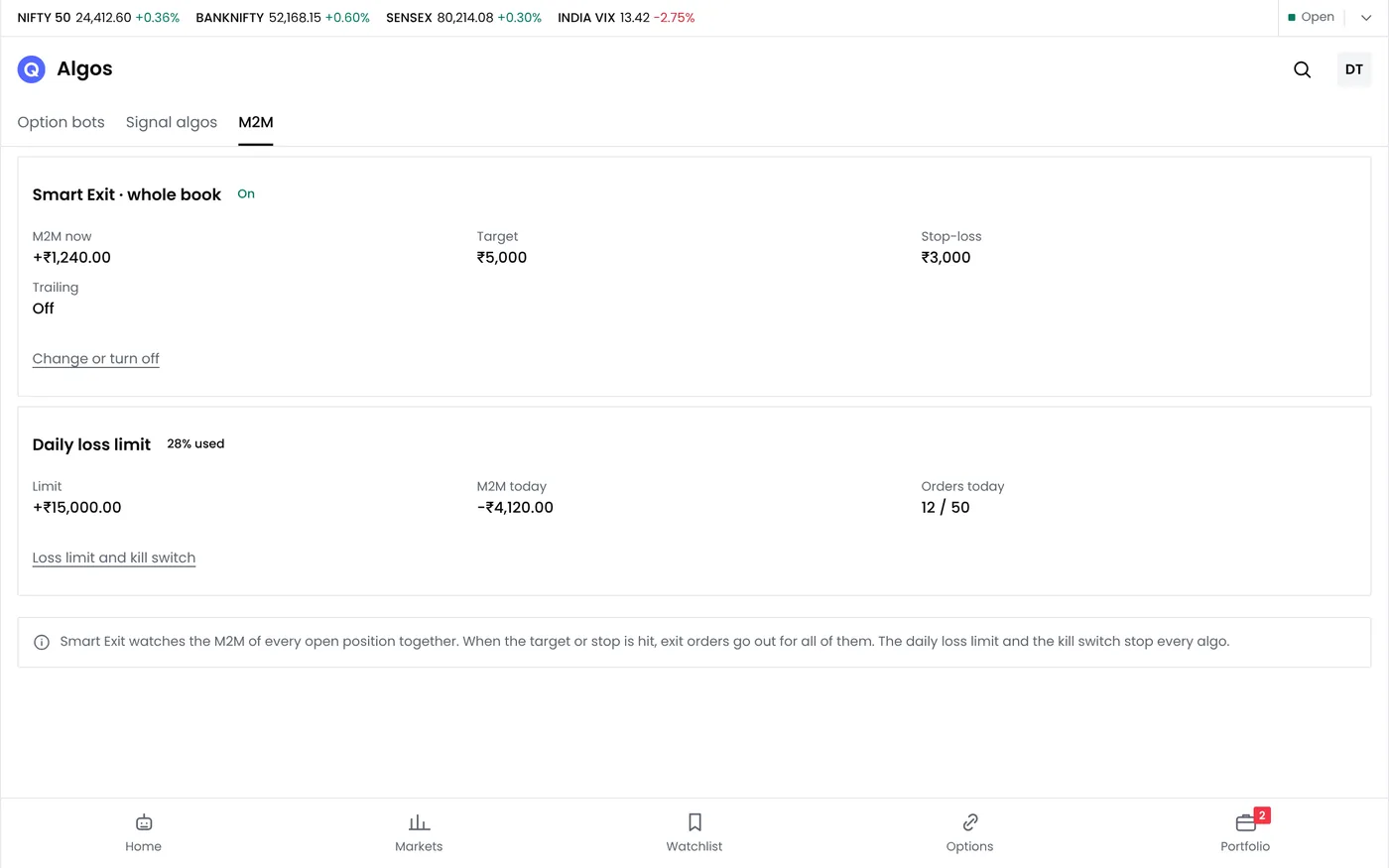
Set the daily MTM loss limit in the risk settings before going live. It closes every position when it is hit, including those from other strategies.
Step 6. Deploy and monitor
Connect your broker, check that the commodity segment is active on your account, choose the strategy and the number of lots, confirm the limits and deploy. The bot places the stop and the target as each entry fills and applies the time exit and the event windows. SEBI's retail algo framework applies on MCX as well, so every order goes through your broker with an exchange-assigned Algo ID. Our MCX algo trading page explains how commodity strategies run on the platform, and Pause all stops every bot at once.
Measuring a crude oil strategy
| Measure | What to look for |
|---|---|
| Net result per trade | Positive after costs and slippage, over at least a hundred trades |
| Costs as a share of gross profit | Under a third; above that, targets are too small for the contract |
| Exits by type | The share of trades closed by the target, the stop and the time exit |
| Results by weekday and on event days | Wednesdays and data days compared with the rest |
| Overnight gaps | The largest gap loss against the planned stop, for strategies that hold overnight |
| Margin used | The peak share of capital, with headroom for a higher rate |
| Fills against the backtest | Large gaps mean the backtest's fills were too kind |
A trade journal helps track these week by week.
Common crude oil trading mistakes
- Trading the minutes around the EIA report or US data without a rule for them.
- Using summer times in winter, or the other way round, for session limits and event filters.
- Holding into expiry, or into options expiry without margin for devolvement.
- Sizing by margin available instead of by the loss at the stop.
- Carrying full size over weekends and OPEC+ meetings.
- Aiming for a few ticks on the Mini, where costs take most of the profit.
- Reading only the WTI chart and ignoring the rupee.
Pre-trade checklist
- The event calendar for the day is checked: EIA, US data, Fed and OPEC+.
- Session times and event windows match the current season.
- The contract is the near month, with at least three trading days to expiry.
- The stop, target and time exit are set before the entry order.
- Lots follow from the risk per trade, and margin uses no more than about half the capital.
- The daily MTM limit is set for the account.
- The rules have been backtested with costs and paper traded through event days.
For guides to gold and silver, see gold commodity trading.
Start your free trial
Connect your broker, build a strategy and test it on paper before a single live order goes out.
Frequently asked questions
How do I start crude oil trading in India?
Open a trading account with a broker that offers MCX and activate the commodity segment. Start with the Crude Oil Mini contract, learn how the evening session and the US events affect it, and paper trade a written rule set for a few weeks before risking money. Keep enough capital for margin and a buffer for losses.
What is the lot size of crude oil on MCX?
100 barrels for the Crude Oil contract and 10 barrels for Crude Oil Mini. A ₹1 change in the price per barrel moves a standard lot by ₹100 and a Mini lot by ₹10. Options on each contract have the same lot size as their futures.
How much margin do I need for crude oil trading?
About 31% of the contract value in September 2026, according to broker data: about ₹26,900 for a Mini lot and ₹2.69 lakh for a standard lot at ₹8,600 a barrel. MCX changes margins with volatility, so check your broker's margin calculator, and keep extra capital so that a margin increase or a losing day does not force a square-off.
What is the best time to trade crude oil in India?
Most of the movement comes in the evening, from about 5:30 pm when US traders become active until the close. The busiest moments are US data at 6:00 pm and the EIA inventory report at 8:00 pm on Wednesdays, an hour later in winter. Many rule-based traders avoid entering in the minutes around those releases.
When does crude oil expire on MCX?
Crude oil futures expire monthly, around the 19th, and settle in cash at a rate based on the NYMEX WTI settlement price. Options expire two business days before their futures, and options in the money at expiry become futures positions. MCX publishes the exact dates in its contract calendar.
Can crude oil go negative on MCX?
It has happened once. On 20 April 2020, MCX settled its expiring crude contract at minus ₹2,884 a barrel after the NYMEX contract it follows settled at minus $37.63. Holders of long positions had to pay the difference, and in 2026 the Bombay High Court upheld the settlement.
What moves the crude oil price in India?
The dollar price of WTI and the rupee-dollar rate. WTI responds to OPEC+ decisions, US inventory figures, US economic data, geopolitics and global demand. A weaker rupee raises the MCX price even when WTI is unchanged.
Can I automate crude oil trading?
Yes. A strategy built in QuantPower runs as a bot on your own broker account, provided the commodity segment is active. SEBI's retail algo framework applies on MCX, so every order goes through your broker with an exchange-assigned Algo ID. Set session times and event windows for the season before deploying.
Related guides and terms
- Commodity trading, MCX algo trading and MCX market timings
- Gold commodity trading
- Supertrend strategy, VWAP indicator for option trading and opening range breakout strategy
- Option buying strategies and option selling strategies
- Trailing stop loss, how to place stop loss order and position size calculator
- F&O margin calculator, brokerage calculator and slippage calculator
Sources
- MCX, Crude Oil and Crude Oil Mini futures contract specifications (mcxindia.com)
- MCX, contract specification for Crude Oil options with Crude Oil (100 barrels) futures as underlying, May 2023 contract onwards: options on futures, expiry two business days before the futures, devolvement into futures
- MCX Clearing Corporation circular of 21 April 2020 on the due date rate for crude oil futures expiring 20 April 2020; Business Standard, 22 April 2020
- Bombay High Court judgment dismissing challenges to the April 2020 crude oil settlement, 2026 (lead petitioner Dhanera Diamonds)
- US Energy Information Administration, Weekly Petroleum Status Report release schedule (eia.gov)
- Broker charge schedules for CTT and MCX transaction charges, and broker margin data for September 2026 contracts
- Finance Act, 2013, Chapter VII: commodities transaction tax
- SEBI circular on safer participation of retail investors in algorithmic trading, 4 February 2025, and MCX's implementation circulars