
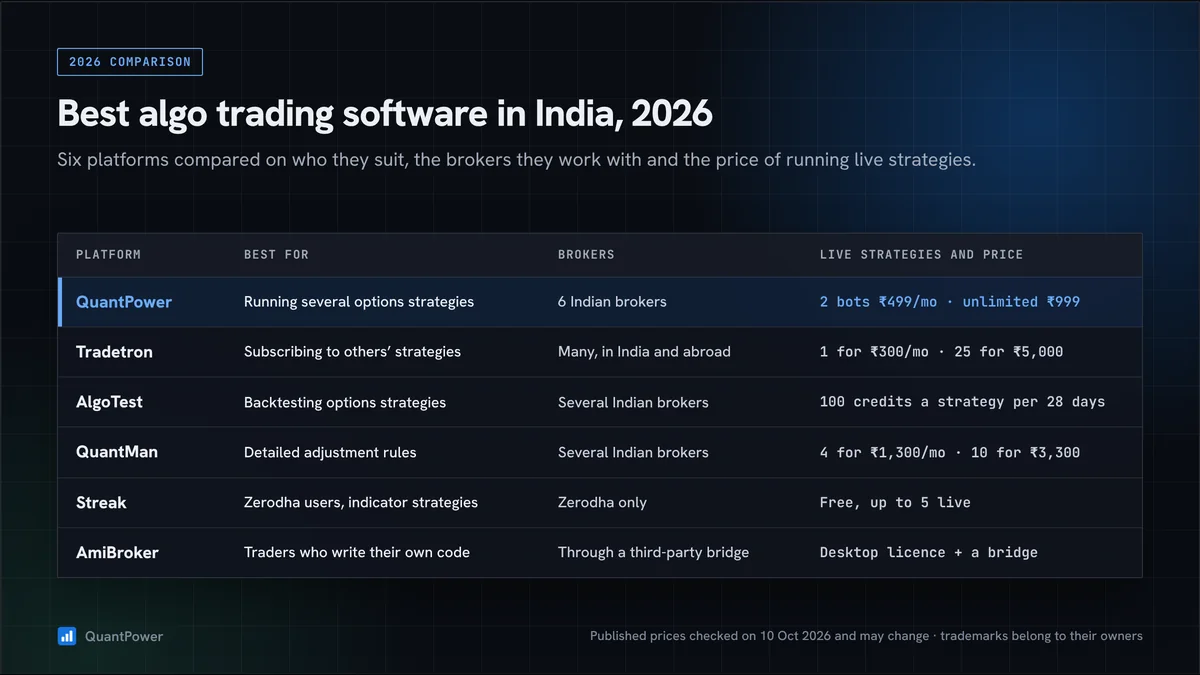
The best algo trading software in India at a glance
| Platform | Best for | Brokers | Live strategies and price |
|---|---|---|---|
| QuantPower | Options traders who automate several strategies | 100+ brokers, including Wisdom Capital, Zerodha, Upstox, Fyers and IIFL Capital | Standard free during the Beta; paid plans from ₹499 a month |
| Tradetron | Subscribing to strategies built by other traders | Many brokers in India and abroad | 1 for ₹300 a month, up to 25 for ₹5,000 |
| AlgoTest | Backtesting options strategies | Several Indian brokers | 100 credits per strategy per 28 days; packs from ₹499 for 500 credits |
| QuantMan | Detailed adjustment rules | Several Indian brokers | 4 for ₹1,300 a month; 10 for ₹3,300, excluding GST |
| Streak | Zerodha users with indicator strategies | Zerodha only | Free, up to 5 live at a time |
| AmiBroker | Traders who write their own code | Through a third-party bridge | Desktop licence; automation needs a separate bridge |
Key takeaways
- Start with your broker. A platform that does not support your broker means opening a new account. Streak works only with Zerodha, QuantPower with 100+ brokers and Tradetron with many.
- Price the number of strategies you will run. For one or two live strategies, per-strategy pricing is cheapest. The QuantPower Standard plan is free during the Beta (₹299/month after); Professional is ₹499/month and Ultimate ₹999/month, GST extra. See pricing.
- You rarely need code. Five of the six platforms build strategies without code. Only AmiBroker needs its own language.
- Brokerage often costs more than the software. A four-leg strategy entered and exited every day places eight orders, about ₹160 a day at ₹20 an order.
- Check compliance before you connect an account. Since 1 April 2026, platforms that offer algos to retail traders must be empanelled through a broker, with their strategies registered with the exchange.
What to look for in an algo trading platform in India
An algo trading platform turns your rules into orders on your broker account. When you compare platforms, seven points decide most of the outcome.
Broker support
Platforms connect to brokers through each broker's official API, so the list of supported brokers is the first filter. Check that the platform supports your broker for every segment you trade: NSE index and stock options, BSE Sensex options, futures or MCX commodities. Most broker API sessions expire each day, so expect to log in once every trading day, with two-factor authentication, before your strategies can place orders.
Strategy types
Most platforms are built around one style of strategy:
- Option legs. Strikes picked by distance from the at-the-money strike, by premium or by delta, with stops on each leg and on the whole position. Option sellers and spread traders need this.
- Indicators. Entries and exits from moving averages, RSI, breakouts and similar conditions on stock or futures candles, often with scanners that find matching stocks.
- Signals. Orders placed when an alert arrives from charting software such as TradingView.
- Code. Rules written in a programming language and run on your own computer or server.
A platform that handles one style well can be awkward for another. An iron condor needs four legs that enter together, a combined stop and an exit time. An RSI strategy on stocks needs candle conditions and a stock list. Build one of your real strategies during the trial instead of relying on the feature list.
How many strategies you can run, and how they are priced
Algo platforms in India use five pricing models:
| Model | How it works | Examples |
|---|---|---|
| Per deployment | Each plan sets how many strategies can be live at once | Tradetron, QuantMan |
| Credits | Each live or forward-tested strategy uses credits per cycle | AlgoTest |
| Flat plan | A fixed number of strategies, or no limit, for one price | QuantPower |
| Free with a broker | No fee, within the broker's limits | Streak (Zerodha) |
| Licence and bridge | A desktop licence, plus a separate tool that sends orders | AmiBroker |
Count the strategies you will run at the same time, including any you are forward testing if the platform charges for that. The cost table further down works out the numbers for one, two, four and ten strategies.
Testing tools
A backtest is only as good as its data and assumptions. Check how many years of options data the platform has, whether it uses minute-level prices and whether you can set slippage and charges. A trade-by-trade list matters more than a summary chart, because it lets you check each entry against a price chart.
Paper trading runs your rules on live prices without sending orders, which shows how a strategy behaves on days the backtest never saw.
Risk controls
Look for four levels of control: a stop on each leg, a stop on the whole strategy, a daily loss limit across the account and a time at which everything closes. The account-level limit, often called an MTM stop loss, is the one that protects you when several strategies lose on the same day.
Ask how stops are placed. Some platforms send a stop-loss order to the exchange as soon as a position opens. Others watch prices and send an exit order when the stop is hit, which depends on the platform staying connected to your broker. Ask what happens to open positions if that connection drops.
Compliance
SEBI's rules for retail algo trading decide which platforms can run strategies on your account, how orders are tagged and what a provider may say about returns. The SEBI section further down sets out what to check.
Where it runs, and support
Cloud platforms run strategies on the provider's servers, so a strategy does not stop because your laptop goes to sleep. Desktop software runs on your own computer, which then has to stay on, online and logged in for the whole session. A power cut or a system update can stop a strategy with positions open.
Check when support answers. A question about an open position needs an answer during market hours, not the next morning.
1. QuantPower
Best for: options traders who run several strategies at once and want testing, live trading and an account-level loss limit on one platform.
QuantPower is an options analytics and algo trading platform from Wisdom Tree Ventures, Noida. In March 2026 it announced exchange approval for its in-house execution algos in the F&O segment, including an iron fly strategy.
- Algo bots run your strategies on your own broker account. Ready-made strategy templates, such as straddles and iron flies, load into the strategy builder; you edit and run them as your own strategy.
- Bridge sends your own strategies and signals to your broker through its official API. For further details, please contact us.
- Strategy builder creates options and futures strategies without code.
- Backtesting and paper trading test the rules before real orders go out.
- Signal trading places orders from TradingView alerts.
- MTM stop loss exits when the combined profit or loss of your positions reaches your limit.
- Live trading terminal, option chain, multiple charts and iceberg orders sit in the same platform.
The Standard plan is free during the Beta; see pricing for each plan's daily allowances. Prices exclude GST.
Limits: QuantPower has no marketplace of strategies from other traders, connects 100+ brokers and does not offer volatility surface charts.
2. Tradetron
Best for: subscribing to strategies built by other traders, or trading with a broker that the other platforms here do not support.
Tradetron is a no-code platform for building and deploying strategies, with a marketplace where traders subscribe to strategies built by others. Plans are priced by the number of live deployments: ₹300 a month for 1, ₹1,200 for 5, ₹2,500 for 12 and ₹5,000 for 25. Quarterly billing saves 7% and yearly billing 17%.
Limits: marketplace strategies carry their own fees, each exchange segment needs its own subscription, and on the Retail plan strategy conditions are checked once a minute. See our comparison of Tradetron vs QuantPower.
3. AlgoTest
Best for: traders who backtest often and run one or two strategies live.
AlgoTest focuses on backtesting options strategies on historical data, with forward testing and live execution. Every account gets 25 free backtests a week. Beyond that, you buy credits: a live strategy uses 100 credits per 28-day cycle, forward testing 50, and the Signals plan for TradingView alerts 1,299 credits for 30 days.
Limits: costs rise with each strategy, so running many strategies gets expensive. See AlgoTest vs QuantPower.
4. QuantMan
Best for: option traders whose rules depend on detailed adjustments.
QuantMan is a no-code platform for options algos, with more than 80 indicators and rules for adjustments, calendar spreads and strike multipliers. Basic costs ₹1,300 a month with 4 live deployment credits, and Premium ₹3,300 with 10. Extra live credits cost ₹250 a month each, and prices exclude GST. A 7-day free trial is available.
Limits: the price per live strategy is higher than on plans with unlimited strategies.
5. Streak
Best for: Zerodha users who trade stocks with indicator strategies.
Streak is Zerodha's no-code platform for strategies built from technical indicators, with scanners that find stocks matching your conditions. It has been free for Zerodha users since January 2024, with up to 5 live and 15 virtual deployments at a time.
Limits: it works only with Zerodha, and it is built around indicators rather than option legs. See how Streak vs QuantPower compares the two.
6. AmiBroker
Best for: traders who write their own code and are comfortable running software on their own computer.
AmiBroker is desktop charting and backtesting software. Strategies are written in its own AFL language, and to place orders automatically, traders connect it to their broker through a third-party bridge.
Limits: you need to write code, and the bridge must follow SEBI's rules for client algos, including a registered static IP and no more than 10 orders a second unless the algo is registered.
Options analytics tools
Sensibull and Opstra are often mentioned alongside algo platforms, but they are built for analysing options and placing trades by hand. Sensibull is free for Zerodha users, and Opstra is offered to Definedge Securities clients. See our comparisons Sensibull vs QuantPower and Opstra vs QuantPower.
What it costs to run 1, 2, 4 and 10 strategies
The cheapest platform depends on how many strategies you run at the same time. This table uses each provider's published prices for the smallest plan that covers that number.
| Live strategies at once | 1 | 2 | 4 | 10 |
|---|---|---|---|---|
| QuantPower, a month | Free in Beta (Standard) | Free in Beta (Standard) | Free in Beta (Standard) | Free in Beta (Standard) |
| Tradetron, a month | ₹300 | ₹1,200 | ₹1,200 | ₹2,500 |
| AlgoTest, per 28 days | 100 credits | 200 credits | 400 credits | 1,000 credits |
| QuantMan, a month | ₹1,300 | ₹1,300 | ₹1,300 | ₹3,300 |
| Streak, Zerodha only | Free | Free | Free | Not available: 5 live at most |
- GST. QuantPower and QuantMan publish prices before GST. The Standard plan is free during the Beta; see pricing for each plan's daily allowances. Check the other providers' terms.
- AlgoTest credits. At the entry pack of 500 credits for ₹499, 100 credits cost about ₹100, so ten strategies cost about ₹1,000 per 28-day cycle. Forward tests use 50 credits each on top. Check how long purchased credits stay valid.
- Tradetron. Each exchange segment needs its own subscription, and marketplace strategies carry their own fees.
- QuantMan. Extra live credits cost ₹250 a month each, which can be cheaper than moving up a plan.
- AmiBroker is a desktop licence plus a separate bridge, so it does not fit a monthly table.
The Standard plan is free during the Beta; see pricing for each plan's daily allowances.
Costs beyond the subscription
Whichever platform you use, your broker charges for each executed order, and the exchange and government add their own charges. For option strategies with several legs, these usually cost more than the software.
Most discount brokers charge about ₹20 an executed order for options. At ₹20 an order, the four strategies in the example above cost this much in brokerage alone:
| Strategy | Orders per trade, in and out | Brokerage per trade | Trades a month | Brokerage a month |
|---|---|---|---|---|
| Morning short straddle, daily | 4 | ₹80 | 21 | ₹1,680 |
| Iron condor, weekly | 8 | ₹160 | 4 | ₹640 |
| Expiry-day iron fly | 8 | ₹160 | 4 | ₹640 |
| Option-buying breakout | 2 | ₹40 | 30 | ₹1,200 |
| Total | ₹4,160 |
The Standard plan is free during the Beta; see pricing for each plan's daily allowances. Re-entries and adjustments add more orders. On top come STT, exchange transaction charges, SEBI fees, stamp duty and GST, which are the same on every platform.
Some brokers also charge for API access or market data. Check your broker's current terms before you count a platform as cheap.
Free algo trading software in India
Several platforms let you start without paying, each with limits:
- Streak is free for Zerodha users, with up to 5 live and 15 virtual deployments at a time.
- AlgoTest gives every account 25 free backtests a week. Live trading needs credits.
- QuantPower offers a free trial, and paper trading runs strategies on live prices without sending orders.
- QuantMan has a 7-day free trial.
- Your broker's API is free at several brokers, and your own code can trade without registering the algo if it stays within 10 orders a second. You need programming skills and a static IP registered with the broker.
A free plan still leaves you paying brokerage and statutory charges on every order, which the section above shows can be the larger cost. Free plans also tend to limit live strategies, backtests or supported brokers, so check the limit that matters for your trading before you build on one.
How to choose
If you sell options and run several strategies
You need multi-leg entries, stops on each leg and on the whole position, exit times and an account-level loss limit. The Standard plan is free during the Beta; see pricing for each plan's daily allowances. QuantMan suits traders whose rules depend on detailed adjustments.
If you buy options
Option buyers lose to time decay when a move stalls, so exits matter more than entries. Look for trailing stops, a time-based exit and a limit on re-entries after a stop. Keep the cost per trade low as well, since buying strategies usually trade more often than selling strategies. Any of the four option-focused platforms can run buying rules, so choose on exit rules and price per strategy.
If you trade stocks with indicators
Streak is free for Zerodha users and built for indicator strategies and stock scanners, within its limit of 5 live strategies. If you trade with another broker or need more strategies live, choose a no-code builder that supports indicator conditions on stocks.
If you trade from TradingView alerts
You need a platform that turns an alert into an order. The Standard plan is free during the Beta; see pricing for each plan's daily allowances. AlgoTest's Signals plan costs 1,299 credits for 30 days.
If you write code
Code gives the most control and the most work. You can use AmiBroker with a bridge, or call your broker's API directly, within the 10-orders-a-second limit and from a registered static IP. QuantPower's Bridge is the other route: it sends your own strategies and signals to your broker through its official API.
If you are starting out
Start with one simple strategy in paper trading, on a free plan or a trial, and move to live trading only after it has behaved as expected for a few weeks.
| If you | Consider |
|---|---|
| Trade options and want several strategies live | Verify final plan allowances against your needs |
| Want to copy strategies built by other traders | Tradetron |
| Backtest often and run one or two strategies | AlgoTest |
| Manage positions with detailed adjustment rules | QuantMan |
| Trade with Zerodha and use indicator strategies on stocks | Streak |
| Write your own code | AmiBroker with a bridge, or your broker's API |
Whichever you choose, backtest the strategy, run it in paper trading and set a daily loss limit before you go live.
How to test a platform before you pay
Most platforms offer a trial or a cheap first month. Use it to run the same strategy on each platform you are considering, so the results are comparable. A Nifty short straddle works well for this: sell the at-the-money call and put at 9:20 am, put a 25% stop on each leg and close at 3:15 pm.
- Build the same rules on each platform. Note how long it takes and anything you could not express, such as a stop on the combined premium.
- Backtest the same period. Use at least a year, with the same slippage and charges. The results should be close. A large gap means the platforms treat entries, stops or data differently, so find out why before you trust either.
- Check five trades by hand. Pick five days from the trade list and compare entry time, strikes, stop price and exit with a one-minute chart.
- Paper trade for five sessions. Compare the paper fills with the prices you saw on screen at the time.
- Test the loss limit. Set a small daily limit in paper trading and confirm that it closes every position when it is hit.
- Go live with one lot for a week. Compare the platform's log with your broker's order book. Every order, time and price should match.
- Ask support two questions during market hours. Note how long the answers take and whether they solve the problem.
Also check what happens when you close the browser, and what happens if your broker session expires during the day.
What the 2026 SEBI rules mean for your choice
SEBI's framework for retail algo trading has applied to all brokers since 1 April 2026. Any automated trading platform in India now has to work within it, and the rules affect which platforms you can use and how.
- Empanelment. Platforms that offer algos must be empanelled through a broker, and their strategies must be registered with the exchange. Every order carries an Algo ID.
- Your own code. Code you write and run yourself can send up to 10 orders a second without registration. Above that, the algo must be registered through your broker.
- Static IP. API orders must come from a static IP registered with the broker. Empanelled platforms use their own.
- Black-box strategies. An algo whose logic is not disclosed to you can be offered only by a provider registered with SEBI as a research analyst. If you subscribe to a strategy whose rules you cannot see, check that registration.
- No return claims. Brokers may not refer to the past or expected returns of an algo, or work with platforms that do. Treat any promise of fixed returns as a warning sign.
Before you connect an account, ask the platform which brokers it is empanelled with and whether the strategy you plan to run is registered.
Running your strategies on QuantPower
- Start the free trial and connect your broker. QuantPower connects 100+ Indian brokers, including Wisdom Capital, Zerodha, Upstox, Fyers and IIFL Capital, and you log in on the broker's own page.
- Set your daily MTM limit first. It closes every position when the combined loss for the day reaches your number, whichever strategy caused it.
- Build your own strategy. The strategy builder creates options and futures strategies without code, and they run as algo bots on your own broker account.
- Backtest it. Run the rules over at least a year with slippage and charges included, and read backtest results trade by trade before you trust the summary.
- Paper trade for two weeks. Run the strategy on live prices without orders and compare the results with the backtest.
- Go live with one lot. Compare the platform's log with your broker's order book for the first week, then add size slowly.
The Standard plan is free during the Beta; see pricing for each plan's daily allowances.
Common mistakes when choosing algo trading software
- Choosing on the headline price. Compare the verified plan allowance and total bill for your actual strategy count. QuantPower's Standard plan is free during the Beta, so you can test your own strategy count before paying.
- Trusting a backtest you cannot check. If the platform shows only a summary chart, you cannot see whether entries, stops and fills match real prices.
- Skipping paper trading. A strategy that has never run on live prices has not yet met slippage, rejected orders or an expired broker session.
- Running several strategies with no account-level limit. Each strategy's own stop can look reasonable while the combined loss for the day does not.
- Ignoring order count. Multi-leg strategies with re-entries can place dozens of orders a day, and brokerage grows with every one.
- Paying for rules you cannot see. A strategy whose logic is hidden is a black box under SEBI's rules, so check its provider's research analyst registration.
- Starting on a yearly plan. Yearly billing saves money only if the platform still suits you after the trial. Start monthly.
Questions to ask before you pay
- Does it support my broker for every segment I trade?
- How many strategies can I run live at once on this plan, and what does the next one cost?
- Are stops placed with the exchange, or held on the platform until they are hit?
- Is there a daily loss limit across the whole account?
- How many years of minute-level options data does the backtest use, and can I set slippage and charges?
- Which brokers is the platform empanelled with, and are its strategies registered with the exchange?
- What happens to open positions if the platform or my broker session goes down?
- When does support answer during market hours, and how?
How we compared
We compared each platform's published features and prices on 10 October 2026: brokers supported, types of strategy, live strategies per plan, testing tools and risk controls. The cost tables use those published prices, and where a provider prices in credits or per 28-day cycle, we show its own units. We did not measure live trading performance, and no platform paid to be included.
Start your free trial
Connect your broker, build a strategy and test it on paper before a single live order goes out.
Frequently asked questions
Which is the best algo trading software in India?
It depends on your broker and your strategies. The Standard plan is free during the Beta; see pricing for each plan's daily allowances. Zerodha users with indicator strategies can use Streak for free, and traders who mainly backtest may prefer AlgoTest's credits.
How much does algo trading software cost in India?
From nothing to a few thousand rupees a month. The Standard plan is free during the Beta; see pricing for each plan's daily allowances. Brokerage and statutory charges come on top and are often larger.
Do I need to download algo trading software?
Not for most platforms. QuantPower, Tradetron, AlgoTest, QuantMan and Streak run in a web browser. AmiBroker is desktop software for Windows and needs a bridge to place orders. Be wary of downloads that promise ready-made profitable bots: under SEBI's rules, algos reach retail traders through a broker.
Which algo trading platform is best for option buying?
One that exits quickly and cheaply. Look for trailing stops, a time-based exit and a limit on re-entries, and compare the cost per trade, since buying strategies trade often. Any of the option-focused platforms on this page can run buying rules.
Can I build an algo strategy without coding?
Yes. QuantPower, Tradetron, AlgoTest, QuantMan and Streak let you build strategies without code. AmiBroker needs its AFL language.
Can I use algo trading software with any broker?
Only with brokers the platform supports through their official APIs. QuantPower connects 100+ Indian brokers, including Wisdom Capital, Zerodha, Upstox, Fyers and IIFL Capital, and Streak supports only Zerodha. If your broker is not listed, you change platform or open an account with a supported broker.
Can I move my strategies from one platform to another?
Not directly. Each platform stores strategies in its own format, so you rebuild the rules on the new platform and test them again. Keep a written copy of every rule, with the exact strike selection, stops and times, so the rebuild is quick.
Can algo trading software guarantee profits?
No. A backtest shows how rules would have performed in the past, and live results differ because of slippage, costs and changing markets. SEBI bars brokers from referring to the returns of algos.
Related guides and terms
- Platform comparisons: Tradetron vs QuantPower, AlgoTest vs QuantPower, AlgoTest alternative, QuantMan vs QuantPower, Streak vs QuantPower, Sensibull vs QuantPower and Opstra vs QuantPower
- Brokers: Best broker for algo trading, Zerodha algo trading and broker connection requirements
- Testing: Backtesting, paper vs live trading and backtesting vs forward testing
- Rules and risk: SEBI rules for option trading, algo trading risks and how to place stop loss order
Sources
- SEBI, circular on safer participation of retail investors in algorithmic trading, 4 February 2025, and glide-path circular, 30 September 2025 (sebi.gov.in)
- NSE, implementation standards for retail algo trading, 5 May 2025, and operational modalities, 22 July 2025 (nseindia.com)
- TradingView Help Center, documentation on alerts and webhooks (tradingview.com)
- Zerodha, Upstox, Fyers, IIFL Capital, Wisdom Capital: published brokerage, API and support pages (checked 10 October 2026)
- Sensibull, Streak, AlgoTest, QuantMan, Tradetron, Opstra, AmiBroker: pricing and feature pages on each provider's website (checked 10 October 2026)