
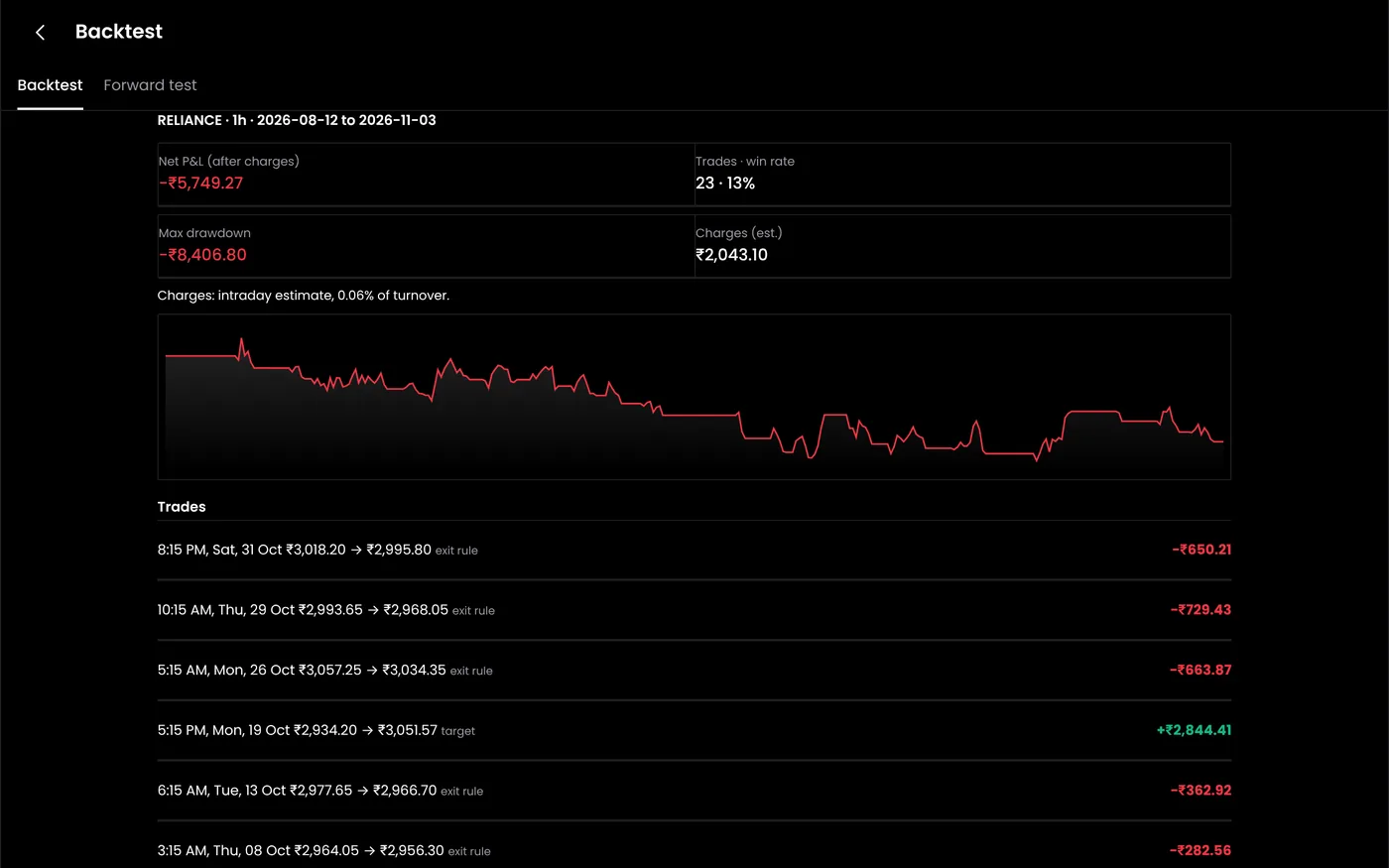
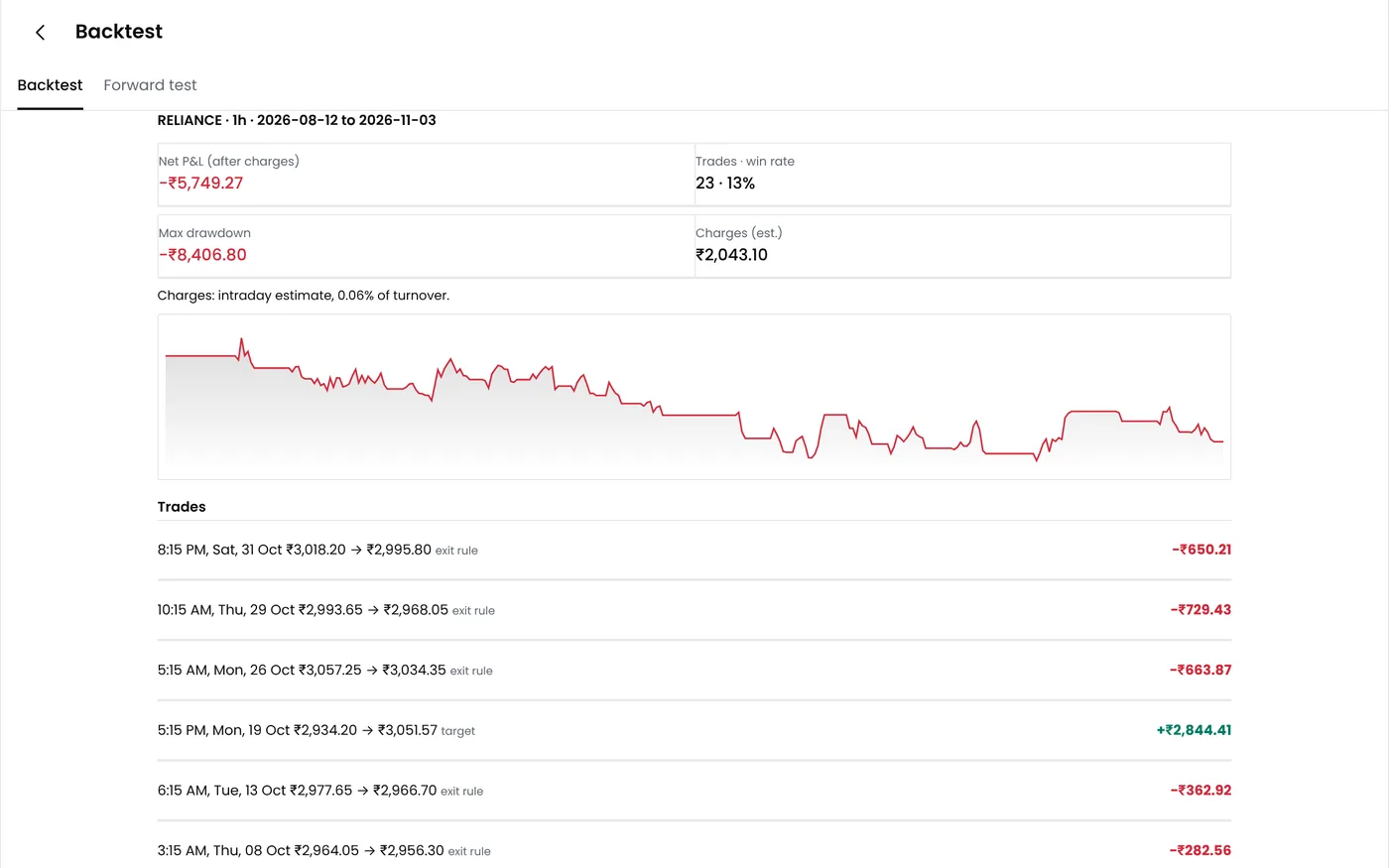
What the backtesting engine does
| Part | What it does |
|---|---|
| Data | 1-minute candles for index options and futures, with five years of history |
| Rules | The same entries, exits, stops and strike selection you set in the strategy builder |
| Costs | Brokerage and statutory charges deducted from each trade |
| Results | Every trade with its entry, exit and P&L, plus summary measures |
| Measures | Net P&L, maximum drawdown, win rate, average win and loss, P&L by month |
| Next step | Paper trade the same strategy on live prices, then deploy it |
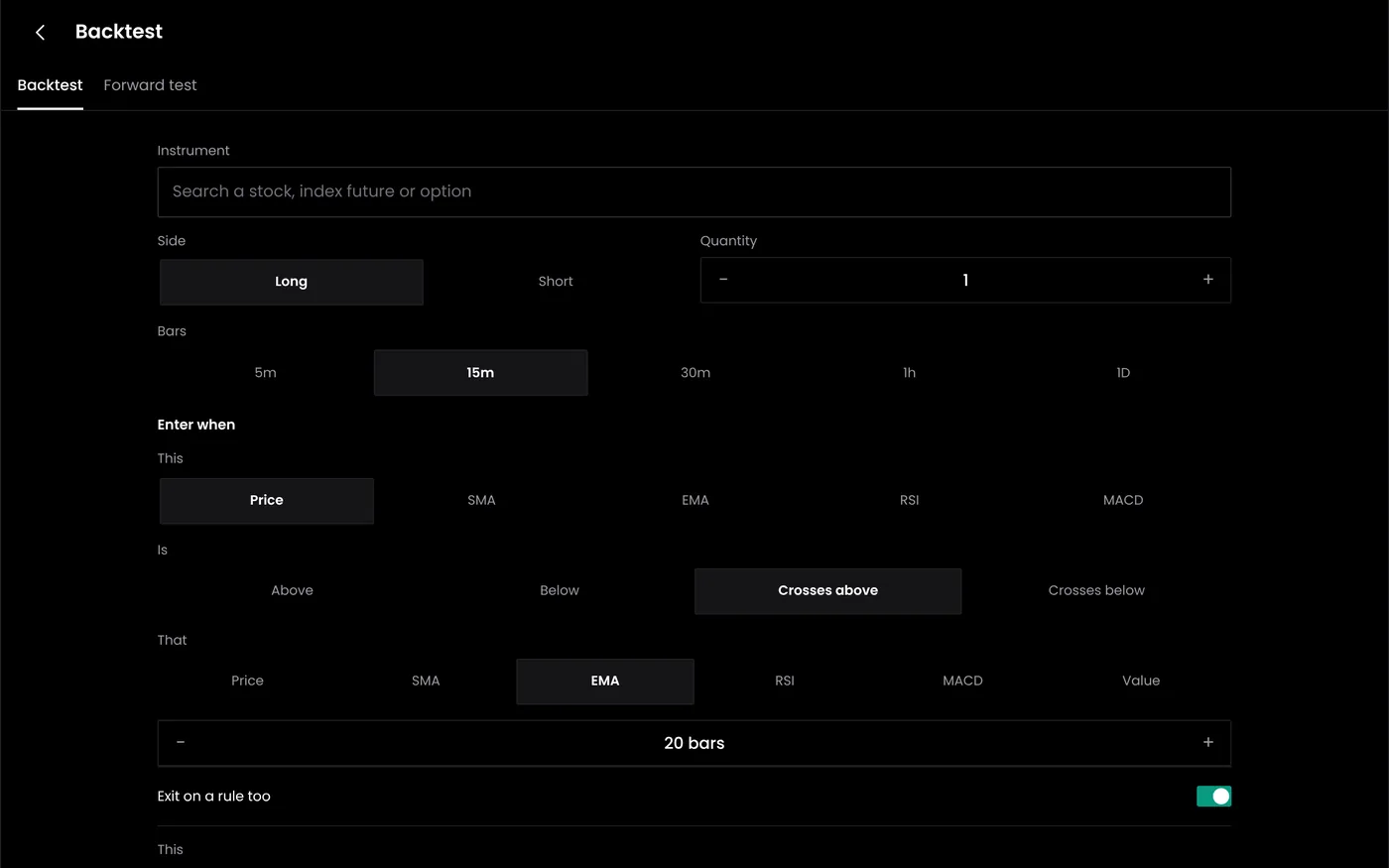
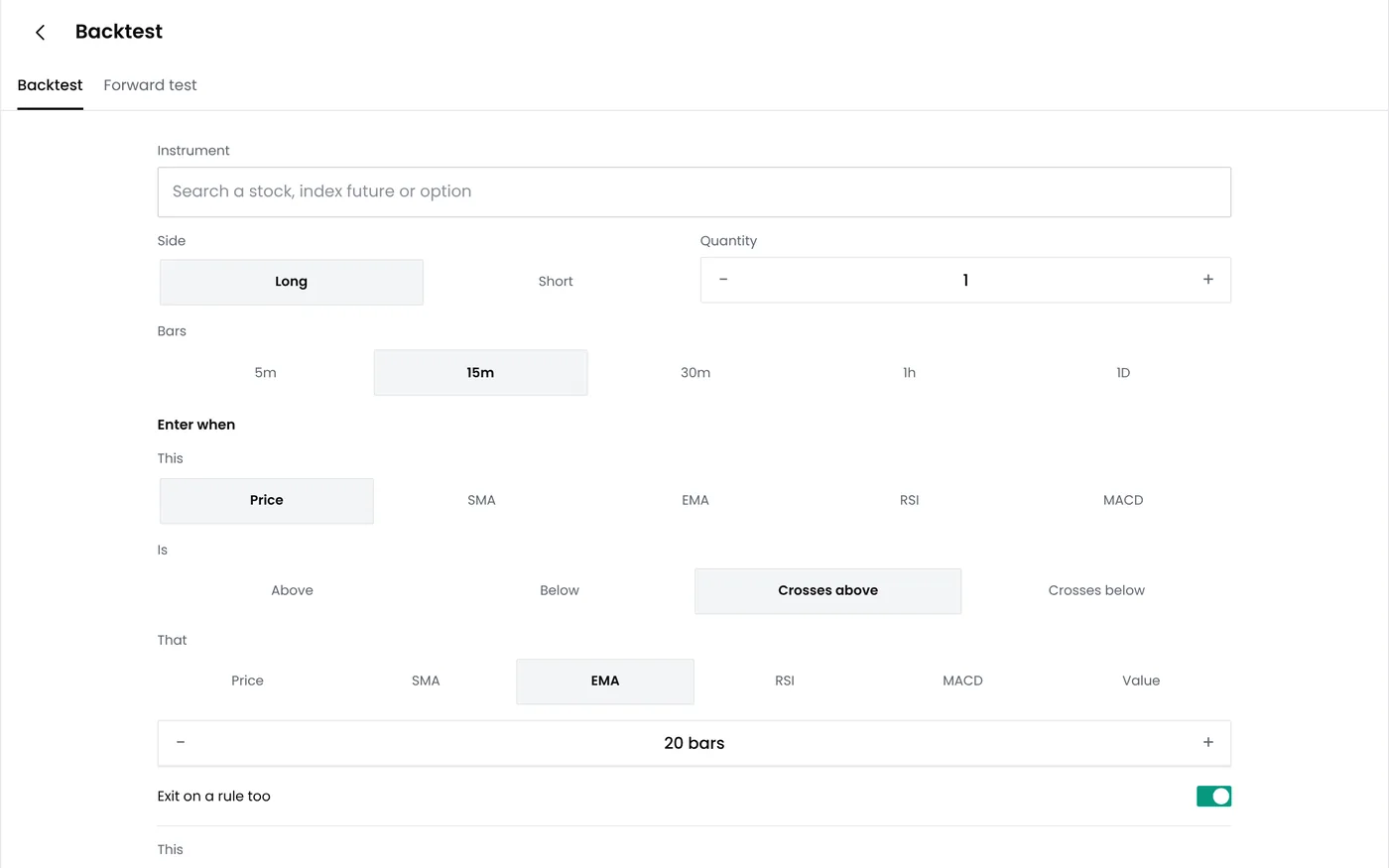
How a backtest works
- Build the strategy in the option strategy builder: instrument, legs, strike selection, entry time or condition, exits, stops and an MTM limit.
- Choose the period to test, up to five years back.
- Run the backtest. For each trading day in the period, the engine reads the 1-minute candles, applies the rules minute by minute and records each trade.
- Deduct costs from each trade.
- Read the results: the trade list, the equity curve, the drawdown and the monthly table.
What 1-minute data means for your results
A 1-minute candle records the open, high, low and close of each minute. That is fine-grained enough to test most intraday and positional options strategies, with a few points to keep in mind:
- Entries and exits at minute level. A rule such as "enter at 9:20 am" or "exit at 3:10 pm" is tested at the price of that minute.
- Stops within a minute. If a stop and a target both fall inside the same 1-minute candle, the data cannot show which came first. Read such trades conservatively: assume the stop was hit first.
- Fast strategies. Strategies that trade within seconds, or need the exact sequence of trades, cannot be tested precisely on 1-minute data. Scalping rules with targets of a few rupees fall into this group.
- Fills. The backtest fills at candle prices. Live orders face the bid-ask spread and slippage, so include an allowance for them in your stop and target levels.
For most option buying, option selling and spread strategies held for minutes to days, 1-minute data captures the moves that decide the result.
What the results show
| Measure | What it tells you |
|---|---|
| Net P&L after costs | Whether the rules made money over the period |
| Maximum drawdown | The largest fall from a peak, and the loss you must be ready to sit through |
| Win rate and average win and loss | How the result is made: many small wins or a few large ones |
| Longest losing run | How many losing trades in a row the rules produced |
| P&L by month | Whether the result is steady or comes from a few months |
| Every trade | The entry, exit, legs and P&L of each trade, to check the rules worked as intended |
How to read a backtest well
- Check the trades, not only the total. Open a few trades from good and bad months and confirm they follow the rules.
- Look at the worst period. The maximum drawdown and the longest losing run matter more than the average.
- Split the period. If the rules work only in one year, they may fit that year's market rather than a lasting pattern.
- Test small changes. If moving a stop from 30% to 35% turns a profit into a loss, the result is fragile.
- Compare with a simple baseline, such as the same entry without the filter you added.
- Include costs and slippage. A strategy that makes a few rupees a trade before costs rarely survives them.
The guides on backtesting mistakes, look ahead bias and walk-forward testing cover the traps in detail.
Built for options strategies
Options backtests need more than an index price series. Each leg is a specific strike and expiry, priced from its own data. The engine selects strikes by the rule you set, such as at the money, a number of points away, a delta or a premium, and tracks each leg's 1-minute prices through the trade, including expired contracts. Weekly Nifty and Sensex expiries and monthly Bank Nifty expiries are handled with their actual dates, so a rule that exits "the day before expiry" uses the right day in every week of the test.
| Strategy type | What the backtest tests well |
|---|---|
| Short straddles and strangles | Entry time, stops per leg or combined, re-entries, exit time |
| Iron condors and iron flies | Strike distance, wing width, profit target, breach exits |
| Option buying on breakouts | Entry on a candle break, stops on premium, time stops |
| Spreads | Debit and credit spreads with combined targets and stops |
| Futures strategies | Entries on candle conditions, stops and trailing exits |
Costs in the backtest
Charges are deducted from each trade: brokerage per order and the statutory charges, including STT at the rates in force from 1 April 2026. A one-lot Nifty option round trip costs about ₹64 at ₹20 per order, and a one-lot Nifty futures round trip about ₹968. For strategies with many legs or many trades a day, costs can take a large share of the gross result, so look at the result after costs first.
A worked setup: testing a short straddle
Take a Nifty weekly short straddle: sell the at-the-money call and put at 9:20 am on the day before expiry, with a stop of 30% on each leg and an exit at 3:10 pm.
- Build the legs in the strategy builder with strike selection "at the money" at 9:20 am.
- Set the stops per leg and the time exit.
- Choose the period, for example the last three years, so the test covers both Thursday and Tuesday expiry weeks.
- Run the test and open the trade list.
- Check the weeks with the largest losses: did the stops trigger at the minute you expect, and were both legs closed on time?
- Split the result by year, and test the stop at 25% and 35% to see whether the result holds.
Only if the result is steady across years and nearby settings is it worth paper trading.
From backtest to live trading
A backtest is the first of three tests. After it:
- Paper trade the same strategy on live prices for several weeks; see the paper trading platform for options.
- Compare the paper results with the backtest for the same weeks. Large gaps point to fills, spreads or rules that behave differently live.
- Deploy the strategy on your broker account with the smallest size, and increase it only when live results match.
Limits of any backtest
- The past is one path. Five years include rallies, falls and quiet periods, but not every kind of market.
- Rule changes since the data. Lot sizes, expiry days and STT changed in 2024 to 2026. Results from earlier years under different rules may not repeat.
- Liquidity. The backtest cannot see whether a large order would have moved a thin strike.
- Overfitting. Testing many versions of a rule and keeping the best one finds patterns in noise.
Plans
The QuantPower Standard plan is free during the Beta (₹299/month after); Professional is ₹499/month and Ultimate ₹999/month, GST extra. See pricing. Every plan starts with a free trial.
Related guides
- Backtest trading strategies: the method step by step
- Backtest performance metrics: reading the report
- Backtesting mistakes and look ahead bias
- Walk-forward testing: checking a strategy on data it was not built on
- Paper trading platform for options: the next step after a backtest
- Avoiding overfitting: why rules tuned to the past fail on new data
- Option strategy builder: entry, exit and stop rules on the same legs
Start your free trial
Connect your broker, build a strategy and test it on paper before a single live order goes out.
Frequently asked questions
What data does QuantPower's backtesting use?
1-minute candles for index options and futures, with five years of history.
Can I backtest options strategies with several legs?
Yes. Each leg is priced from its own strike and expiry data, and exits can be set per leg or for the combined position.
Are costs included in the backtest?
Yes. Brokerage and statutory charges, including STT, are deducted from each trade.
Can I backtest a scalping strategy?
Strategies that trade within seconds or aim for a few rupees a trade cannot be tested precisely on 1-minute candles. Strategies held for several minutes or longer can.
How do I know a backtest is reliable?
Check individual trades, the worst drawdown and the results across different years, test small changes to the rules, and confirm the results with paper trading on live prices.
Which plans include backtesting?
The Standard plan is free during the Beta; see pricing.
Sources
- QuantPower: backtesting data (1-minute candles, five years of history), confirmed by QuantPower, 17 October 2026
- QuantPower plans and features as listed on the live pricing page (checked 11 October 2026)
- Charges from the QuantPower brokerage calculator, rates from 1 April 2026