
It suits traders who expect the index to stay close to its current level and want the worst case fixed before they enter. This guide covers the numbers on one lot, how the wing width changes the trade, the Greeks, margin, entries, exits, adjustments, a worked expiry-week trade, costs, backtesting and how to automate it.
Iron fly at a glance
| Feature | Iron fly |
|---|---|
| Market view | Range-bound, close to the centre strike |
| Legs | Buy 1 OTM put, sell 1 ATM put, sell 1 ATM call, buy 1 OTM call, same expiry |
| Maximum profit | The net credit, if the index expires exactly at the short strike |
| Maximum loss | Wing width minus the net credit, beyond either wing |
| Breakevens | Short strike minus and plus the net credit |
| Time decay | Works for you, mostly in the last days |
| Volatility | A rise in IV hurts, a fall helps |
| Margin | Low compared with a naked straddle, thanks to the wings |
| Typical users | Expiry-week and expiry-day sellers who want a defined loss |
| Difficulty | Intermediate: simple shape, demanding timing |
Key takeaways
- On one lot of Nifty at 25,000 with 12 days to expiry and 14% IV, the iron fly 24,700 / 25,000 / 25,300 collects ₹15,867 and can lose at most ₹3,634.
- The breakevens are close, near 24,756 and 25,244. The model chance of finishing between them is only about 30%, so the fly relies on large wins when the index stays near the strike and small, capped losses when it does not.
- With wings this close, time decay is slow until the last few days: the model P&L with Nifty unchanged is only +₹327 after two days and +₹1,829 with five days left. That is why many traders use the iron fly in expiry week.
- Wider wings collect more and win more often, but raise the maximum loss. Choose the width from the loss you can accept.
- Fixed rules suit it: a profit target, a stop on the combined premium, a time exit and a daily account limit.
How an iron fly makes money
The trade has four legs on the same expiry:
- Buy a put below the market: the lower wing.
- Sell the at-the-money put.
- Sell the at-the-money call on the same strike.
- Buy a call above the market: the upper wing.
The two at-the-money options are the most expensive on the chain, so the net credit is large. Without the wings this would be a short straddle, with unlimited risk. The wings turn it into two credit spreads that meet at one strike: a bull put spread below and a bear call spread above.
At expiry:
- At the short strike: both short options expire worthless and you keep the full credit.
- Away from the strike: one short option is in the money, and the profit falls point for point until the breakeven.
- Beyond a wing: the long option offsets the short one, so the loss stops at the wing width minus the credit.
The numbers on one lot
Nifty at 25,000, 12 days to a weekly expiry, implied volatility of 14%, an interest rate of 6.5% and a lot of 65. Black–Scholes model prices, for illustration:
| Leg | Strike | Model price | Per lot |
|---|---|---|---|
| Buy put | 24,700 | ₹113.40 | −₹7,371 |
| Sell put | 25,000 | ₹227.10 | +₹14,762 |
| Sell call | 25,000 | ₹280.50 | +₹18,233 |
| Buy call | 25,300 | ₹150.10 | −₹9,757 |
| Net credit | ₹244.10 | ₹15,867 |
| Measure | Value |
|---|---|
| Maximum profit | ₹15,867, only at 25,000 at expiry |
| Maximum loss | (300 − 244.10) × 65 = ₹3,634, below 24,700 or above 25,300 |
| Breakevens | About 24,756 and 25,244 |
| Risk to reward | ₹3,634 at risk to make up to ₹15,867 |
| Model chance of expiring between the breakevens | About 30% |
Profit or loss at expiry for one lot:
| Nifty at expiry | P&L |
|---|---|
| 24,700 or lower | −₹3,634 |
| 24,750 | −₹384 |
| 24,900 | +₹9,367 |
| 25,000 | +₹15,867 |
| 25,100 | +₹9,367 |
| 25,250 | −₹384 |
| 25,300 or higher | −₹3,634 |
The shape is a tent. The profit is large only near 25,000, and every 100 points away costs ₹6,500 until the wings take over. Try other strikes and dates in the payoff builder:
Interactive payoff chart: change the spot, IV, lot size and days to expiry to see the curve, breakevens and Greeks.
Choosing the wing width
The wings decide the trade's character. Narrow wings make a cheap, low-risk fly with a small credit after the wings are paid for; wide wings make something close to a straddle.
| Iron fly, one lot | 300-point wings | 500-point wings |
|---|---|---|
| Strikes | 24,700 / 25,000 / 25,300 | 24,500 / 25,000 / 25,500 |
| Net credit | ₹244.10 (₹15,867) | ₹350.15 (₹22,760) |
| Maximum loss | ₹3,634 | ₹9,740 |
| Breakevens | About 24,756 and 25,244 | About 24,650 and 25,350 |
| Model chance inside the breakevens | About 30% | About 42% |
| Theta a day at entry | About +₹152 | About +₹360 |
| Vega per IV point | About −₹230 | About −₹620 |
The wider fly wins more often and earns more each day, but its worst case is almost three times larger. A common approach is to set the maximum loss first, for example 1% of the trading account, and pick the width that fits it.
The Greeks of an iron fly
For the 300-point fly at entry:
| Greek | Per lot | What it means |
|---|---|---|
| Delta | −0.40 ₹ a point | Neutral at entry |
| Gamma | −0.009 | Delta turns against you as the index moves |
| Theta | +₹152 a day | Slow decay with 12 days left |
| Vega | −₹230 per IV point | A rise in IV hurts a little |
With close wings, the long options cancel most of the short options' Greeks while expiry is far away. As expiry nears, the at-the-money options decay much faster than the wings, and theta and gamma both grow sharply.

How an iron fly behaves before expiry
Model P&L for one lot with 10 days left, at the same IV and after a two-point rise:
| Nifty | P&L at IV 14% | P&L at IV 16% |
|---|---|---|
| 24,500 | −₹714 | −₹883 |
| 24,700 | −₹35 | −₹397 |
| 24,850 | +₹266 | −₹188 |
| 25,000 | +₹327 | −₹144 |
| 25,150 | +₹141 | −₹269 |
| 25,300 | −₹253 | −₹541 |
| 25,500 | −₹978 | −₹1,066 |
Early in the trade the P&L barely moves, in either direction. With five days left the picture changes: +₹1,829 at 25,000, +₹1,368 at 24,800 and −₹222 at 25,400. The fly earns its money in the final days, which is when most iron fly traders open it.
Margin for an iron fly
Because the wings hedge the short legs, the margin is a fraction of a naked straddle's, often about a quarter: roughly ₹45,000 to ₹65,000 for one lot of Nifty with 300-point wings in normal conditions. Our F&O margin calculator shows how the figures are built.
- Wings first. Buy the wings before selling the short legs, and buy back the short legs before selling the wings, to keep the hedge benefit at every step.
- Expiry day. Short index options carry an extra 2% extreme loss margin on their expiry day. A fly held on expiry day needs more margin than the day before.
- Size by the loss. The defined loss, ₹3,634 a lot in the example, is the number to size by.
Weekly, expiry-week and expiry-day flies
Nifty 50 weekly options expire on Tuesdays and Sensex weekly options on Thursdays. Bank Nifty and FinNifty have monthly expiries only. The Nifty expiry date calendar lists every date.
- Positional, a week or more out: the credit is large but decays slowly, and a move in either direction has time to happen.
- Expiry week, one to three days out: the most common use. Decay is fast, the credit is smaller, and the fly stays near the strike more often over a short window.
- Expiry day: the at-the-money options are cheap and decay within hours. The margin includes the extra 2%, and a 100-point move can take the whole fly to its maximum loss. It suits strict intraday rules only.
When to enter
Days to expiry
For Nifty weeklies, most iron fly sellers enter one to three days before expiry, when decay is fastest. Earlier entries need patience and wider wings.
The market's recent range
The fly needs the index to settle near the strike. A market that has been moving in a range for a few sessions suits it better than one trending away from it.
Volatility
Higher implied volatility means a bigger credit for the same wings. If IV is likely to fall, for example after an event has passed, the fly benefits twice: from decay and from lower IV.
Event days
Avoid holding a fly through RBI policy, the Union Budget or election results. A single gap can reach a wing.
Exits
Profit target
Because the full credit needs the index to finish exactly at the strike, iron fly targets are usually set at 25% to 50% of the credit. In the expiry-week example below, a 40% target closes the trade when the fly is worth ₹100.47 or less.
Stop loss on the combined premium
Set the stop inside the maximum loss: for example, exit when the fly's value rises by an amount equal to half the maximum loss. Each unit can lose at most the wing width minus the credit.
Strike distance
Some traders exit when the index moves a set distance from the short strike, for example half of the credit. This reacts before the P&L shows the full damage.
Time exit
Close by a fixed time on expiry day, before the last half hour, to avoid the final swings.
Daily MTM limit
An account-level MTM stop loss squares off everything when the day's loss reaches your limit.
A worked expiry-week trade
A model example, not a record of results. The same fly is opened two days before expiry, when its credit is smaller and its decay faster. Rules: profit target 40% of the credit, stop when the fly is worth ₹230, time exit at 3:10 pm on expiry day.
- Day 1, 9:40 amNifty 25,000, two days to expiry, IV 13%. Buy the 24,700 put at ₹11.10 and the 25,300 call at ₹13.50, then sell the 25,000 put at ₹91.55 and the 25,000 call at ₹100.50. Net credit ₹167.45, or ₹10,884. Maximum loss (300 − 167.45) × 65 = ₹8,616. Breakevens about 24,833 and 25,167.
- Day 1, 10:30 amNifty 25,060. The fly is worth ₹169.06. P&L −₹105.
- Day 1, 2:00 pmNifty rises to 25,120. The fly is worth ₹175.27, a loss of ₹508, well short of the ₹230 stop.
- Day 2, 10:00 amNifty is back at 25,040 and IV has eased to 12.5%. The fly is worth ₹130.10. P&L +₹2,428.
- Expiry day, 11:00 amNifty 25,010, IV 12%. The fly's value falls through ₹100.47, the 40% target. The bot buys back the short legs and sells the wings at a net ₹99.00. Profit (167.45 − 99.00) × 65 = ₹4,449 before charges, about ₹4,210 after them.
Holding to 2:00 pm would have raised the model profit to about ₹6,385, and a 100-point move in the last hours could have cut it to a loss. The target trades part of the upside for a smaller chance of giving it back.
Adjustments
- Roll the fly to the new price. If the index moves and settles, buying back the fly and opening a new one at the current strike resets the profit zone. It costs two sets of four orders and realises the loss on the first fly.
- Widen one wing. Moving the wing on the tested side further out gives the position more room, at the cost of a larger maximum loss on that side.
- Convert to an iron condor. Rolling the untested short option away from the market turns the fly into an iron condor strategy with a wider profit zone and a smaller credit.
- Let the stop decide. Many systematic traders do not adjust: the stop closes the trade, and the next fly starts fresh.
Iron fly vs iron condor vs short straddle
Same assumptions: Nifty 25,000, 12 days, IV 14%, one lot of 65.
| Strategy | Credit | Maximum loss | Breakevens | Model chance inside |
|---|---|---|---|---|
| Iron fly 24,700 / 25,000 / 25,300 | ₹15,867 | ₹3,634 | 24,756 and 25,244 | About 30% |
| Iron condor 24,500 / 24,750 / 25,250 / 25,500 | ₹9,051 | ₹7,199 | 24,611 and 25,389 | About 46% |
| Short straddle 25,000 | ₹32,994 | Unlimited | 24,492 and 25,508 | About 58% |
The fly takes a small, defined risk for a large but rarely complete reward. The condor wins more often with a smaller credit. The straddle collects the most and has no loss limit.
Nifty, Sensex and Bank Nifty flies
- Nifty 50: weekly expiry on Tuesday, 50-point strikes, lot of 65, and the deepest liquidity for four-leg orders.
- Sensex: weekly expiry on Thursday on BSE, 100-point strikes. Check the spreads on the wings.
- Bank Nifty: monthly expiry on the last Tuesday, 100-point strikes, lot of 30. Higher implied volatility gives a bigger credit and bigger moves; wings are usually wider.
Costs, slippage and tax
- Brokerage: eight orders for a round trip, ₹160 at ₹20 an order.
- Statutory charges: STT of 0.15% on the premium of options sold, exchange charges, the SEBI fee, stamp duty and GST, about ₹80 for the example.
- Slippage: the at-the-money legs are liquid, the wings less so. Limit orders help, and every backtest should include slippage on all four legs.
Use the brokerage calculator and the slippage calculator for your own numbers. F&O profits are generally taxed as non-speculative business income.
How to backtest an iron fly
- Fix the entry day and time, wing width, target, stop and time exit before you start.
- Use option prices for all four legs at each step, with costs and slippage on every fill.
- Test expiry-week entries separately from earlier ones; they behave like different strategies.
- Study the losing streaks. The fly loses small amounts often, so a run of losses is normal and the backtest tells you how long one can last.
- Keep part of the data for an out-of-sample check.
Setting up the iron fly in QuantPower
The strategy builder includes an iron fly preset, and the fly's exact rules suit an algo bot.
| Rule | Example setting |
|---|---|
| Instrument | Nifty 50, current weekly expiry |
| Entry | 9:40 am, two days before expiry |
| Legs | Buy the wings 300 points away first, then sell the ATM call and put |
| Profit target | 40% of the net credit |
| Stop loss | Fly value rises to a set level inside the maximum loss |
| Time exit | 3:10 pm on expiry day |
| Daily limit | Your MTM loss limit for the account |
| Skip | Days with RBI policy, the Union Budget or election results |
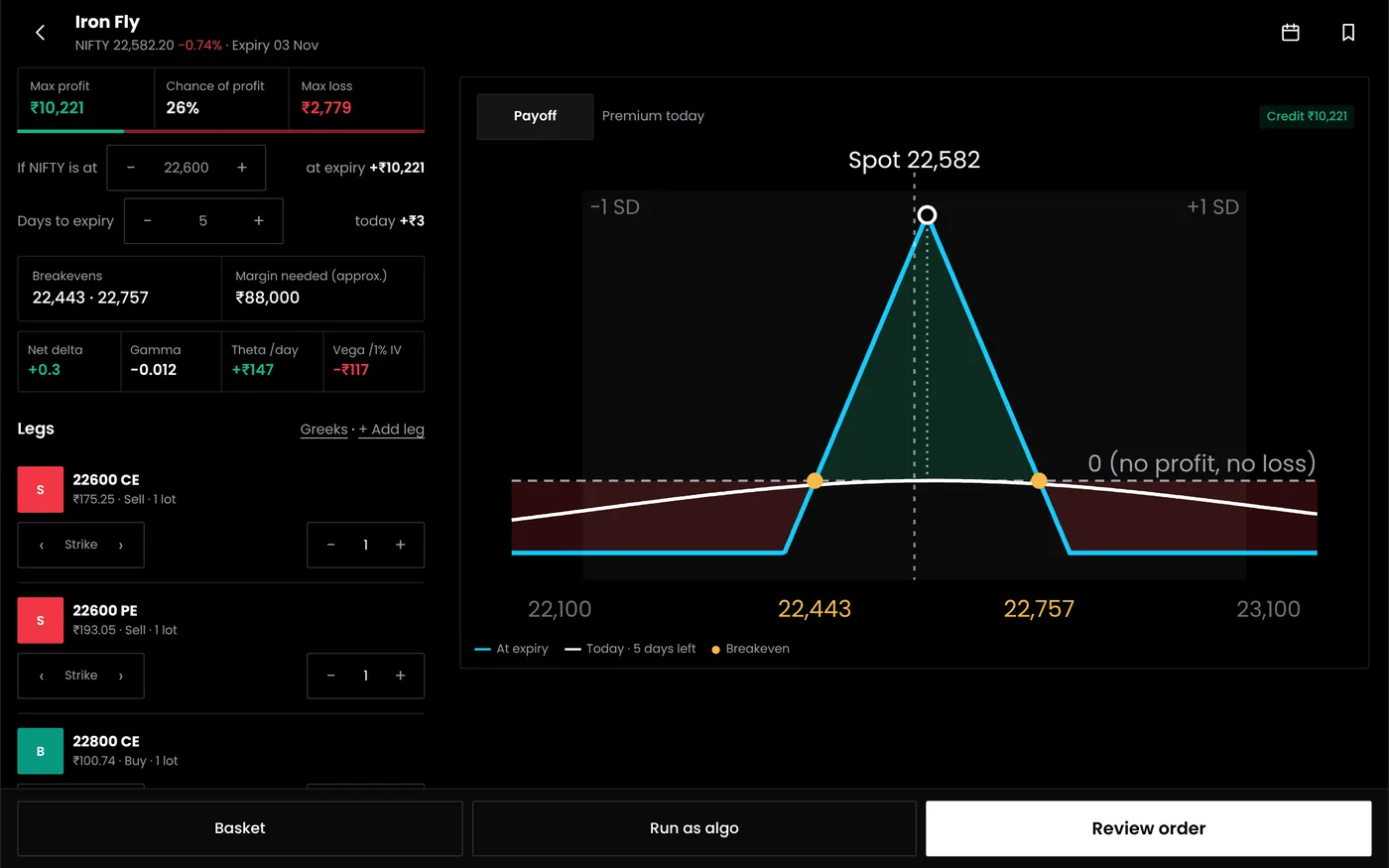
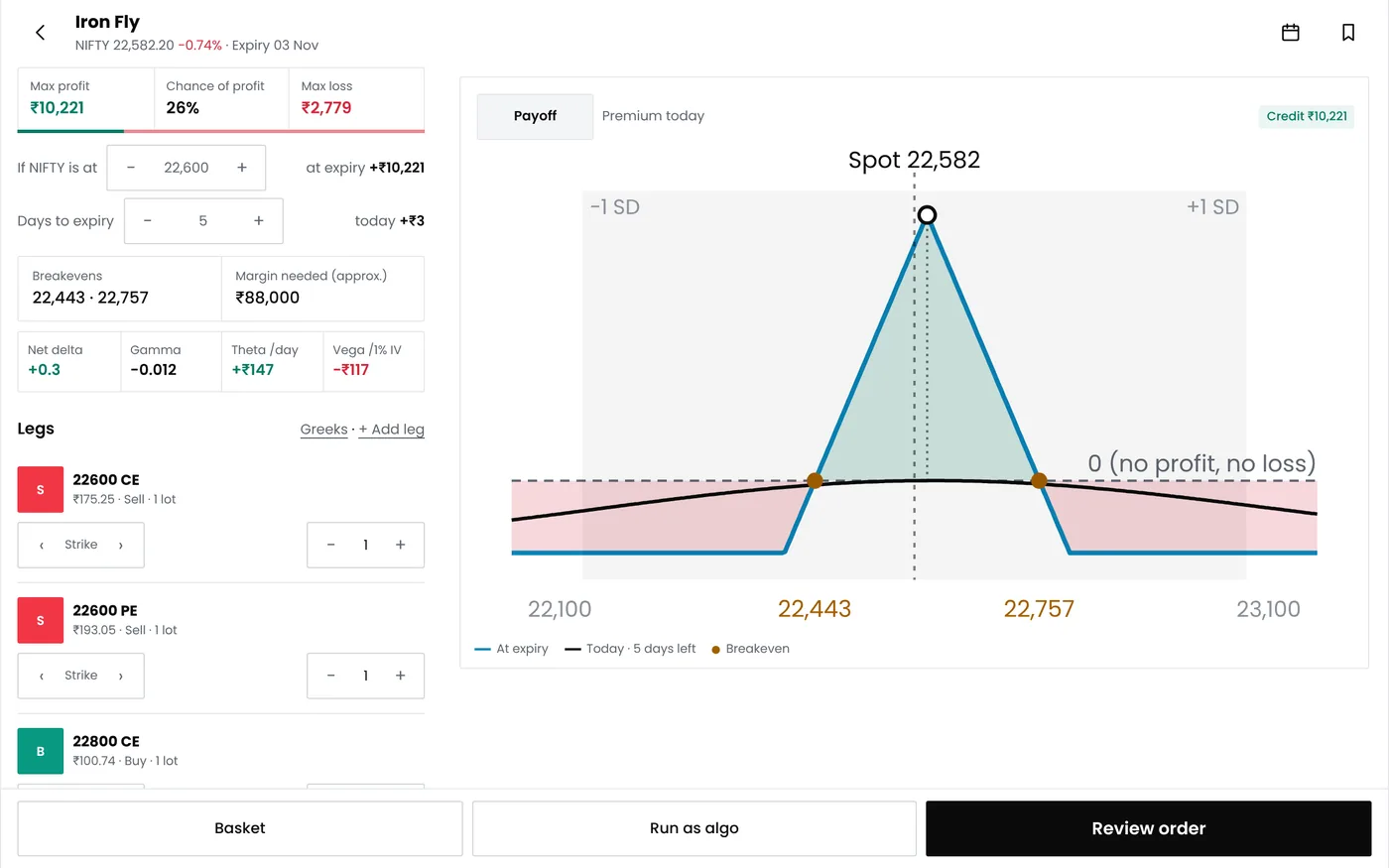
Step 1. Open the preset
In the strategy builder, choose the iron fly preset, set the index and expiry, and set lots to 1.
Step 2. Set the exits
Enter the profit target, the stop, the time exit and the event filter.
Step 3. Backtest it
Run the rules over past expiries with costs and slippage on, and compare expiry-week entries with earlier ones.
Step 4. Paper trade it
Run it on live prices with virtual money through several expiries before going live.
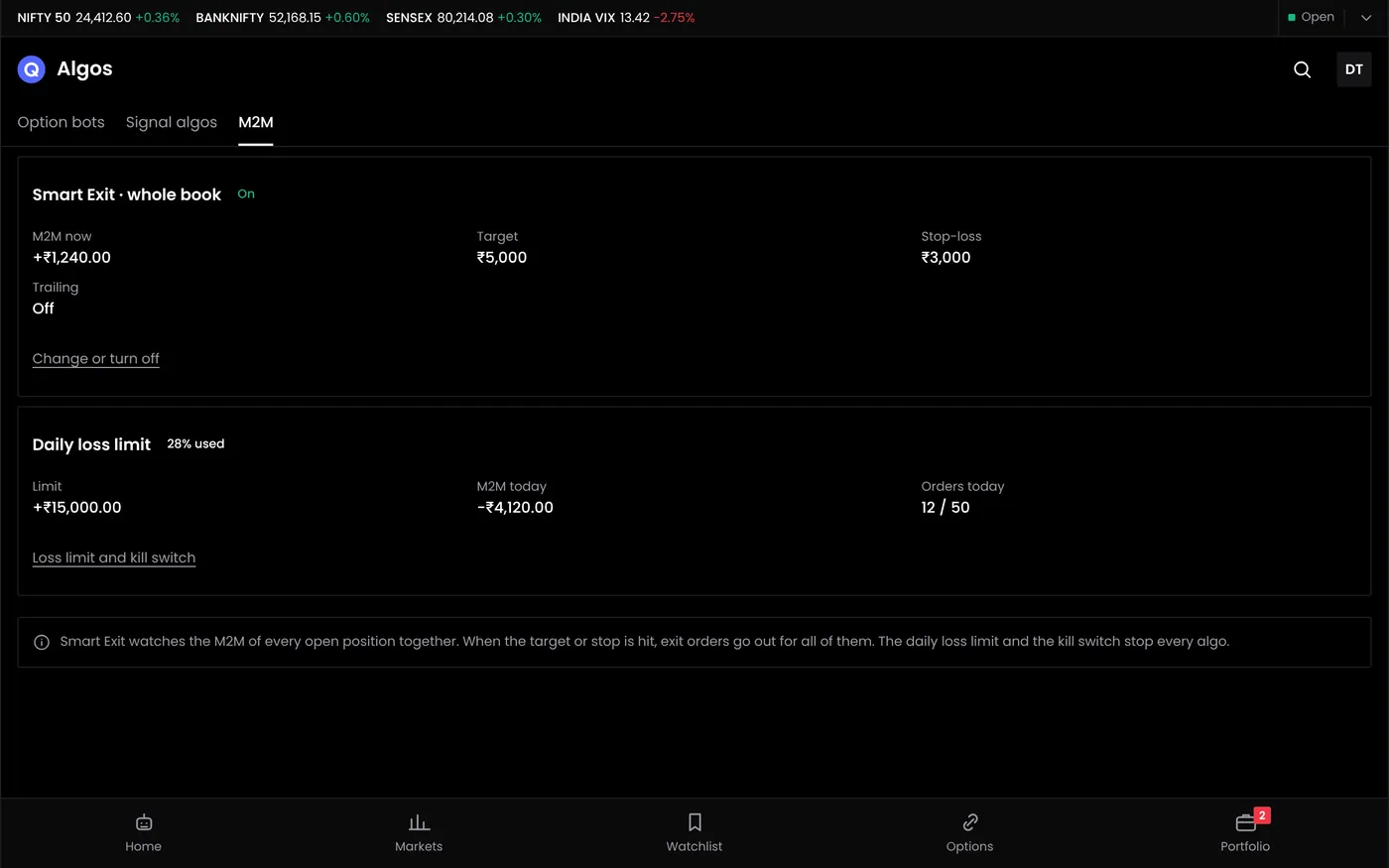
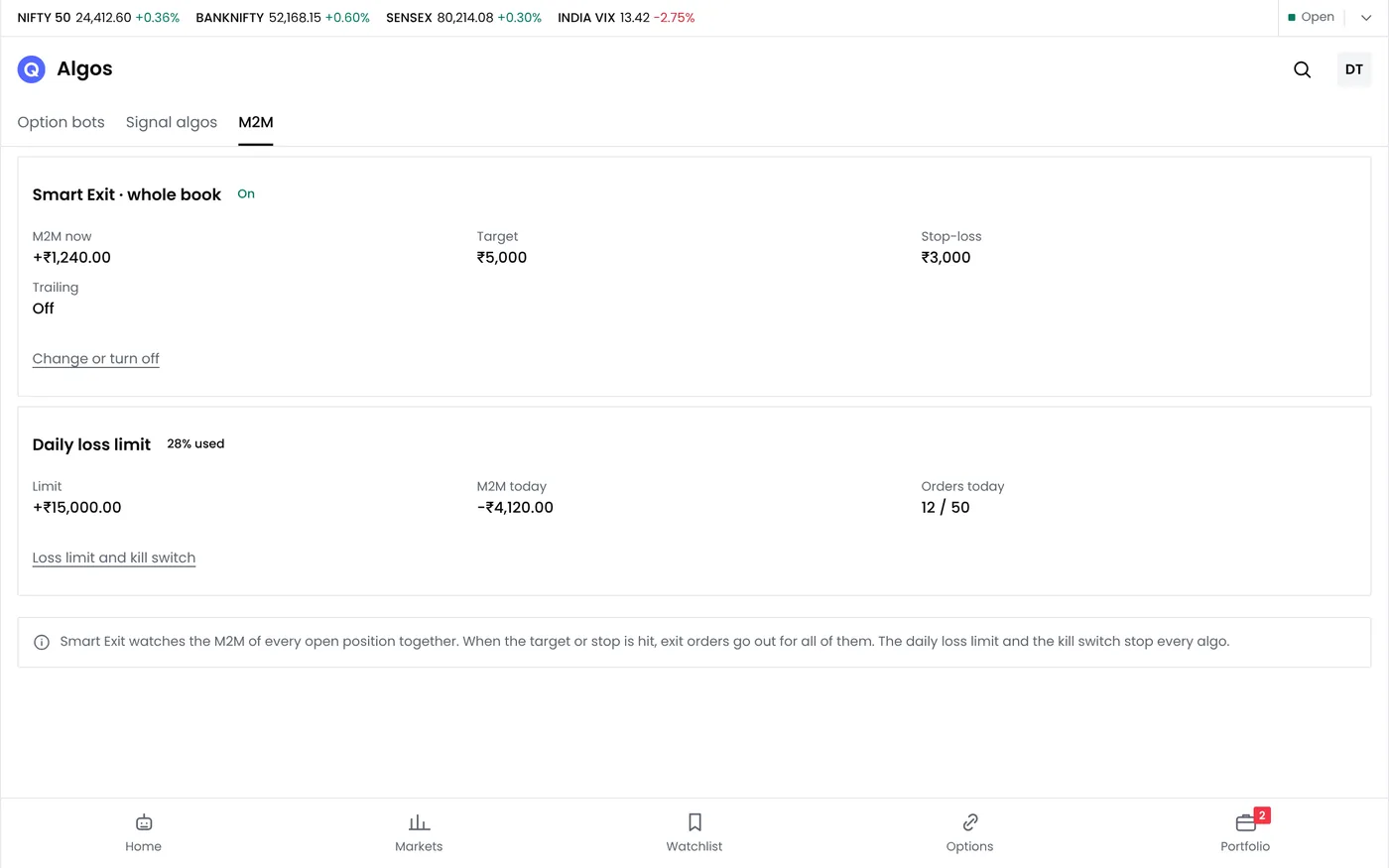
Step 5. Set the account limit
Set the daily MTM loss limit in the risk settings. When it is hit, every position is squared off.
Step 6. Deploy the bot
Connect your broker, choose the strategy and lots, confirm the limits and deploy.
Step 7. Monitor and pause
Watch the position on expiry day, and use Pause all to stop every bot at once if you need to. The bot runs in QuantPower on your own computer or VPS, and its orders go to your own broker account through the broker's API, within SEBI's retail algo framework. Keep that computer or VPS on and logged in to your broker during market hours. Ready-made strategy templates, such as straddles and iron flies, load into the strategy builder; you edit and run them as your own strategy.
Common iron fly mistakes
- Expecting the full credit. It needs the index to finish exactly at the strike. Set a realistic target.
- Opening it too early with narrow wings. Decay is slow for days, and a move in that time ends the trade.
- Selling the short legs before buying the wings. It can block far more margin, or get the order rejected.
- Holding into the last minutes of expiry day. A late move can turn a large profit into the maximum loss.
- Ignoring the expiry-day margin. The extra 2% applies to the short legs on their expiry day.
- Sizing by the low margin. Size by the maximum loss.
Pre-trade checklist
- The strike is at the money and the wings match your maximum loss.
- The order of legs is set: wings first.
- No event falls before your planned exit.
- The profit target, the stop and the time exit are entered.
- The daily MTM limit is set for the account.
- Margin covers the expiry-day requirement if you plan to hold into it.
- The strategy has been backtested with costs and paper traded.
Frequently asked questions
What is the difference between an iron fly and an iron butterfly?
None: they are two names for the same strategy. Some traders also say iron fly for the version that sells the at-the-money straddle and buys wings at equal distances, which is the version on this page.
Is an iron fly safer than a short straddle?
Its loss is capped, so the worst case is known and far smaller. It also collects less, because the wings cost money. It is safer in the sense of risk, not in the sense of a higher chance of profit.
How much can an iron fly lose?
The wing width minus the net credit, times the lot size. In the example, (300 − 244.10) × 65 = ₹3,634 a lot, plus costs.
How much margin does an iron fly need?
Roughly ₹45,000 to ₹65,000 for one lot of Nifty with 300-point wings in normal conditions, about a quarter of a naked straddle's, and more on expiry day. Your broker's calculator gives the exact figure.
When should I enter an iron fly?
Most traders use it one to three days before expiry, when decay is fastest, and avoid event days. Backtest your entry day and time.
Is the iron fly profitable?
It wins less often than it loses, with larger wins than losses when it works. The result depends on the target, the stop and the timing. SEBI's study of FY26 found that 87.7% of individual F&O traders lost money, so test the rules thoroughly first.
Can I run an iron fly on Bank Nifty or Sensex?
Yes. Bank Nifty has monthly expiries only and higher volatility, so wings are usually wider. Sensex has weekly expiries on Thursdays. Check liquidity on the wing strikes before you trade.
Related guides and terms
- Iron condor strategy and short straddle strategy
- Butterfly spread strategy, the debit version
- Hero zero option trading and the Nifty expiry date
- Option selling strategies and options risk management
- Hedge margin benefit and the F&O margin calculator
- Terms: Theta meaning, gamma meaning, vega meaning, ITM ATM OTM meaning, hedging meaning
Start your free trial
Connect your broker, build a strategy and test it on paper before a single live order goes out.
Sources
- Black, F. and Scholes, M. (1973). The Pricing of Options and Corporate Liabilities. Journal of Political Economy, 81(3), 637–654
- SEBI circular SEBI/HO/MRD/TPD-1/P/CIR/2024/132: Measures to strengthen the equity index derivatives framework, 1 Oct 2024 (expiry-day extreme loss margin, one weekly expiry per exchange)
- SEBI circular on safer participation of retail investors in algorithmic trading, 4 Feb 2025, and the implementation timeline to 1 April 2026
- NSE: Equity derivatives contract specifications (lot sizes and expiry days)
- SEBI, Profitability of Individual Traders in the Equity Derivatives Segment (FY25–FY26), PR No. 50/2026, 20 August 2026