
This guide covers the whole trade: the numbers on one lot, the Greeks that drive it, margin, entries, exits, adjustments, the hedged version, costs, backtesting, and how to set it up as an algo bot with strict exits.
Short straddle at a glance
| Feature | Short straddle |
|---|---|
| Market view | Range-bound, little movement until you exit |
| Legs | Sell 1 ATM call and sell 1 ATM put, same strike and expiry |
| Maximum profit | The net premium collected, if the index expires at the strike |
| Maximum loss | Unlimited without a stop loss or hedge |
| Breakevens | Strike plus and minus the net premium |
| Time decay | Works for you: the position earns theta every day |
| Volatility | A rise in IV hurts, a fall helps |
| Margin | High for a naked straddle; much lower as an iron fly |
| Typical users | Intraday index sellers with per-leg stops; positional sellers with hedges |
| Difficulty | Intermediate: the setup is easy, the risk control is not |
Key takeaways
- A short straddle is a bet that the market moves less than the option prices imply. It wins on quiet days and loses on trending or gapping days.
- On one lot of Nifty at 25,000 with 12 days to expiry and 14% IV, the model credit is about ₹32,994, with breakevens near 24,492 and 25,508.
- Theta earns about ₹1,411 a day at entry, and an average day's move costs roughly the same through gamma. The edge, if any, comes from days that are quieter than priced.
- Per-leg stop losses, a combined stop, a time exit and an account-level MTM limit are the four exits most straddle algos use. Decide them before entry and let the bot execute them.
- Adding wings turns the straddle into an iron fly, caps the loss and cuts the margin to a fraction.
- Backtest with option prices, costs and slippage, and test the final rules on a period you did not use to design them.
How a short straddle makes money
A short straddle sells an at-the-money (ATM) call and an ATM put with the same strike and expiry. At the moment of entry, both options are almost pure time value. If the index stays near the strike, that time value decays and the seller buys the options back for less than they were sold for, or lets them expire.
The seller profits when the market moves less than the premium collected implies. The seller loses when the market moves more. In effect, a straddle seller is betting that the market will be quieter than the option prices expect.

The payoff diagram shows the shape of the trade. Profit peaks at the strike and falls in a straight line on either side. The lines keep falling, which is the whole problem with the naked version: there is no level at which the loss stops on its own.
The numbers on one lot
Using Black–Scholes model prices with Nifty at 25,000, 12 days to expiry, implied volatility (IV) of 14% and a lot of 65 units:
- Sell the 25,000 call at ₹280.50
- Sell the 25,000 put at ₹227.10
- Net credit: ₹507.60 per unit, or ₹32,994 per lot
At expiry, the position's P&L depends only on where Nifty settles:
| Nifty at expiry | P&L per lot |
|---|---|
| 24,000 | −₹32,006 |
| 24,250 | −₹15,756 |
| 24,500 | +₹494 |
| 24,750 | +₹16,744 |
| 25,000 | +₹32,994 |
| 25,250 | +₹16,744 |
| 25,500 | +₹494 |
| 25,750 | −₹15,756 |
| 26,000 | −₹32,006 |
The breakevens are about 24,492 and 25,508, the strike plus and minus the credit. In the model, the chance that Nifty finishes between them is about 57.5%.
It is useful to compare the breakeven distance with the market's expected move. At 14% IV, one standard deviation of Nifty's move over 12 days is about 635 points. The straddle's breakevens are only about 508 points away, so a fairly ordinary move for the period takes the position into a loss at expiry.
Change the spot, IV or days below to see how the credit, breakevens and today's curve move. Switch to the iron fly to see what wings do to the loss.
Interactive payoff chart: change the spot, IV, lot size and days to expiry to see the curve, breakevens and Greeks.
The Greeks of a short straddle
The Greeks explain how the position behaves before expiry. Per lot at entry:
| Greek | Value | What it means |
|---|---|---|
| Delta | −₹5 per point | Close to neutral at the start |
| Gamma | −0.081 | Delta moves against you as the market moves |
| Theta | +₹1,411 a day | What the position earns from a quiet day |
| Vega | −₹2,340 per IV point | What it loses if IV rises one point |
Theta against gamma
The straddle earns about ₹1,411 a day from time decay. At 14% IV, a one standard deviation daily move in Nifty is about 183 points. Gamma says a move of that size costs roughly half of 0.081 × 183 × 183, or about ₹1,356. So an ordinary day roughly cancels a day's decay. The seller makes money on days quieter than average and loses on busier ones. That is the trade in one sentence.

Decay is not spread evenly. An ATM option loses time value slowly when expiry is far away and quickly in the last few days. That is why many sellers prefer the current weekly expiry: the decay per day is highest. The flip side is that gamma is highest too, so the same days that pay the most are the days a move hurts the most.
Delta drift
The straddle starts nearly neutral, but its delta shifts as the market moves:
- At 25,100, delta is about −₹13 per point.
- At 25,200, it is about −₹21 per point.
- At 24,800, it is about +₹11 per point.
As the market rallies, the position becomes increasingly short, and as it falls, increasingly long. Losses accelerate in both directions. This is why exits matter more than entries for a straddle.
Vega
With the index unchanged, a fall in IV from 14% to 12% adds about ₹4,677 per lot. A rise from 14% to 17% costs about ₹7,024. IV usually rises before scheduled events and falls after them, so selling straddles just before an event takes on both gap risk and volatility risk.
Margin for a short straddle
Because the loss is unlimited, the exchange asks for a large margin: SPAN margin for the risk of the position plus an exposure margin on each short leg. In normal conditions a one-lot Nifty short straddle needs roughly ₹2 to 2.4 lakh. The figure rises when volatility rises, because the SPAN scanning range widens, and brokers can ask for more than the exchange minimum.
Two rules matter for straddle sellers:
- Expiry-day margin. Since November 2024, short index options carry an extra 2% extreme loss margin on expiry day. A straddle held into expiry day needs more margin that morning than it did the day before.
- The hedge benefit. Buying wings turns the straddle into an iron fly, and the margin falls to a fraction of the naked requirement, often about a quarter. To keep the benefit, place the bought legs before the sold legs and square them off after.
Margins change daily with the exchange's SPAN file, so treat these figures as indications. Our F&O margin calculator explains how the numbers are built, and your broker's calculator gives the exact requirement before you trade. Size the position by the loss you can accept, never by the margin alone.
Intraday and positional straddles
There are two broad ways to trade a short straddle.
Intraday. Enter in the morning and exit before the close, every day. The position captures part of the day's decay and avoids overnight gaps. Because it is closed every day, an unexpected overnight event cannot hit it. The trade-off is that it earns only a fraction of a day's theta and pays charges every day.
Positional. Hold the straddle for several days, often until close to expiry. It captures more decay, including the decay that markets price in over weekends and holidays. It also carries overnight gap risk, and the gap can open beyond any stop loss.
Many traders start with the intraday version because the risk is easier to control, then test positional versions once their exits are reliable.
When to enter
Time of day
The first minutes after the 9:15 am open are often the most volatile part of the day. Many intraday sellers wait until 9:20 am or later so the opening moves have settled and the ATM strike is clear. Later entries collect less premium but face fewer hours of risk. The best entry time differs by index and by day of the expiry cycle, so test several times rather than copying one.
Volatility
Selling a straddle when IV is low collects little premium and leaves little room. Selling when IV is high collects more, but IV is usually high for a reason. Comparing current IV with its own recent range, using the implied volatility calculator, helps you judge whether the premium on offer is worth the risk.
Event days
RBI policy days, the Union Budget, election results and major global announcements can move the market by several standard deviations in minutes. Many straddle sellers skip those days entirely. Some traders sell after events instead, once the uncertainty has passed.
Expiry day
On expiry day, an ATM straddle has the least premium and the highest gamma. It can decay to almost nothing in a calm session, or turn into a large loss within minutes. Add the extra 2% margin described above, and expiry-day straddles need tighter stops and smaller size. Check the next Nifty expiry date, because a holiday moves Nifty's Tuesday expiry to Monday.
Exits: where the strategy is won or lost
Because losses grow faster than gains, a straddle's exits matter more than its entry.
Per-leg stop loss
A per-leg stop exits each option on its own when its price rises by a set percentage, such as 25% above the entry premium.
Here is how it plays out. Suppose Nifty rallies 150 points to 25,150 within the first hour. The call rises from ₹280.50 to about ₹367.80, passing its 25% stop at about ₹350.60. If the stop fills near that level, the call leg loses about ₹4,558 per lot. Meanwhile the put has fallen to about ₹164.60, a gain of about ₹4,064. The position is down about ₹490, with only the put left open.
The per-leg stop has cut the losing side and left the winning side to keep decaying. If the market then settles, the put can recover the loss. If the market reverses sharply downward, the put becomes the problem, which is why the remaining leg needs its own stop.
Combined stop loss
A combined stop watches the total P&L of both legs and exits everything when the loss reaches a limit. It avoids exiting one leg on a brief spike while the other is making money, but it reacts more slowly to a strong one-way move. Many sellers use per-leg stops for sharp moves and a combined stop as the final limit.
Trailing stop loss
A trailing stop locks in profit. If the straddle has decayed from ₹507 to ₹350 per unit, a trailing stop might exit if it climbs back above ₹400. The trail protects a good day from turning into a loss in the last hours.

Time exit
Intraday straddles should close at a fixed time, such as 3:10 pm or 3:15 pm, whatever the P&L. Positional straddles often exit before the final session of expiry day to avoid peak gamma.
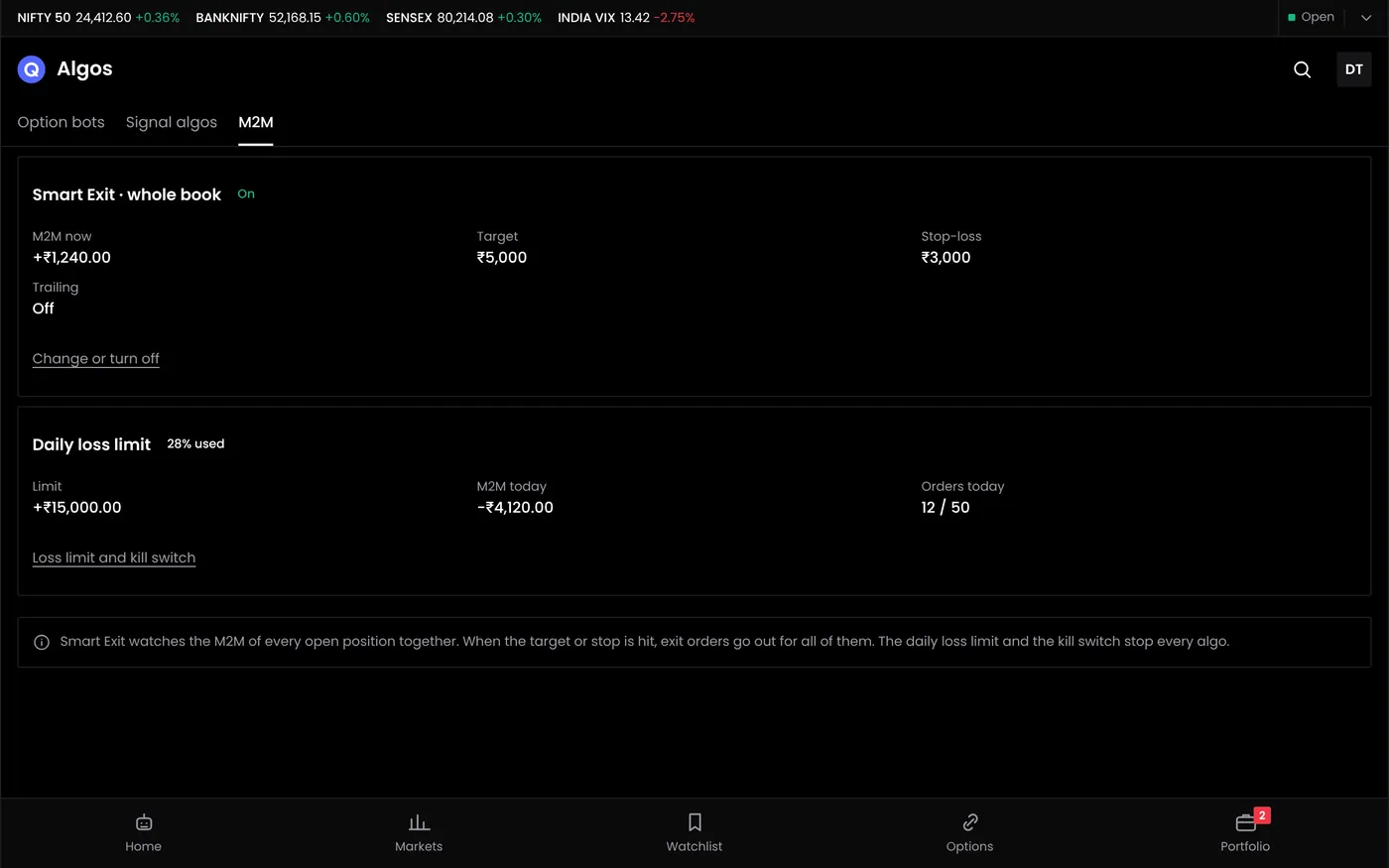
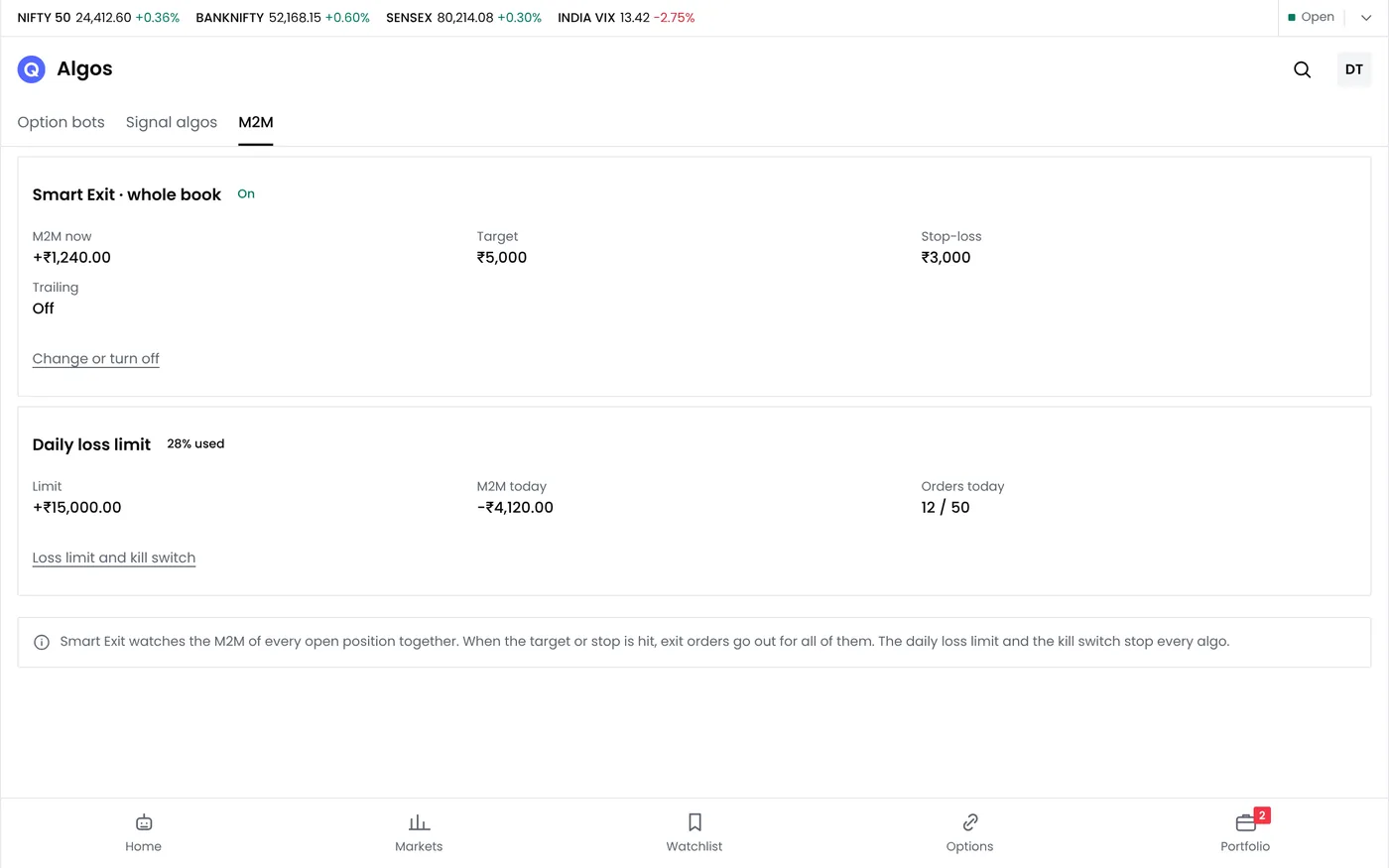
Daily MTM limit
An account-level MTM stop loss squares off every position if the day's total loss reaches your limit. It protects you when several strategies lose at the same time. Like any stop, it sends exit orders and cannot guarantee the final price.
Re-entry rules
Some straddle strategies re-enter a leg after its stop is hit, for example once per leg before 1:00 pm. Re-entries can recover a whipsaw day, but on a trending day they can stack loss upon loss. Limit the number of re-entries, and backtest the strategy with and without them.
A worked day, minute by minute
Here is how the rules above can play out on one trading day, using model prices with Nifty at 25,000 at entry, 12 days to expiry and IV of 14%. It is an illustration of the mechanics, not a record of results.
- 9:20 amNifty 25,000. Sell the 25,000 call at ₹280.50 and the 25,000 put at ₹227.10. Credit ₹32,994. Stops placed at ₹350.60 (call) and ₹283.90 (put), 25% above entry.
- 10:05 amNifty rallies to 25,150. The call trades at ₹367.80, so the stop fills near ₹350.60: a loss of about ₹4,558. The put is at ₹164.60, a gain of ₹4,064 that is still open.
- 11:40 amNifty eases to 25,060. The re-entry rule allows one more call before 1:00 pm, so the bot sells the 25,000 call again at ₹312.60 with a stop at ₹390.80.
- 1:30 pmNifty 25,020 and IV has eased to 13.5%. Call ₹280.30, put ₹207.70. Both legs are decaying; the day's open loss is shrinking.
- 3:10 pmNifty 24,990. Time exit: buy back the put at ₹220.80 (+₹410) and the second call at ₹263.10 (+₹3,218). The day closes at about −₹930 before charges, because the first stop cost more than the decay earned.
Three things stand out. The stop did its job: without it, the call would have been ₹5,676 under water at 10:05 with no limit beyond. The re-entry recovered most of that loss, but only because the market came back. And a day that moved 150 points and returned to the strike still ended slightly negative, which is why costs and stop levels need testing rather than guessing.
Adjustments
Adjustments change the position when the market moves, instead of simply exiting.
- Roll the untested side. If Nifty rallies, the put loses value. Buying it back and selling a higher put collects more premium and re-centres the position, at the cost of more risk if the rally reverses.
- Shift the straddle. Close the whole position and sell a new straddle at the new ATM strike. This resets the position but locks in the loss so far.
- Add wings. Buying an out-of-the-money call and put turns the straddle into an iron fly and caps the loss from that point on.
Every adjustment costs charges and slippage, and repeated adjustments can turn a manageable loss into a large one. Decide the adjustment rules before the trade, keep them simple and test them like any other rule.
The hedged version: the iron fly
An iron fly is a short straddle with a bought put below and a bought call above. The wings cap the loss and reduce the margin required.
| Version | Credit per lot | Maximum loss per lot | Breakevens |
|---|---|---|---|
| Naked short straddle | ₹32,994 | Unlimited | 24,492 and 25,508 |
| Iron fly, 500-point wings | ₹22,760 | ₹9,740 | 24,650 and 25,350 |
| Iron fly, 300-point wings | ₹15,867 | ₹3,634 | 24,756 and 25,244 |
The wings cost part of the premium and move the breakevens inward, but they turn an unlimited loss into a known one. For many traders, especially those running several strategies, that certainty is worth more than the extra premium.
Short straddle, short strangle, iron fly or iron condor?
All four sell time value around the current price. They differ in how much they collect, how wide the profit zone is and how the loss is capped. Model figures for one lot, Nifty at 25,000, 12 days to expiry, IV 14%:
| Strategy | Legs | Credit per lot | Maximum loss | Breakevens | Best when |
|---|---|---|---|---|---|
| Short straddle | Sell 25,000 CE and PE | ₹32,994 | Unlimited | 24,492 / 25,508 | You expect a very quiet session and will exit fast |
| Short strangle strategy | Sell 25,300 CE and 24,700 PE | ₹17,128 | Unlimited | 24,437 / 25,564 | You want a wider zone and accept less premium |
| Iron fly | Straddle plus 300-point wings | ₹15,867 | ₹3,634 | 24,756 / 25,244 | You want the straddle's theta with a known loss |
| Iron condor | Strangle plus 250-point wings | ₹9,051 | ₹7,199 | 24,611 / 25,389 | You want a wide zone and a known loss |
The straddle collects the most and has the narrowest zone. The strangle widens the zone at the cost of premium. Wings cap the loss and cut the margin on either. Our option selling strategies guide compares them over a full expiry cycle.
Nifty, Sensex and Bank Nifty straddles
The index you trade changes the straddle.
- Nifty 50 has weekly and monthly expiries on Tuesdays, a lot of 65 units and the deepest options market in India.
- Sensex has weekly expiries on Thursdays on BSE. Its options behave similarly to Nifty's because the two indices move closely together.
- Bank Nifty has monthly expiries only since November 2024, with a lot of 30 units. Monthly straddles decay more slowly and leave more time for the index to move, and Bank Nifty has historically moved more than Nifty in percentage terms.
Running straddles on Nifty and Sensex at the same time doubles your exposure to the same move rather than diversifying it.
Costs, slippage and tax
A straddle places at least four orders a day: two to enter and two to exit. Stops, re-entries and adjustments add more. Each order pays brokerage, securities transaction tax, exchange charges, the SEBI fee, stamp duty and GST, plus the bid-ask spread. On the entry alone, STT at 0.15% of the ₹32,994 premium sold is about ₹49, before any other charge.
ATM Nifty options usually have tight spreads, but stops are often hit in fast markets, when spreads widen and fills slip. A strategy that earns a few hundred rupees per lot on an average day can lose most of that to costs. Use the calculator below for a round trip on each leg, and include the figure in every backtest.
Brokerage, STT, exchange charges, SEBI fee, stamp duty and GST for one round trip, by broker.
Profits from a short straddle are taxed as non-speculative business income, and frequent trading can cross the turnover thresholds for a tax audit.
How to backtest a short straddle
A straddle backtest needs the price of each option every minute, not just the index. Test:
- Entry times, such as 9:20, 9:30, 9:45 and 10:00 am.
- Stop levels, such as 20%, 25%, 30% and 40% per leg, with and without a combined stop.
- Re-entry rules, from none to two per leg.
- Day filters, such as skipping event days or expiry day.
- Hedged versions with different wing widths.
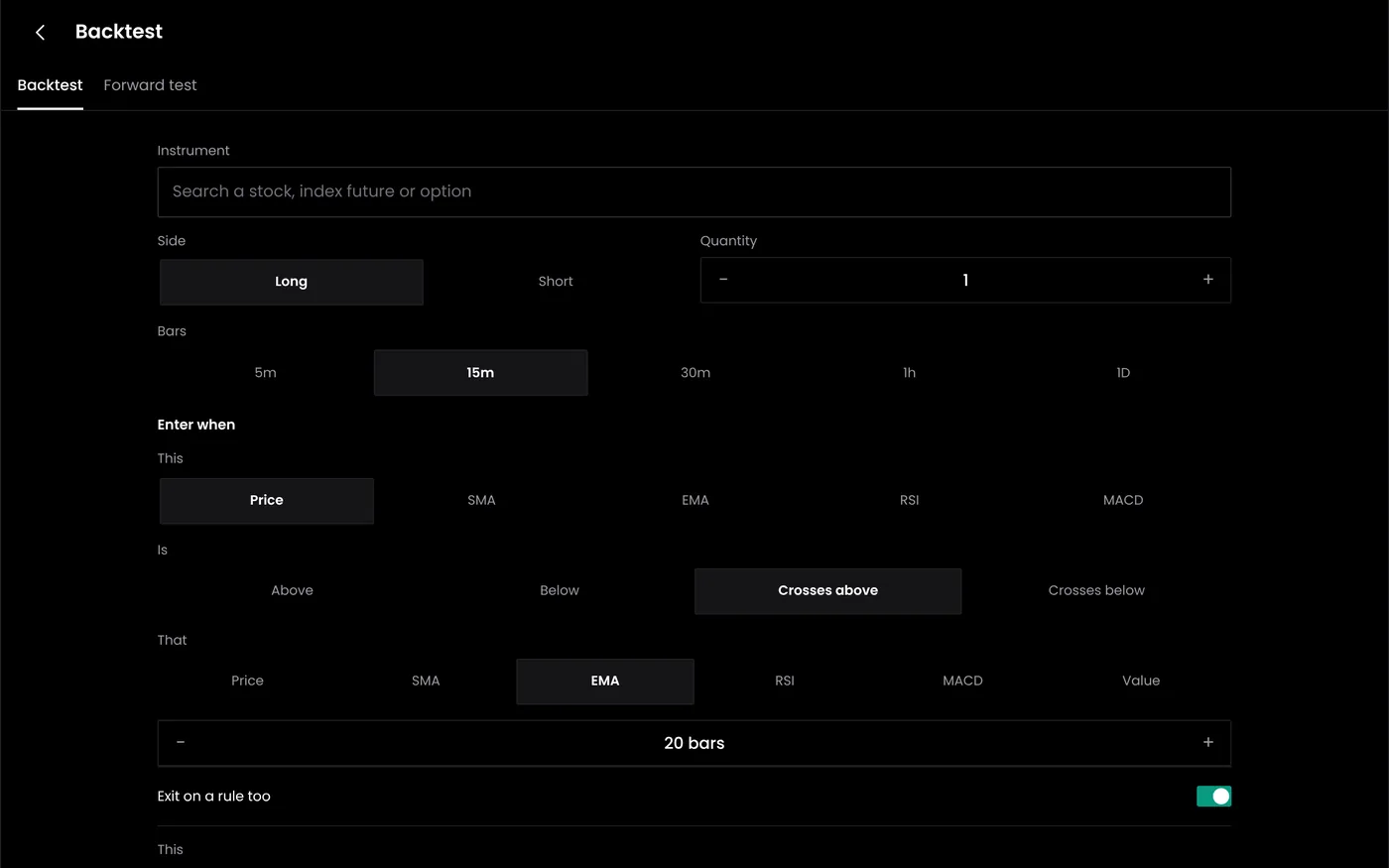
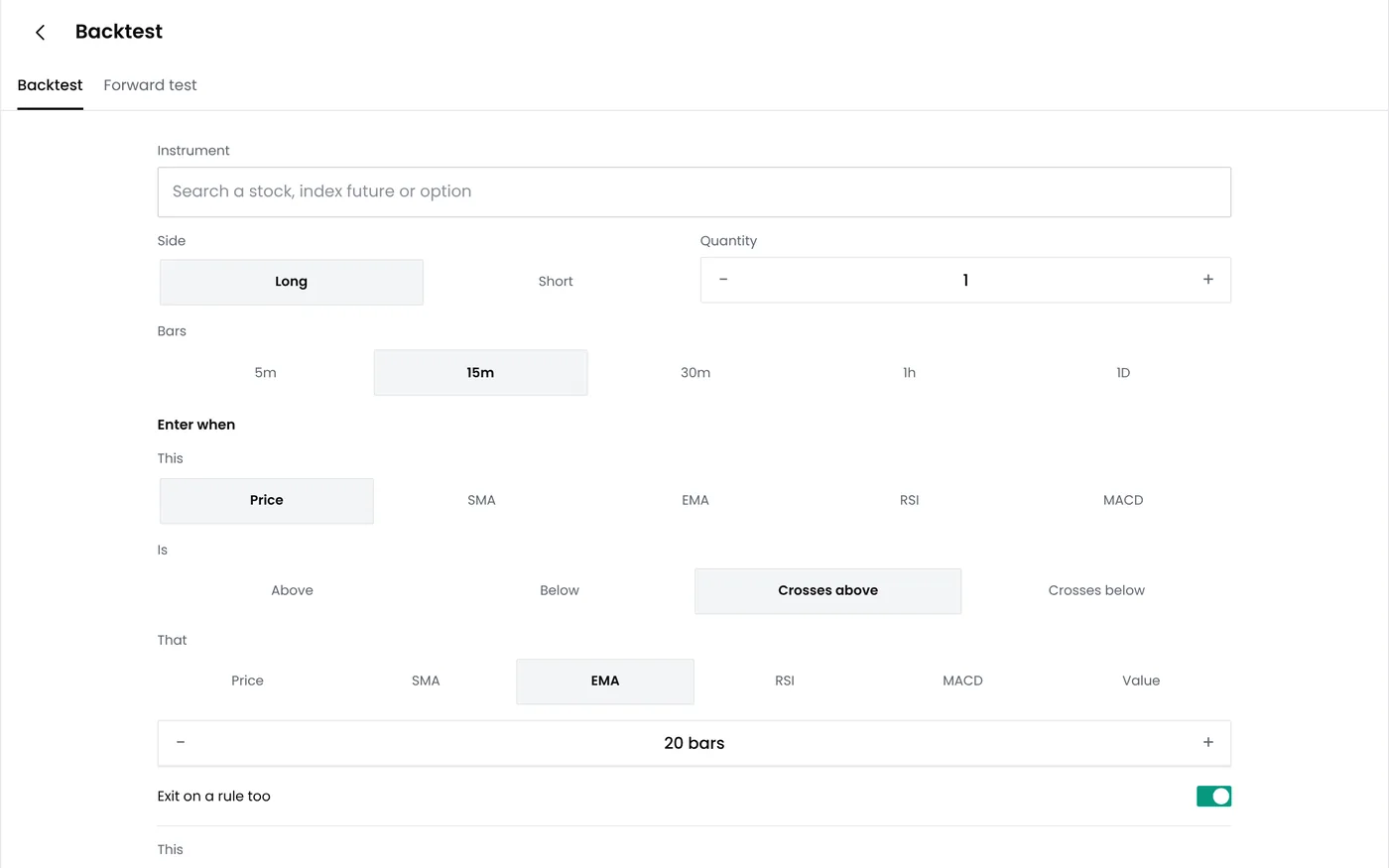
Look for settings that work across a range of neighbouring values, not one perfect combination. Check the worst days in detail, measure the maximum drawdown and test the final rules on a period you did not use to design them. Our guides on how to backtest trading strategies, avoiding overfitting and walk-forward testing explain each step, and the backtesting engine runs straddle rules over past expiries with costs included.
Setting up the short straddle in QuantPower
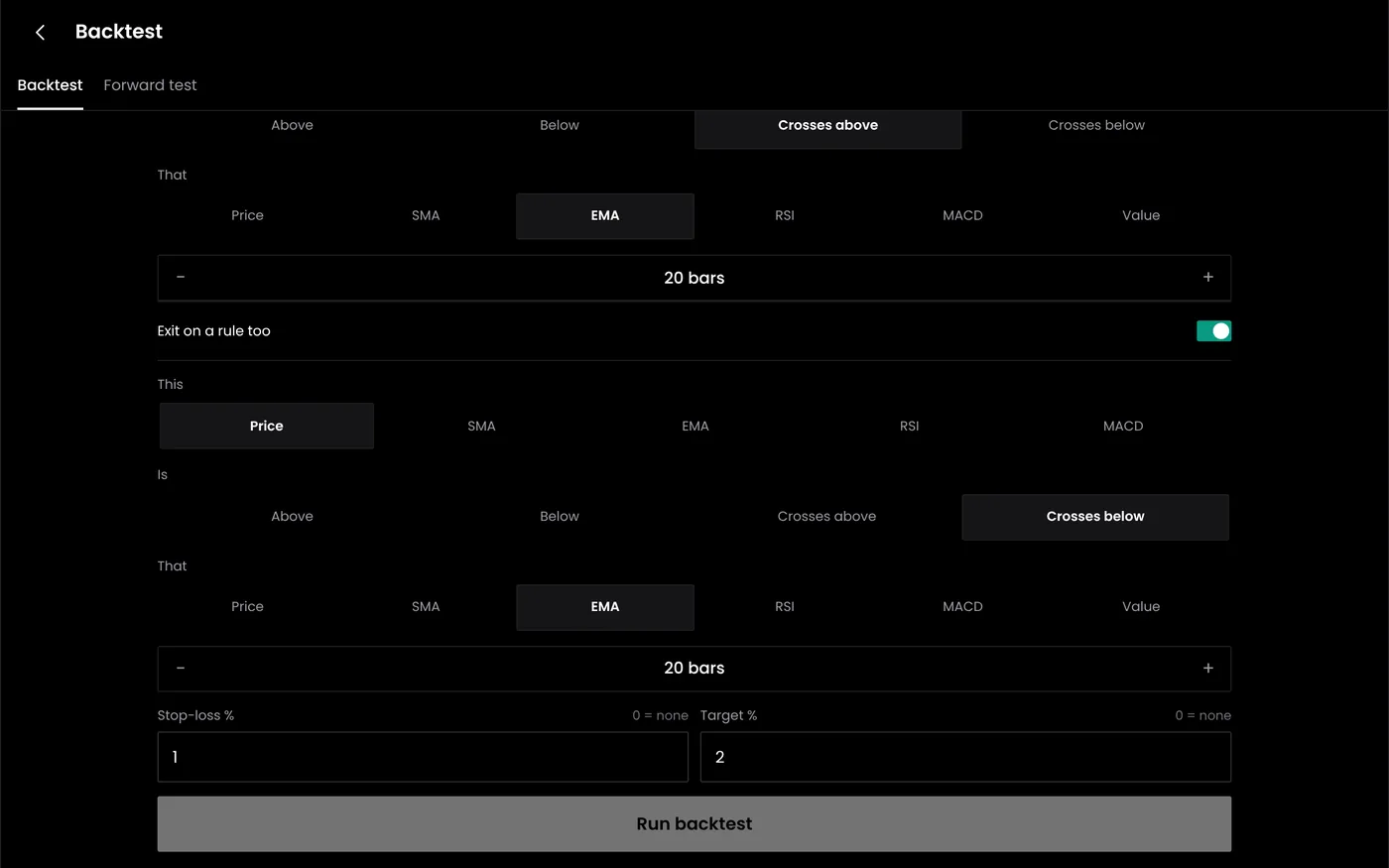
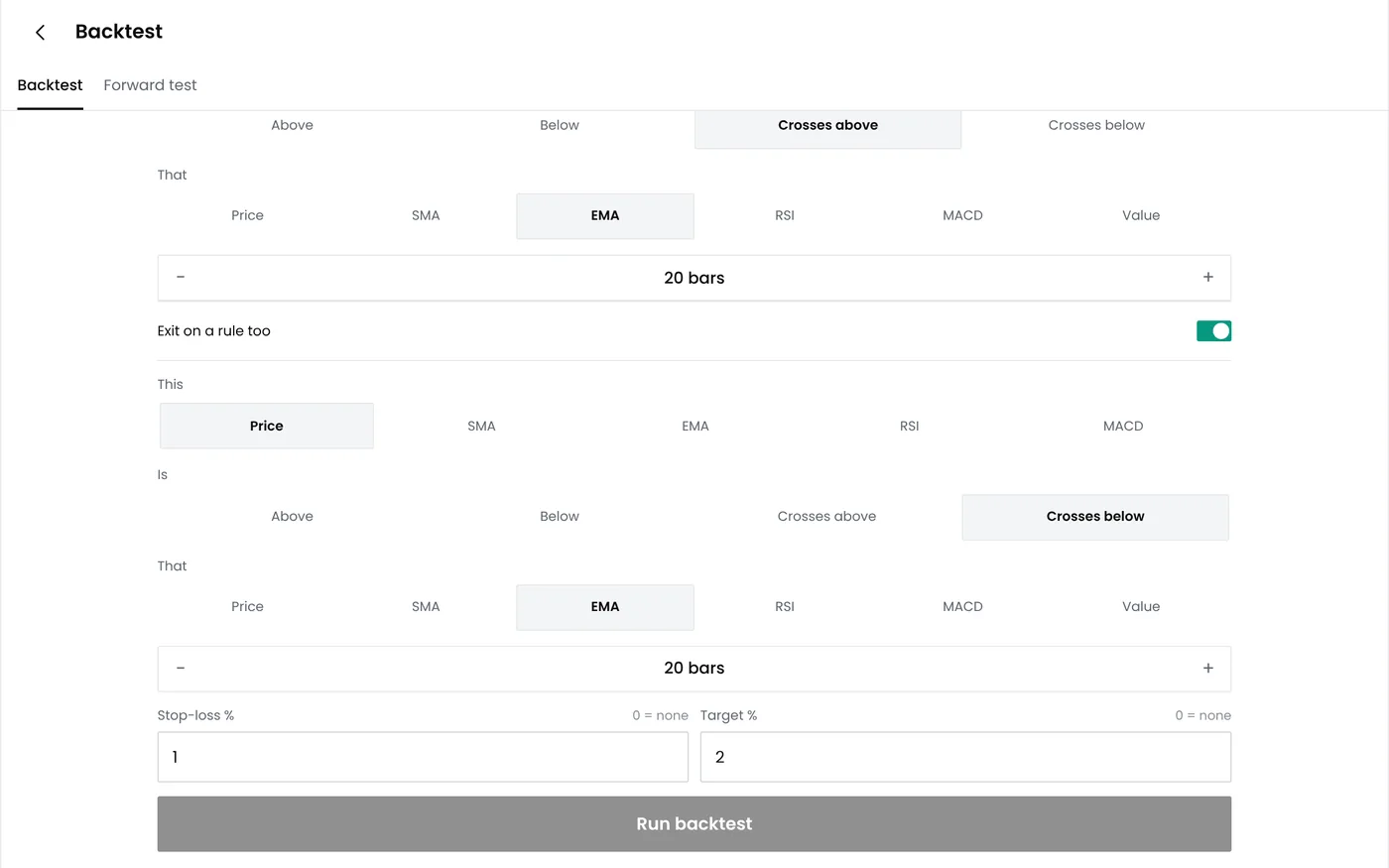
The short straddle is well suited to automation: its rules are exact and its exits must happen without hesitation. The strategy builder includes a Nifty short straddle template. Here is the full setup, from rules to a live bot.
| Rule | Example setting |
|---|---|
| Instrument | Nifty 50, current weekly expiry |
| Entry | 9:20 am, every trading day |
| Legs | Sell 1 lot ATM call and 1 lot ATM put |
| Stop loss | 25% above each leg's entry premium |
| Re-entry | Once per leg, if stopped out before 1:00 pm |
| Trailing stop | Optional: trail the combined premium once it has decayed 20% |
| Daily limit | Your MTM loss limit for the account |
| Time exit | Square off everything at 3:10 pm |
| Skip days | RBI policy, Union Budget and other event days |
Step 1. Open the template
In the strategy builder, choose the short straddle template, set the index to Nifty 50 and the expiry to the current week. Set lots to 1.
Step 2. Set the entry and exits
Enter the 9:20 am entry, the per-leg stop at 25%, the re-entry rule and the 3:10 pm time exit. Add the event-day filter.
Step 3. Backtest it
Run the rules over past expiries with costs and slippage on, then change one setting at a time.
Step 4. Paper trade it
Run the strategy on live prices with virtual money for at least a few weeks, including an expiry day, and compare the fills with the backtest.
Step 5. Set the account limit
Before anything goes live, set your daily MTM loss limit in the risk settings. The limit squares off every position when it is hit.
Step 6. Deploy the bot
Connect your broker, choose the strategy and lots, confirm the limits and deploy. The bot places the straddle at 9:20 am and manages the exits on its own.
Step 7. Monitor and pause
Watch the positions, and use Pause all if you need to stop every bot at once. The bot uses broker infrastructure or the client’s own static IP setup, not Wisdom Tree Ventures servers. Client-hosted operation needs the host and broker session to stay available; broker-hosted clients do not need their own static IP.
Orders use the applicable broker-hosted or client-static-IP connection and its account permissions.
Common short straddle mistakes
- Trading without a stop because "it usually comes back." The day it does not can cost weeks of profit.
- Sizing by margin instead of by maximum loss. Margin is the minimum the exchange requires, not what you can afford to lose.
- Removing stops after a few whipsaws. Stops cost money on some days and save the account on others.
- Selling straddles into scheduled events. The premium is higher for a reason.
- Holding short ATM options into the last hour of expiry without a plan for a sudden move.
- Running straddles on several indices at once and treating them as separate risks.
- Ignoring costs in a strategy that trades every day.
- Changing the rules after one bad week. Judge a straddle over many expiries, and change one setting at a time.
Pre-trade checklist
- The loss limit is set in rupees, per day and per lot, and the position size follows from it.
- Every leg has a stop, and the account has an MTM limit.
- The time exit is set, and no scheduled event falls before it.
- Margin, including the expiry-day addition, is available with room to spare.
- The rules were backtested with costs and tested on unseen data.
- The strategy ran in paper trading through at least one expiry.
- You know how to pause the bot and square off by hand if your connection drops.
For sizing rules and the other eight habits that keep sellers in the game, read options risk management and try the position size calculator.
Start your free trial
Connect your broker, build a strategy and test it on paper before a single live order goes out.
Frequently asked questions
Is the short straddle profitable?
It can earn steady premium on quiet days, but one large move can wipe out weeks of gains. Whether it works for you depends on your exits, position size, costs and the period you trade it in. Backtest your exact rules with costs, then paper trade them before any live order. We do not publish returns for any strategy, and nothing here is a performance claim.
What stop loss suits a short straddle?
Most straddle algos use a per-leg stop between 20% and 50% above each leg's entry premium, a combined stop or trailing stop for the whole position, a fixed time exit and an account-level MTM limit. Tighter stops get hit more often; wider stops lose more when hit. Test several levels and look at the worst days before choosing.
How much margin does a short straddle need?
Roughly ₹2 to 2.4 lakh for one lot of Nifty in normal conditions, more when volatility is high and an extra 2% on expiry day. Buying wings, which turns it into an iron fly, cuts the margin to a fraction. Your broker's margin calculator gives the exact figure for the day.
What is the best time to enter a short straddle?
Many intraday sellers enter between 9:20 and 10:00 am, after the opening moves settle. There is no single best time: it differs by index, by day of the expiry cycle and by period. Test a few entry times and prefer the one that is robust across neighbouring times, not the single best one.
Can I run a short straddle on Bank Nifty or Sensex?
Yes. Bank Nifty options now have monthly expiries only and a lot of 30 units, so decay is slower and the index has more time to move. Sensex has weekly expiries on Thursdays on BSE. Remember that Nifty and Sensex straddles share almost the same risk, so running both doubles the exposure.
Short straddle or short strangle: which is better?
The straddle collects more premium and has a narrower profit zone; the strangle collects less and gives the index more room. Neither is better in general. Straddle sellers rely on tighter stops; strangle sellers accept less income for fewer stop-outs. Many traders test both with the same exits and keep the one whose worst days they can live with.
What happens to a short straddle on expiry day?
The premium is smallest, gamma is highest and short index options carry an extra 2% margin. A calm expiry day can decay the straddle to almost nothing; a sudden move can cost more than a week of decay in minutes. Most algos use smaller size and tighter stops on expiry day, or skip it.
Is selling straddles with an algo allowed under SEBI's rules?
Yes, for retail traders, when the orders go through a SEBI-registered broker under the retail algo framework that has applied in full since 1 April 2026. Follow the applicable broker and exchange requirements; this strategy example is not a claim of approval. The rules govern how orders are sent, not which strategies you may trade.
Related guides and terms
- Option selling strategies
- Iron fly strategy and iron condor strategy
- Short strangle strategy and long straddle strategy
- Hero zero option trading
- How to place stop loss order and trailing stop loss
- Option greeks and strike price selection
- Option profit calculator and brokerage calculator
- Glossary: Premium meaning, theta meaning, gamma meaning, vega meaning, ITM ATM OTM meaning, what is margin in trading, MTM meaning
- Long strangle strategy
- Option buying strategies
- Option buying vs selling
- Short selling meaning
Sources
- Black, F. and Scholes, M. (1973). The Pricing of Options and Corporate Liabilities. Journal of Political Economy, 81(3), 637–654
- SEBI circular SEBI/HO/MRD/TPD-1/P/CIR/2024/132: Measures to strengthen the equity index derivatives framework, 1 Oct 2024 (expiry-day extreme loss margin, one weekly expiry per exchange)
- SEBI circular on safer participation of retail investors in algorithmic trading, 4 Feb 2025, and the implementation timeline to 1 April 2026
- NSE: Equity derivatives contract specifications (lot sizes and expiry days)
- NSE and BSE trading holiday lists for 2026
- SEBI, Profitability of Individual Traders in the Equity Derivatives Segment (FY25–FY26), PR No. 50/2026, 20 August 2026