
This guide covers the whole session: what changes on expiry day, the numbers on one lot, the Greeks, the extra margin, the closing auction that now sets the settlement price, the main selling and buying strategies, exits, a worked day, costs, backtesting, and how to run expiry-day rules as an algo bot with strict limits.
Expiry day at a glance
| Feature | Expiry day |
|---|---|
| Weekly index expiries | Nifty 50 on Tuesdays (NSE) and Sensex on Thursdays (BSE) |
| Monthly index expiries | Bank Nifty, FinNifty and other NSE indices on the last Tuesday; other BSE index options on the last Thursday |
| Holidays | The expiry moves to the previous trading day |
| F&O trading hours | 9:15 am to 3:40 pm since 3 August 2026 |
| Settlement price | The index's official close, set by the closing auction of its stocks between 3:15 and about 3:35 pm |
| Settlement | Cash, at intrinsic value; out-of-the-money options expire worthless |
| Time value | Falls to zero by the close |
| Gamma | The highest of the cycle for at-the-money options |
| Extra margin | 2% of contract value on every short index option expiring that day |
| Difficulty | Advanced: small premiums, fast moves and little room for error |
Key takeaways
- With Nifty at 25,000 and IV of 14%, the at-the-money straddle is worth about ₹145 at 9:20 am on expiry day, or ₹9,440 a lot, and about ₹83 at 1:30 pm if the index has not moved.
- That price matches the average move the model expects for the rest of the day. A seller makes money only on days quieter than average, and a buyer only on busier ones.
- Gamma at 9:20 am is about 3.5 times its level with 12 days to expiry and keeps rising. At 2:45 pm, a 100-point move costs almost the whole credit left in the straddle.
- Each short index option expiring that day needs an extra 2% of contract value in margin: about ₹32,500 a lot on Nifty, or ₹65,000 for a straddle, strangle, iron fly or condor.
- The settlement price is now set in a closing auction after 3:15 pm, while options trade until 3:40 pm. Most expiry-day algos close their positions before 3:15 pm.
- Cheap out-of-the-money options rarely pay. The 25,300 call at 9:20 am costs ₹267 a lot, and the model gives it about a 5% chance of finishing in the money.
What changes on expiry day
On the last day of an option's life, three things happen at once:
- Time value collapses. Every option's time value must reach zero by the close.
- Gamma peaks. At-the-money options become extremely sensitive to small moves.
- Out-of-the-money options become lottery tickets. Options a few hundred points away cost very little and usually expire worthless.
The table shows Black–Scholes model values through the day for Nifty at 25,000, IV of 14% and no change in the index. The model counts the 9:15 am to 3:30 pm session as one day and measures the time left in trading minutes.
| Time | 25,000 call | 25,000 put | ATM straddle | 25,200 call | 24,800 put |
|---|---|---|---|---|---|
| 9:15 am | ₹75.33 | ₹70.87 | ₹146.20 | ₹13.57 | ₹12.02 |
| 10:30 am | ₹67.16 | ₹63.60 | ₹130.76 | ₹9.34 | ₹8.30 |
| 12:00 pm | ₹55.95 | ₹53.45 | ₹109.40 | ₹4.67 | ₹4.16 |
| 1:30 pm | ₹42.06 | ₹40.63 | ₹82.69 | ₹1.13 | ₹1.00 |
| 2:30 pm | ₹29.59 | ₹28.88 | ₹58.47 | ₹0.08 | ₹0.07 |
| 3:00 pm | ₹20.85 | ₹20.49 | ₹41.34 | below ₹0.05 | below ₹0.05 |
| 3:15 pm | ₹14.71 | ₹14.53 | ₹29.23 | below ₹0.05 | below ₹0.05 |
Two patterns stand out. The at-the-money straddle loses about a quarter of its value by noon and most of the rest in the afternoon, because decay speeds up as the time left shrinks. And options 200 points away lose almost everything by early afternoon: their value was a bet on a move, and the hours for that move have run out.

At 14% IV, one standard deviation of Nifty's move over a full expiry session is about 183 points. From 1:30 pm to the close, it is about 104 points. Those distances decide whether most out-of-the-money options end the day with any value at all.
Why so much trading happens on expiry day
Expiry-day trading dominates Indian index options. SEBI's FY26 study of individual traders found that trading was heavily concentrated near expiry, with about 59% of index options turnover in contracts on their expiry day. The same study found that 87.7% of individual traders in equity derivatives made net losses in FY26, with options accounting for about 92% of those losses.
SEBI's measures since 2024 have made expiry day more expensive to trade: one weekly expiry per exchange, larger lots, extra margin on short options and no calendar spread benefit on the expiring contract. Each of these is covered below.
The numbers on one lot
Using model prices with Nifty at 25,000, IV of 14% and a lot of 65 units, a morning short straddle at 9:20 am on expiry day looks like this:
- Sell the 25,000 call at ₹74.81
- Sell the 25,000 put at ₹70.42
- Net credit: ₹145.23 per unit, or ₹9,440 per lot
If the position is held to settlement, the P&L depends only on the settlement price:
| Nifty at settlement | P&L per lot |
|---|---|
| 24,600 | −₹16,560 |
| 24,700 | −₹10,060 |
| 24,800 | −₹3,560 |
| 24,900 | +₹2,940 |
| 25,000 | +₹9,440 |
| 25,100 | +₹2,940 |
| 25,200 | −₹3,560 |
| 25,300 | −₹10,060 |
| 25,400 | −₹16,560 |
The breakevens are about 24,855 and 25,145, and the model's chance of a settlement between them is about 57.5%, the same as for a straddle with 12 days left. What changes is the scale: a profit zone 145 points either side of the strike, on a day when one standard deviation of the move is about 182 points.
The model expects Nifty to settle, on average, about 145 points away from where it stood at 9:20 am. That is the straddle's price. The seller is paid the average size of the day's move, so the trade makes money on quieter days and loses on busier ones. Implied volatility sets that price: the same straddle collects ₹8,092 a lot at 12% IV, ₹10,787 at 16% and ₹12,135 at 18%.
The afternoon version
Sold at 1:30 pm instead, with the index unchanged, the straddle collects ₹42.06 for the call and ₹40.63 for the put: ₹82.69 per unit, or ₹5,375 a lot, with breakevens near 24,917 and 25,083. A settlement 100 points from the strike costs ₹1,125 a lot; 200 points costs ₹7,625. Less time means less premium and a narrower zone, but also fewer hours in which the index can move.
Set the days to expiry to 1 in the builder below to see expiry-day prices, then switch between the straddle, the iron fly and the condor to compare their shapes.
Interactive payoff chart: change the spot, IV, lot size and days to expiry to see the curve, breakevens and Greeks.
The Greeks on expiry day
The Greeks change more on expiry day than on any other. Per lot of the short at-the-money straddle, with the index at the strike:
| Greek | 12 days to expiry | 9:20 am on expiry day | 1:30 pm | 2:45 pm |
|---|---|---|---|---|
| Gamma | −0.081 | −0.285 | −0.501 | −0.811 |
| Theta | +₹1,411 a day | +₹391 per half hour | +₹720 per half hour | +₹1,391 per half hour |
| Vega per IV point | −₹2,340 | −₹674 | −₹384 | −₹235 |
Theta against gamma
The decay a seller earns grows through the day, and so does the cost of a move. Per lot of the straddle sold at each time:
| Entry time | Credit per lot | Half an hour later, index unchanged | Half an hour later, index up 100 points |
|---|---|---|---|
| 9:20 am | ₹9,440 | +₹391 | −₹1,185 |
| 1:30 pm | ₹5,375 | +₹720 | −₹1,959 |
| 2:45 pm | ₹3,291 | +₹1,391 | −₹3,225 |
By 2:45 pm, a move of 100 points, well within a normal afternoon, wipes out almost the whole credit left. This is why late-session sellers use tight stops and small size, and why the last hours are where expiry-day accounts are most often damaged.
Delta drift
At 9:20 am the straddle's delta is close to zero, but it shifts quickly. At 25,100 it is about −₹28 per point, at 25,200 about −₹48 and at 24,900 about +₹26. With 12 days left, the same moves change delta by roughly half as much. On expiry day the position turns directional within minutes of a move.
Vega
Vega is smaller than earlier in the cycle, but it has not gone. At 9:20 am, a fall in IV from 14% to 12% adds about ₹1,348 a lot, and a rise to 18% costs about ₹2,696. Expiry-day IV can jump when the market falls fast or before a scheduled announcement.
Margin on expiry day
Three rules make expiry day more expensive for sellers:
- Extra extreme loss margin. Since 20 November 2024, short index options carry an additional 2% extreme loss margin on their expiry day, on the contract value: the previous day's closing index level times the lot size. For Nifty at 25,000, that is about ₹32,500 per short lot. It applies to short positions carried into the day and to new ones sold during the day.
- Two short legs, twice the charge. A straddle, strangle, iron fly or iron condor has two short options, so it needs about ₹65,000 more on expiry day. A naked straddle that needs roughly ₹2 to 2.4 lakh on other days needs about ₹2.65 to 3.05 lakh.
- No calendar spread benefit. Since 1 February 2025, positions in the expiring contract get no margin offset against other expiries on expiry day. A short weekly option hedged with next week's option needs more margin that morning.
Buyers pay the full premium upfront, so their cost is known in advance. Sellers should size by the loss they can accept rather than by the margin. The extra margin also changes the arithmetic of far out-of-the-money selling: a strangle that collects ₹1,629 a lot ties up about ₹65,000 of extra margin on top of the usual requirement. The F&O margin calculator shows how the figures are built.
The closing auction and settlement
What changed on 3 August 2026
Stocks with F&O contracts on NSE and BSE now stop continuous trading at 3:15 pm. Their closing prices come from a closing auction session that ends at about 3:35 pm. The index's official close is built from those prices, and it is the final settlement price for index options. The options themselves keep trading until 3:40 pm.
For an expiry-day trader this has four consequences:
- The index stops moving with trades at 3:15 pm. Its closing value is fixed when the auction matches, at about 3:35 pm, and it can differ noticeably from the 3:15 pm level.
- A position held past 3:15 pm is a bet on the auction. In the model, the at-the-money straddle is still worth about ₹29 at 3:15 pm, and the price discovery still to come is worth about 37 points of index movement, one standard deviation.
- In the final minutes, options trade against a known settlement value. Once the auction result is out, expiring options converge on their intrinsic value until trading ends at 3:40 pm.
- Auto square-off times have moved. Brokers have changed the time at which they close open intraday F&O positions. Check yours, and set your own time exit earlier.
How expiring options settle
Index options are European and cash-settled. Any option still open at the close of expiry day is settled at its intrinsic value, based on the final settlement price:
- An in-the-money call is worth the settlement price minus the strike.
- An in-the-money put is worth the strike minus the settlement price.
- Out-of-the-money options expire worthless.
A seller who sold the 25,100 call at ₹34.71 at 9:20 am and held it to a settlement of 25,180 pays ₹80 per unit: a loss of about ₹2,944 per lot before costs. A buyer whose option settles in the money pays securities transaction tax of 0.15% of the intrinsic value. Since 1 April 2026 that matches the 0.15% charged on selling an option, so closing early no longer saves much STT. The reason to close before 3:15 pm is the auction risk, not the tax.
Expiry-day selling strategies
The morning straddle
Selling the at-the-money straddle between 9:20 and 10:00 am collects the most premium of the day, about ₹9,440 a lot in the model, and leaves the whole session for the index to move. It relies on per-leg stops. On expiry day many sellers set them 30% to 50% above each leg's entry, because the premiums are small and an ordinary move covers a 25% stop within minutes.
The afternoon straddle
Selling after 1:00 pm collects less, about ₹5,375 a lot at 1:30 pm, but the remaining value decays faster and there are fewer hours left. Gamma is higher, so the stops need to be tight and the time exit firm. Some traders sell only if the morning range has been narrow, on the view that a quiet morning makes a quiet afternoon more likely. Test that rule rather than assume it.
The iron fly for a pin
An iron fly is a short straddle with bought wings. On expiry day the wings are cheap, so they cap the loss for a small part of the credit. Model figures at 9:20 am, per lot:
| Version | Credit | Maximum loss | Breakevens | Model chance of profit |
|---|---|---|---|---|
| Naked straddle | ₹9,440 | Unlimited | 24,855 and 25,145 | 57.5% |
| Iron fly, 300-point wings | ₹8,948 | ₹10,552 | 24,862 and 25,138 | 55% |
| Iron fly, 200-point wings | ₹7,811 | ₹5,189 | 24,880 and 25,120 | 49% |
| Iron fly, 100-point wings | ₹5,109 | ₹1,391 | 24,921 and 25,079 | 33% |
The fly profits most from a settlement near the centre strike. Narrow wings cut the maximum loss sharply but also narrow the profit zone. The extra 2% margin still applies to both short legs.
Far out-of-the-money strangles and condors
Selling the 25,200 call and the 24,800 put at 9:20 am collects ₹13.28 and ₹11.77: ₹25.05 a unit, or ₹1,629 a lot, with breakevens near 24,775 and 25,225 and a model chance of profit of about 78%. A high chance of a small gain sounds attractive until you look at the losses. A settlement at 25,500 costs ₹17,871 a lot, and 25,600 costs ₹24,371: eleven to fifteen times the credit.
Buying the 25,400 call and the 24,600 put for ₹1.80 in total turns the strangle into an iron condor. The credit falls to ₹1,512 and the loss is capped at ₹11,488 a lot. Wings cost little on expiry day, which is why many sellers never leave the strangle naked.
Where the index may settle
Index options often settle near strikes with large open interest, and traders watch the strike with the most open interest and the max pain level, where option buyers as a group would lose the most. These are tendencies, not rules. Large open interest can hold the index on a quiet day and be swept aside on a busy one. Since the closing auction began, the final level is set by the auction of the index stocks, not by trading in the options.

Use open interest to choose a centre strike or to judge where a range might hold, and let the stops and the time exit carry the risk.
Expiry-day buying strategies
Momentum buying after a breakout
Buyers need a move that comes quickly, because every hour of waiting costs time value. A common rule waits for the index to break its opening range, then buys an at-the-money or slightly out-of-the-money option with a stop if the breakout fails.
Suppose Nifty's range from 9:15 to 9:45 am is 24,970 to 25,060, and at 10:30 am the index breaks out to 25,070. The 25,100 call costs ₹53.22, or ₹3,459 a lot.
- The breakout works: Nifty reaches 25,150 by 12:30 pm. The call is worth ₹81.15: a gain of ₹1,815 a lot.
- The breakout fails: Nifty falls back inside the range, to 25,040, by 10:50 am. The call is worth ₹38.99: a loss of ₹925.
- Nothing happens: Nifty is still at 25,070 at 2:30 pm. The call is worth ₹16.99: a loss of ₹2,355, more than the failed breakout cost, because the price stop never triggered.
The third outcome is the buyer's hidden risk on expiry day. A time stop, such as exiting if the target is not reached within 90 minutes, matters as much as the price stop.

Debit spreads
Buying the 25,100 call and selling the 25,250 call at 10:30 am costs ₹41.21, or ₹2,679 a lot, with a maximum profit of ₹7,071 if Nifty settles above 25,250. At the 25,150 target the spread is worth ₹64.80, a gain of ₹1,533. At the 25,040 stop it is worth ₹31.71, a loss of ₹618. The short call pays for part of the time decay, so the spread loses less while the index waits.
Hero zero trades
"Hero zero" means buying cheap out-of-the-money options on expiry day in the hope of a large move. The option either becomes a hero, worth many times its price, or goes to zero.
At 9:20 am, the 25,300 call costs ₹4.11, or ₹267 a lot. If Nifty settles at 25,400, it is worth ₹100, or ₹6,500 a lot: more than 24 times the cost. The model's chance of the call finishing in the money at all is about 5%, and of a settlement above 25,400 about 1.5%. By 1:30 pm, the 25,200 call costs ₹1.13 and has a model chance of about 2.8%.
At fair prices, the rare large wins and the frequent losses roughly cancel out before costs. After costs they do not: brokerage of ₹20 an order plus GST is about 9% of a ₹267 premium for the buy alone, and about 18% for a round trip. Hero zero trades buy a small chance of a large gain; they are not a strategy with an edge on their own. If you trade them, treat the premium as spent, cap what you spend per expiry and buy only after a signal.
Choosing an expiry-day strategy
Model figures for one lot of Nifty at 9:20 am on expiry day, index at 25,000, IV 14%:
| Strategy | Legs | Credit or cost | Maximum loss | Breakevens | Model chance of profit |
|---|---|---|---|---|---|
| Short straddle | Sell 25,000 CE and PE | ₹9,440 credit | Unlimited | 24,855 / 25,145 | 57.5% |
| Iron fly | Straddle plus 200-point wings | ₹7,811 credit | ₹5,189 | 24,880 / 25,120 | 49% |
| Short strangle | Sell 25,200 CE and 24,800 PE | ₹1,629 credit | Unlimited | 24,775 / 25,225 | 78% |
| Iron condor | Strangle plus bought 25,400 CE and 24,600 PE | ₹1,512 credit | ₹11,488 | 24,777 / 25,223 | 78% |
| Hero zero call | Buy 25,300 CE | ₹267 cost | ₹267 | 25,304 | 5% |
The chance of profit and the size of the loss move in opposite directions. Strategies that win often lose large amounts when they lose; strategies with a small capped loss win less often. None of them is better in general. The choice depends on which worst day you can live with, and the backtest should show you that day.
When to enter
Time of day
The first minutes after 9:15 am are often the most volatile of the session. Morning sellers usually wait until 9:20 am or later, when the at-the-money strike is clear. Afternoon sellers trade fewer hours of risk for less premium. Entries after 2:30 pm leave little premium and the highest gamma of the day. Test several entry times and prefer one that works as well as its neighbours.
Volatility
Compare the morning's IV with its recent range using the implied volatility calculator. A straddle sold at 12% IV collects about 14% less than one at 14%, for the same risk of a move. When IV is unusually high on expiry morning, ask why: it often reflects news the market expects that day.
Event days
RBI policy decisions, the Union Budget, election results, US data released the evening before or a large overnight move abroad can turn an expiry day into a trend day. Many expiry-day sellers skip scheduled events entirely. Check the Nifty expiry date as well, because a holiday moves the expiry to the previous trading day.
Two expiries a week
Nifty expires on Tuesdays and Sensex on Thursdays. The two indices move closely together, so running the same strategy on both gives two trades on the same market risk, not two independent ones. Size them together within one daily loss limit.
Exits: where expiry day is won or lost
Per-leg stop loss
A per-leg stop exits each option on its own when its price rises by a set percentage. On expiry day the premiums are small, so a 25% stop on the morning straddle is covered by a move of about 35 points. Many sellers use 30% to 50% instead, or a stop set in index points. Wider stops are hit less often and lose more when they are.
Combined stop loss
A combined stop exits the whole position when its total loss reaches a limit, such as 50% of the credit. It ignores brief spikes on one leg but reacts more slowly to a strong one-way move. Many sellers use both.
Trailing stop loss
Once the straddle has decayed, a trailing stop locks in part of the gain: for example, exit if the combined premium climbs 30% above its lowest point of the day.

Time exit
Close everything at a fixed time, such as 3:05 or 3:10 pm, before continuous trading in the index stocks ends at 3:15 pm. Holding into the auction means accepting a settlement price you cannot trade against.
Daily MTM limit
An account-level MTM limit squares off every position if the day's total loss reaches your limit; the guide on how to place stop loss order limits across all positions explains the setup. It protects you when several strategies lose at once. Like any stop, it sends exit orders and cannot guarantee the price.
Re-entry rules
Re-entering a leg after its stop can recover a whipsaw morning, but on expiry day each re-entry collects less premium and carries more gamma. Allow one at most, set a cut-off time such as 12:30 pm, and test the strategy with and without it.
A worked expiry day
Here is how a morning straddle with per-leg stops can play out, using model prices with Nifty at 25,000 at entry and IV of 14%. It is an illustration of the mechanics, not a record of results.
- 9:20 amNifty 25,000. Sell the 25,000 call at ₹74.81 and the 25,000 put at ₹70.42. Credit ₹9,440. Stops 40% above entry: ₹104.73 for the call and ₹98.58 for the put. Time exit 3:05 pm.
- 10:10 amNifty slips to 24,941 and the put reaches its stop. The fill comes at ₹100.08 after ₹1.50 of slippage: a loss of ₹1,928. The call has fallen to ₹43.40.
- 11:45 amNifty is back at 25,000. The call has decayed to ₹57.95, an open gain of ₹1,096 on the remaining leg.
- 1:30 pmNifty rallies to 25,060. The call is at ₹79.15, an open loss of ₹282, still below its stop.
- 2:30 pmNifty 25,080. The call is at ₹85.75, but its time value is draining fast.
- 3:05 pmNifty 25,050. Time exit: buy back the call at ₹53.80, a gain of ₹1,366. The day closes at −₹562 before charges and about −₹679 after them.
This was a whipsaw day: the index dipped, recovered and rallied, and the put's stop cost more than the call's decay earned. Had Nifty settled at 25,050, the straddle held without any stop would have made ₹6,190. On a trend day the same stop protects the account: if the 10:10 am dip had become a 300-point fall by 2:00 pm, the straddle without a stop would have been ₹9,992 under water, with the put at ₹298.94 and rising with every point. Stops cost money on some days and prevent large losses on others, and only a test over many expiries shows the balance.
Adjustments on expiry day
There is little time to adjust on expiry day, and each adjustment pays charges and slippage on small premiums.
- Add wings. Buying an out-of-the-money call and put turns a straddle into an iron fly and caps the loss from that point. On expiry day, wings are cheap.
- Close the tested side. Buying back the losing leg and keeping the other is a per-leg stop taken by hand.
- Shift the straddle. Closing and reselling at the new at-the-money strike resets the position, but it locks in the loss and collects less premium than in the morning.
Rolling a losing position into next week's expiry is a new trade with new risk, not a repair. Decide any adjustment rule before the session and test it like any other rule.
Nifty, Sensex and monthly expiries
- Nifty 50 has weekly expiries on Tuesdays, a lot of 65 units and the deepest options market in India. See Nifty option trading.
- Sensex has weekly expiries on Thursdays on BSE. Its options behave much like Nifty's because the two indices move together. See Sensex option trading.
- Bank Nifty and FinNifty have monthly expiries only, on the last Tuesday of the month. Each of their expiry days brings the same collapse in time value and the same spike in gamma, often with larger moves in points, but it comes about 12 times a year, which leaves fewer days to test.
Stock options also expire monthly, but they are settled by delivery of shares rather than in cash.
Costs, slippage and tax
Expiry-day premiums are small, so fixed costs weigh more. A four-order straddle round trip at ₹20 an order pays ₹80 in brokerage, about ₹14 in STT on a ₹9,440 credit, a few rupees in exchange charges and stamp duty, and GST: about ₹117 in total on the worked day, or 1.2% of the credit. On a ₹1,629 strangle, the same four orders take about 6% of the credit. On a ₹267 hero zero trade, they can take 18%.
Slippage often costs more than the charges. Stops are hit when the market is moving fast, spreads widen and fills come several rupees beyond the trigger. On a ₹70 option, ₹2 of slippage is almost 3% of the premium. Use the calculator below for a round trip on each leg and put the figure into every backtest.
Brokerage, STT, exchange charges, SEBI fee, stamp duty and GST for one round trip, by broker.
Profits from options trading are generally taxed as non-speculative business income.
How to backtest expiry-day strategies
- Use minute-by-minute option prices. Expiry-day prices move too fast for coarser data.
- Use the actual expiry dates. Weekly expiry days have changed several times, Bank Nifty's weekly options ended in November 2024 and holidays move expiries. The wrong day gives wrong results.
- Model settlement for the period. Before 3 August 2026, the index close was built from each stock's last-30-minute average price and options traded until 3:30 pm. Since then, the closing auction sets the close and options trade until 3:40 pm.
- Include the extra margin when you measure returns on capital.
- Put slippage on every stop, and more on expiry day than on other days.
- Count expiries, not trades. A weekly strategy over three years tests about 150 expiry days, a monthly one only about 36.
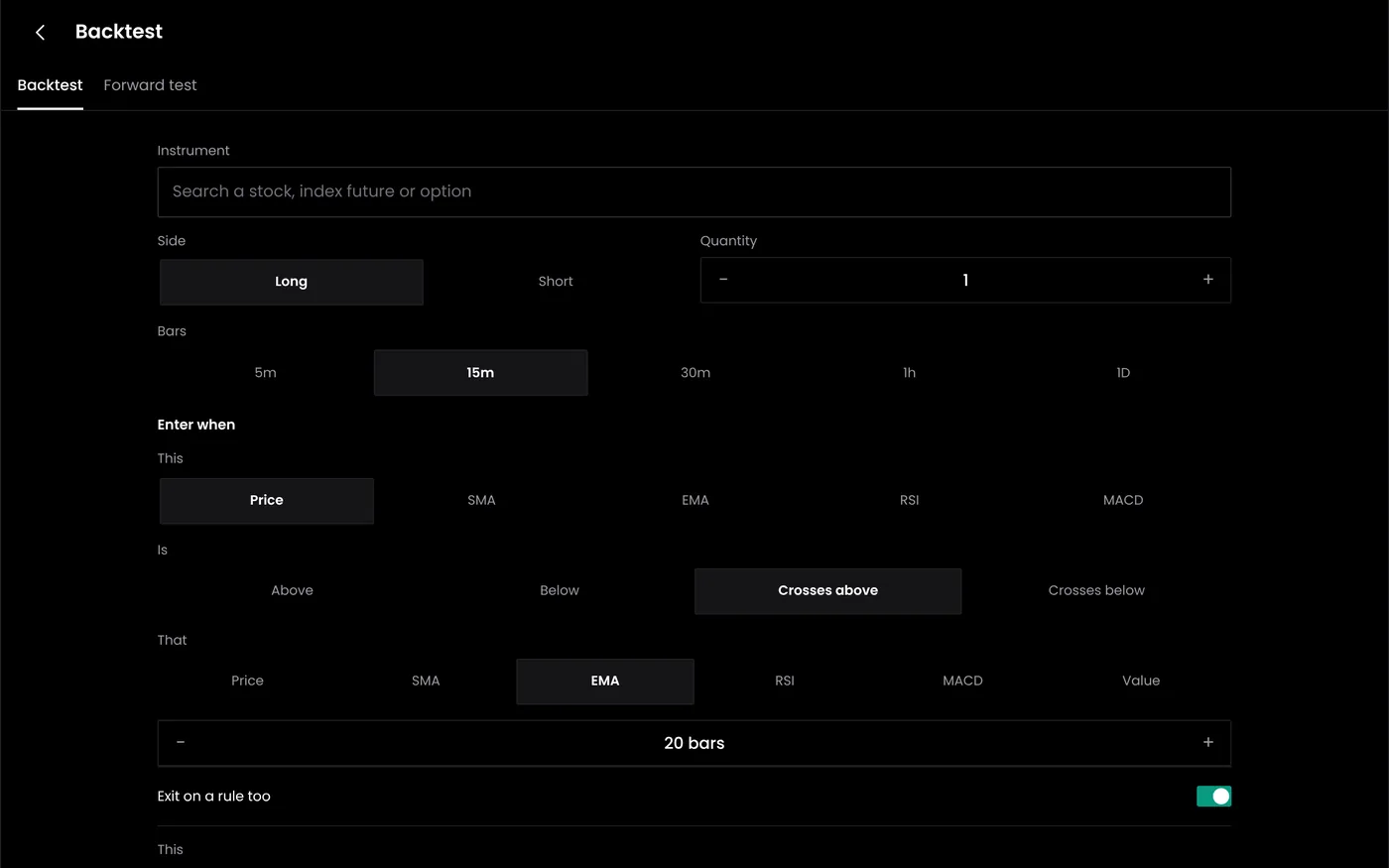
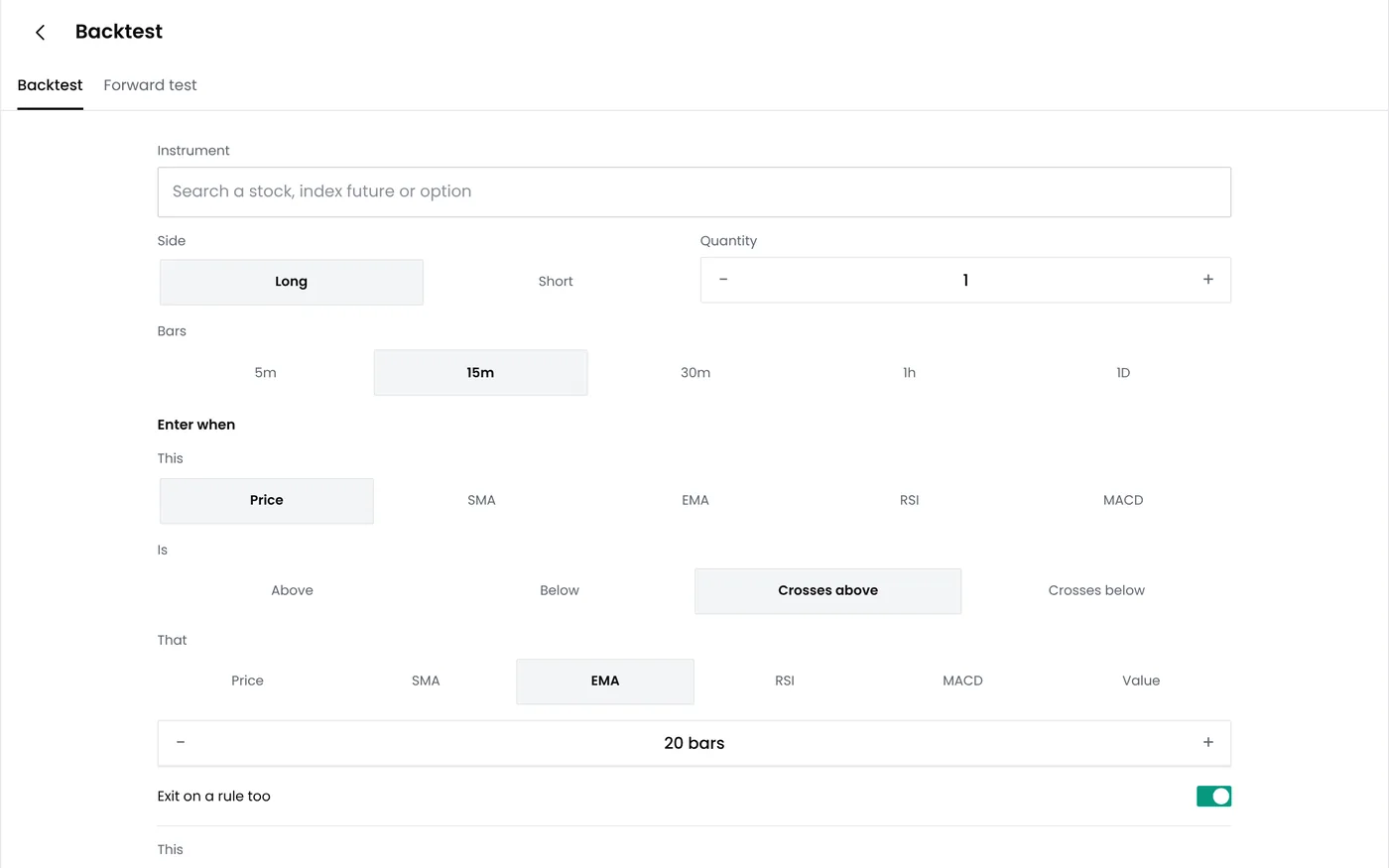
Look for settings that hold across neighbouring values, examine the worst expiry days one by one and test the final rules on a period you did not use to design them. Our guides on how to backtest trading strategies, avoiding overfitting and walk-forward testing explain each step, and the backtesting engine runs expiry-day rules over past expiries with costs included.
Setting up an expiry-day strategy in QuantPower
Expiry-day rules suit automation: the entries are timed, the stops must fire without hesitation and the time exit must happen even when the position looks fine. A sample rule set for the morning straddle:
| Rule | Example setting |
|---|---|
| Instrument | Nifty 50, current weekly expiry |
| Run on | Expiry days only |
| Entry | 9:20 am |
| Legs | Sell 1 lot ATM call and 1 lot ATM put |
| Stop loss | 40% above each leg's entry premium |
| Combined stop | 50% of the credit |
| Re-entry | None |
| Time exit | Square off everything at 3:05 pm |
| Skip days | RBI policy, Union Budget and other event days |
| Daily limit | Your MTM loss limit for the account |
Step 1. Build the strategy
In the strategy builder, choose the short straddle template, set the index to Nifty 50 and the expiry to the current week, and set the strategy to run on expiry days only. Set lots to 1.
Step 2. Set the entry and exits
Enter the 9:20 am entry, the 40% per-leg stops, the combined stop and the 3:05 pm time exit, then add the event-day filter.
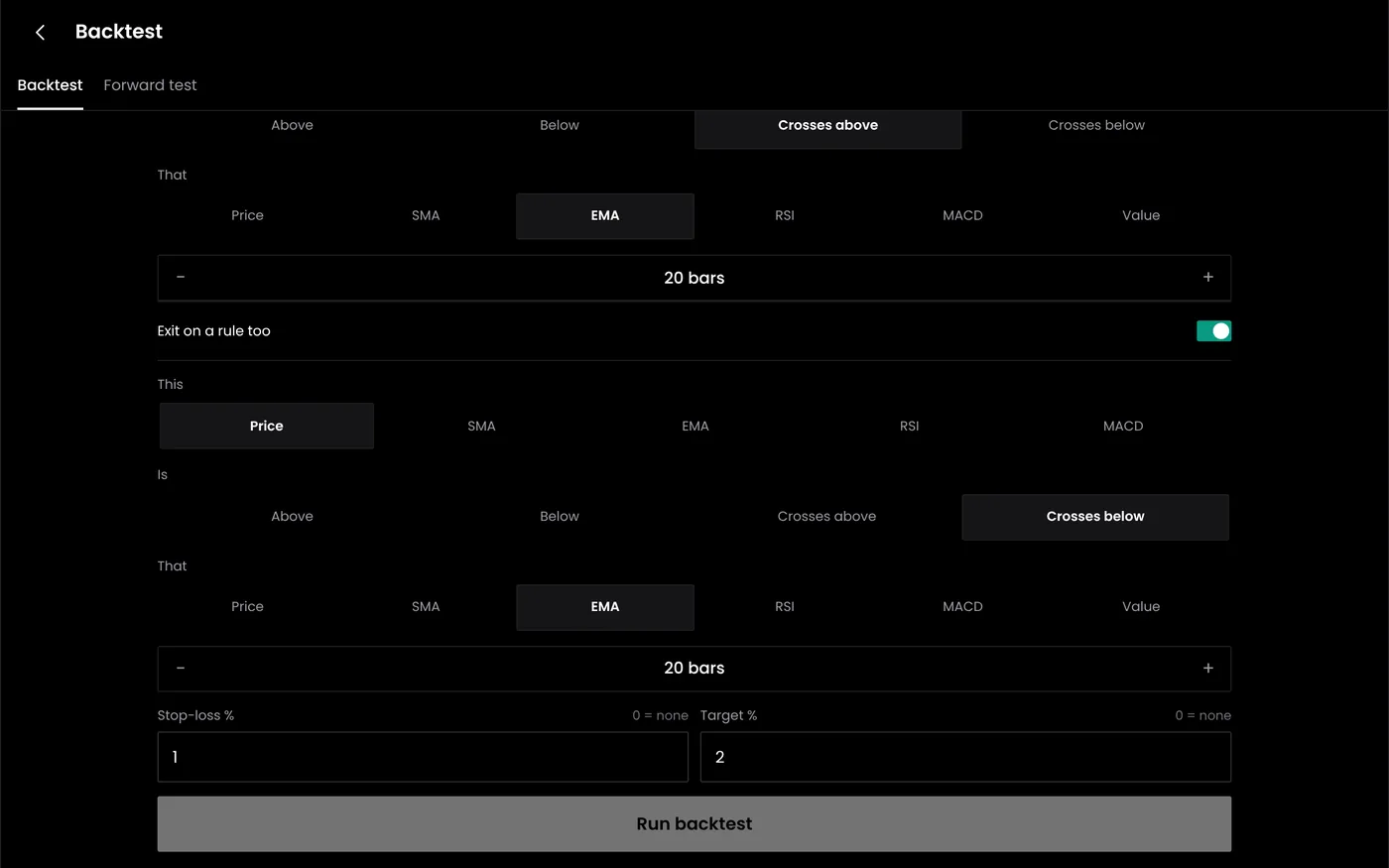
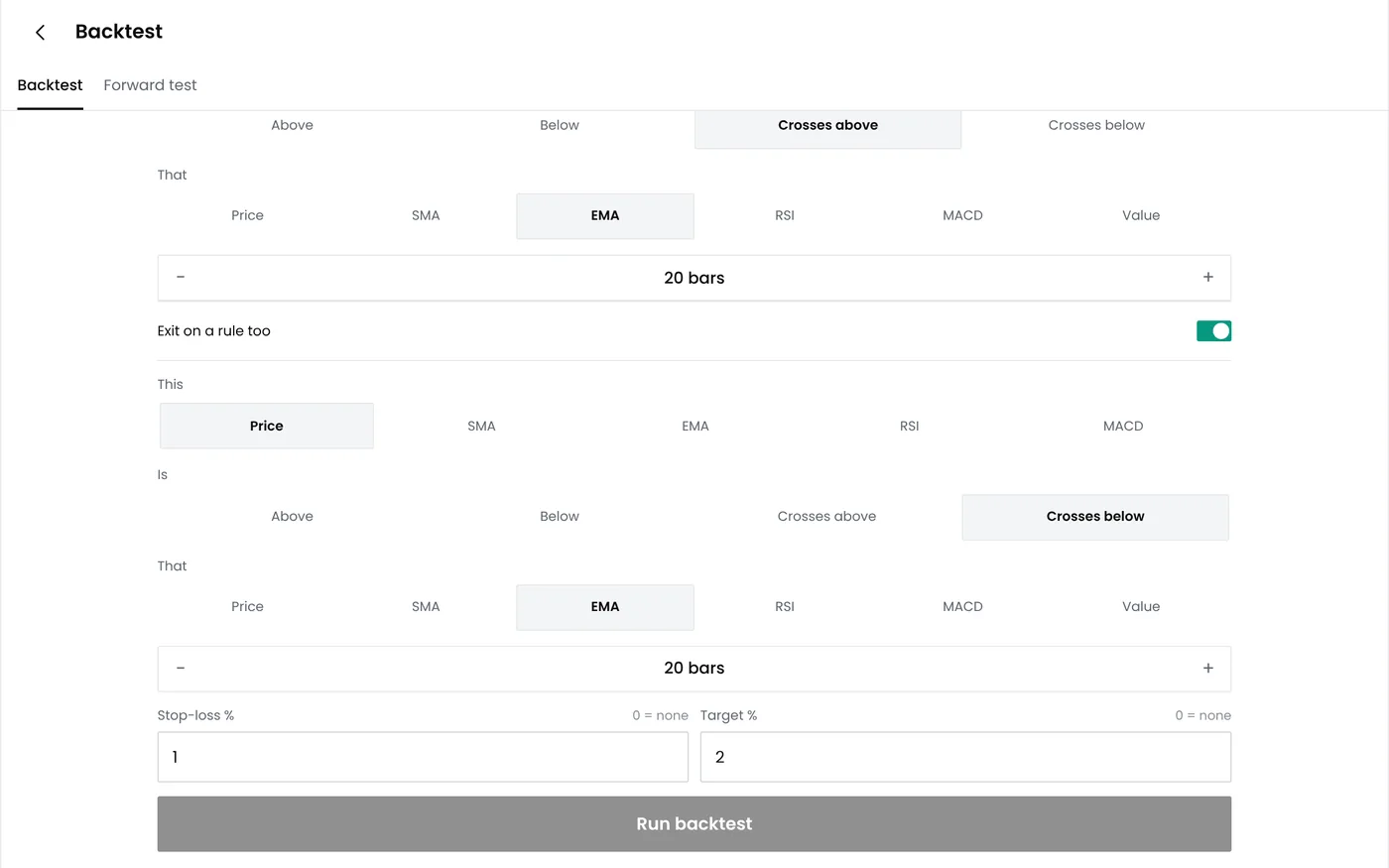
Step 3. Backtest it
Run the rules over past expiry days with costs and slippage on, then change one setting at a time: the entry time, the stop level, the combined stop.
Step 4. Paper trade it
Run the strategy on live prices with virtual money for several expiry days and compare the fills with the backtest.
Step 5. Set the account limit
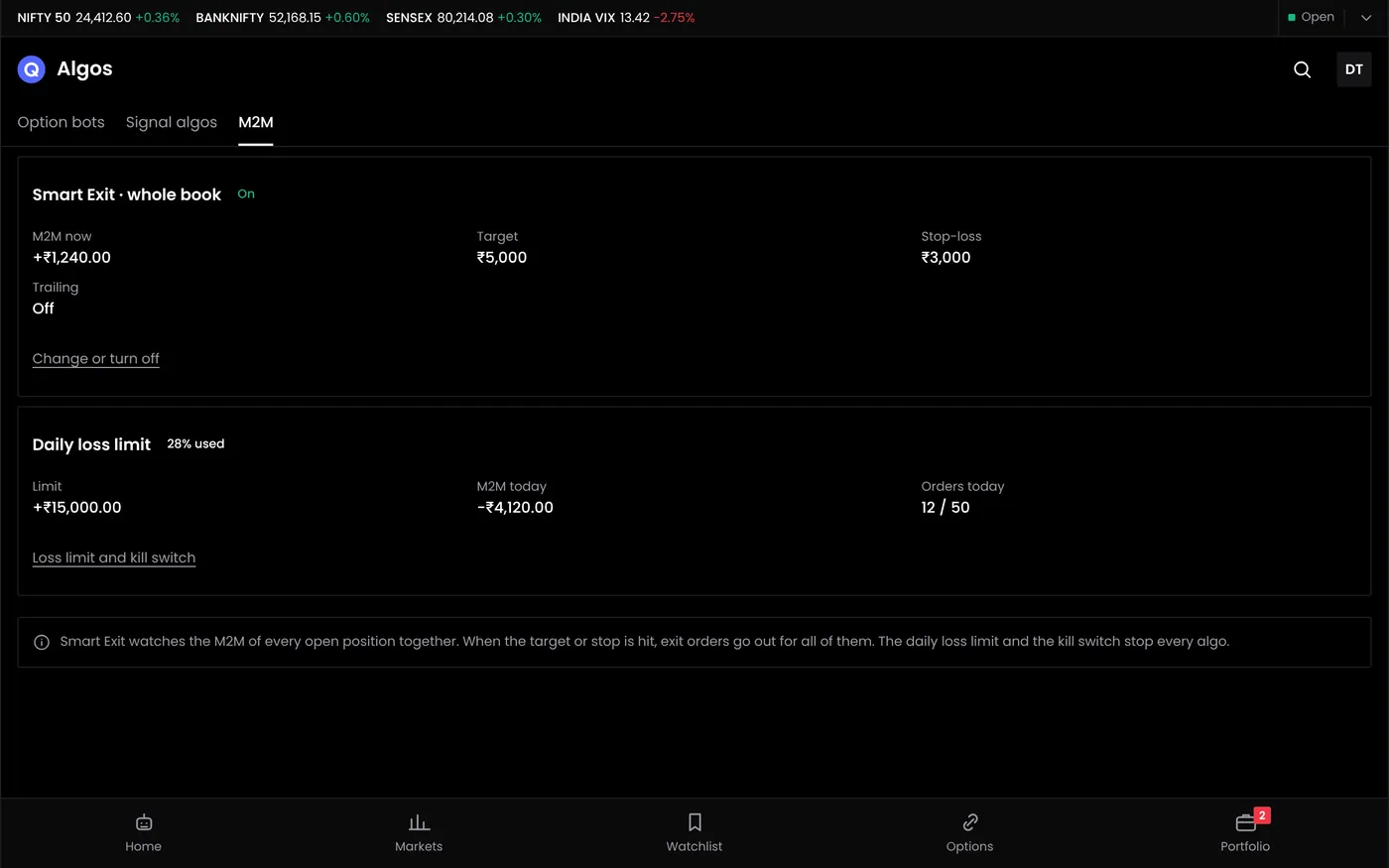
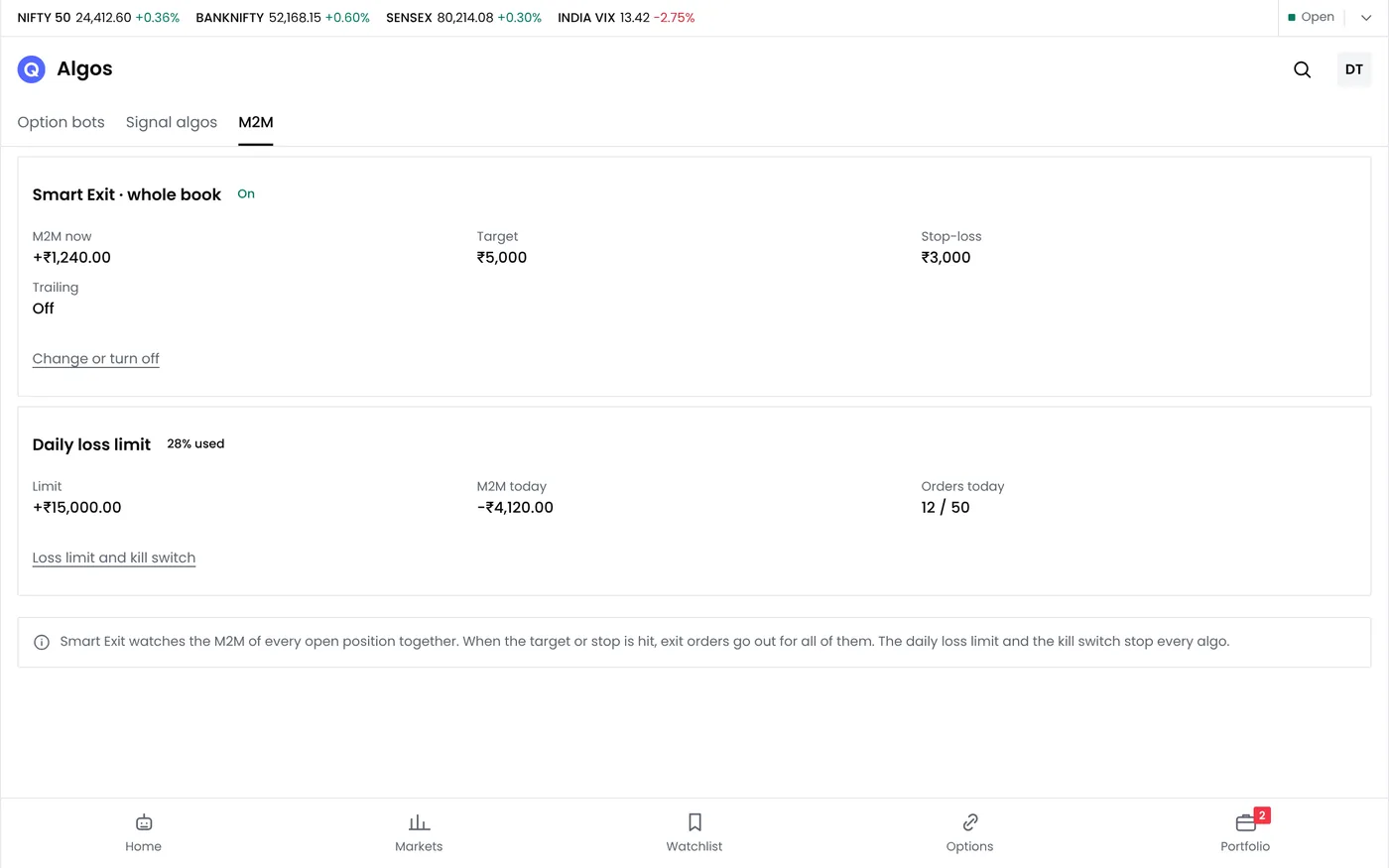
Before anything goes live, set your daily MTM loss limit in the risk settings. The limit squares off every position when it is hit.
Step 6. Deploy the bot
Connect your broker, choose the strategy and lots, check the expiry-day margin, including the extra 2%, and deploy. The bot enters at 9:20 am on expiry days and manages the exits on its own.
Step 7. Monitor and pause
Watch the positions through the session, and use Pause all if you need to stop every bot at once. The bot runs on your own account with a broker connection verified for your release. Ready-made strategy templates, such as straddles and iron flies, load into the strategy builder; you edit and run them as your own strategy.
Orders use the broker-hosted or client-static-IP connection confirmed for your account. Broker-hosted clients do not need their own static IP.
Common expiry-day mistakes
- Buying far out-of-the-money options because they are cheap. Most of them expire worthless.
- Selling without stops because "they will expire worthless". The day they do not can cost a month of premium.
- Averaging down on a losing option in the final hours.
- Trading larger size on expiry day to make up for the small premium.
- Forgetting the extra margin, and finding the position short of margin in the morning.
- Holding into the closing auction without meaning to, or keeping an old 3:30 pm exit time.
- Running the same strategy on Nifty and Sensex and treating them as separate risks.
- Judging a strategy on a few expiries. A good month proves little.
Pre-trade checklist
- No scheduled event falls during the session, in India or abroad.
- You know the strikes with the largest open interest and where the index stands relative to them.
- The most you can lose if every stop fills badly is within your daily limit.
- The time exit is set before 3:15 pm.
- Your size is smaller than on other days.
- Margin for expiry day, including the extra 2% on each short leg, is available with room to spare.
- You know what happens to any position left open at the close.
- The rules have been backtested on past expiries with costs and paper traded.
For sizing rules, read options risk management and try the position size calculator.
Start your free trial
Connect your broker, build a strategy and test it on paper before a single live order goes out.
Frequently asked questions
What is hero zero in option trading?
Buying cheap out-of-the-money options on expiry day in the hope of a large move. The option either rises many times in value or expires worthless, and it expires worthless most of the time. In the model, a 25,300 call bought at 9:20 am with Nifty at 25,000 has about a 5% chance of finishing in the money.
Is expiry-day trading profitable?
For most individual traders, no. SEBI's FY26 study found that 87.7% of individual traders in equity derivatives made net losses, and that about 59% of index options turnover was in contracts on their expiry day. Any strategy can be tested on its own rules, but we do not publish returns, and nothing here is a performance claim.
Why do options lose value so fast on expiry day?
Because all remaining time value must reach zero by the close. With only hours left, each hour removes a large share of what remains. In the model, the at-the-money straddle loses about a quarter of its value by noon and most of the rest in the afternoon.
How much extra margin do I need on expiry day?
Short index options expiring that day carry an extra 2% of contract value, about ₹32,500 per lot of Nifty at 25,000. A straddle or iron fly has two short legs, so it needs about ₹65,000 more. Positions in the expiring contract also lose any calendar spread benefit that day.
What time do options stop trading on expiry day?
Since 3 August 2026, index and stock F&O contracts trade until 3:40 pm. The settlement price comes from the closing auction of the index stocks, which runs from 3:15 pm to about 3:35 pm, so most expiry-day algos exit before 3:15 pm.
How is the settlement price decided?
Index options settle at the index's official closing value on expiry day. Since 3 August 2026 that value is built from the closing auction prices of the index stocks, not from the earlier last-30-minute average. Options settle in cash at their intrinsic value against it.
What happens if I hold an option until expiry?
It settles in cash at its intrinsic value. An in-the-money option pays the difference between the settlement price and the strike, and the buyer pays STT of 0.15% on that value. Out-of-the-money options expire worthless. A short option that ends in the money is settled against the seller.
Should I buy or sell options on expiry day?
Neither is better in general. Sellers win more often and lose more when they lose; buyers lose small amounts often and win large amounts rarely. Traders who use expiry day usually keep size small, prefer defined risk such as an iron fly or a debit spread, and exit before the auction.
Related guides and terms
- Short straddle strategy and iron fly strategy
- Iron condor strategy and short strangle strategy
- Option buying strategies and opening range breakout strategy
- Nifty option trading and Sensex option trading
- Nifty expiry date and expiry day volume analysis
- How to place stop loss order and trailing stop loss
- Option greeks and option chain
- Glossary: Expiry meaning, premium meaning, theta meaning, gamma meaning, max pain meaning, ITM ATM OTM meaning, what is margin in trading
- Scalping in option trading
- F&O margin calculator
Sources
- SEBI, Profitability of Individual Traders in the Equity Derivatives Segment (FY25–FY26), PR No. 50/2026, 20 August 2026
- SEBI circular SEBI/HO/MRD/TPD-1/P/CIR/2024/132: Measures to strengthen the equity index derivatives framework, 1 Oct 2024 (additional 2% ELM on expiry day from 20 Nov 2024; no calendar spread benefit on expiry day and upfront premium from 1 Feb 2025)
- NSE circular of 30 May 2026: equity derivatives close moved to 3:40 pm from 3 August 2026, alongside the Closing Auction Session in the cash market
- NSE: Settlement price (index options settle on the closing price of the underlying index)
- NSE: Equity derivatives contract specifications (lot sizes and expiry days)
- Finance Act, 2026: STT of 0.15% on the sale of options and on exercised options from 1 April 2026
- Black, F. and Scholes, M. (1973). The Pricing of Options and Corporate Liabilities. Journal of Political Economy, 81(3), 637–654