
This guide covers intraday trading as a whole: what it is and how it differs from holding positions, the trading day hour by hour, product types, margin and leverage, what one trade costs, how a rule-based intraday day is run, position sizing, stops and daily limits, which instruments and stocks suit it, tax, SEBI's rules, and what the regulator's data says about who makes money.
Intraday trading at a glance
| Feature | What it means |
|---|---|
| Definition | A position opened and closed in the same session; nothing is held overnight |
| Product type | Intraday or MIS at the broker; squared off automatically if still open near the close |
| Instruments | NSE and BSE shares, index and stock futures, index and stock options, MCX commodities |
| Hours | Equity 9:15 am to 3:30 pm; F&O to 3:40 pm; a pre-open session from 9:00 to 9:08 |
| Leverage | Up to five times on most shares (20% margin); none on F&O beyond the normal margin |
| Short selling | Allowed in shares intraday; the position must be bought back the same day |
| Charges on shares | STT of 0.025% on the sell value, plus brokerage, exchange charges, stamp duty and GST |
| Tax | Speculative business income for intraday shares; non-speculative for F&O |
| Square-off | By the broker from about 3:10 pm, at market price, with a fee; earlier for stocks in F&O |
| SEBI's finding | 71% of individual intraday traders in shares lost money in FY23; 80% of those trading more than 500 times a year |
Key takeaways
- Intraday positions use a separate product type with lower margin for shares, and the broker closes anything still open near the end of the day.
- Leverage is capped by SEBI's margin rules: at least 20% of the trade value for shares, and the full SPAN and exposure margin for futures and options.
- Costs decide intraday results. At ₹20 brokerage per order, a round trip in 500 shares of a ₹1,000 stock costs about ₹224 and one lot of Nifty futures about ₹966, before the spread.
- Size from the stop, not the leverage. Risking 1% of ₹5 lakh with a ₹10 stop means 500 shares, whatever the margin allows.
- Since 3 August 2026, stocks with F&O contracts stop continuous trading at 3:15 pm and close through an auction, so time exits and broker square-offs have moved earlier.
- Most individual intraday traders lose: 71% in FY23 in SEBI's study of the equity cash segment, and loss-makers spent an extra 57% of their losses on charges.
What is intraday trading?
An intraday trade starts and ends in the same session. A trader buys 500 shares at 9:45 am and sells them at 1:20 pm; or sells Nifty futures at 10:05 am and buys them back at 2:50 pm; or buys a Nifty call at 9:35 am and sells it at 11:10 am. In each case the position is flat by the close, there is no overnight exposure, and the result is known the same evening.
That distinguishes it from delivery trading, where shares are bought and held in the demat account, and from swing or positional trading, where a futures or options position is carried for days or weeks under full margin. The difference is not only the holding period. Intraday trades are placed under a product type that brokers call Intraday or MIS, which carries lower margin for shares and an automatic square-off; they pay a lower rate of securities transaction tax on shares; and their profits are taxed under a different head. Shares can also be sold short intraday, which is not possible in delivery.
Intraday traders work with small moves. A liquid large-cap stock moves about 1% to 2% between its high and low on an ordinary day, and Nifty's model one-standard-deviation move over a day is about 183 points with implied volatility at 14%, or 0.7%. The trader's task is to capture part of such a move more often than not, after charges, with a loss on each failed attempt that is small and fixed in advance. Everything that follows, from leverage to the time exit, serves that task.
The trading day on NSE
| Time | What happens |
|---|---|
| 9:00 to 9:08 am | Pre-open session: orders are collected and matched to set each stock's opening price; order entry closes at a random moment in the last minute |
| 9:15 am | Normal market opens for shares and F&O |
| 9:15 to 9:30 am | Opening range: the heaviest volume and widest swings of the day as overnight news is priced in |
| 11:00 am to 1:30 pm | Usually the quietest hours, with the narrowest ranges and thinnest volume |
| 2:30 pm onward | Volume picks up as intraday traders close positions and institutions place closing orders |
| 3:00 to 3:10 pm | Typical time exits for rule-based strategies, ahead of the broker's square-off |
| 3:10 pm onward | Brokers square off open intraday positions; the time differs by broker and segment |
| 3:15 pm | Continuous trading ends for stocks with F&O contracts; their closing auction runs to about 3:35 pm and sets the closing price |
| 3:30 pm | Other stocks close |
| 3:40 pm | Index and stock F&O contracts close |
| After the close | A closing session for shares at the closing price |

Volume through the day has a U shape. The first hour carries the overnight news and the most erratic prices; the middle of the day is thin and often range-bound; the last hour brings volume back as positions are closed. Most rule-based intraday strategies let the opening range form before entering, trade in the middle hours with the range as a reference, and are out before 3:10 pm. Market hours differ for commodities on MCX, which trade until 11:30 or 11:55 pm depending on the season. Holidays follow the exchange calendar.
Product types: intraday vs carry forward
When you place an order, you choose a product type that tells the broker how long you intend to hold.
| Product | Common names | Position at the close | Margin |
|---|---|---|---|
| Intraday | MIS, Intraday | Squared off by the broker if still open | Lower for shares, at least 20% of the value; the same SPAN and exposure margin for F&O |
| Delivery | CNC | Shares are delivered to the demat account | Full value |
| Carry forward | NRML | Carried to the next day | Full margin |
If you want to keep an intraday position, convert it to delivery or carry forward before the square-off time, provided you have the full margin or the full value in the account. Brokers charge a fee for each position they square off, and the square-off happens at market price, which may be far from where you wanted to exit. A short sale in shares must be bought back the same day: a short position carried into delivery fails, and the exchange buys the shares in an auction at the seller's cost, with a penalty on top. The glossary entry on square off covers the mechanics.
Margin and leverage for intraday trades
Since September 2021, brokers must collect the full margin upfront for every trade, and the exchanges check margins at several random times during the day under SEBI's peak margin rules. The practical limits are:
- Shares: at least 20% of the trade value, the exchange's VaR and ELM margin, so leverage of up to five times. Brokers may require more for volatile stocks, and 100% for stocks under surveillance.
- Futures and options selling: the same SPAN and exposure margin as for an overnight position. There is no intraday discount on F&O margin.
- Option buying: the full premium.
A penalty applies if the margin in the account is short of the requirement at any of the exchange's snapshots, so an intraday position cannot be larger than the margin in the account supports at the moment it is open.
Leverage magnifies both sides. Five times leverage turns a 1% move into 5% of the margin, and a 4% move, which a volatile stock can make in an hour, into 20%. The F&O margin calculator shows the requirement for any position before you place it, and the leverage entry explains the arithmetic.
What one intraday trade costs
Every intraday trade pays brokerage, securities transaction tax (STT), exchange transaction charges, the SEBI turnover fee, stamp duty on the buy side and GST on brokerage and exchange charges, plus the bid-ask spread. The table shows the charges on three round trips at ₹20 brokerage per order, with the rates in force from 1 April 2026.
| Round trip | Trade value each side | Gross profit | Charges | Net profit |
|---|---|---|---|---|
| 100 shares of a ₹1,000 stock, sold at ₹1,010 | ₹1,00,000 | ₹1,000 | ₹83 | ₹917 |
| 500 shares of a ₹1,000 stock, sold at ₹1,010 | ₹5,00,000 | ₹5,000 | ₹225 | ₹4,775 |
| One lot of Nifty futures, 25,000 to 25,050 | ₹16.25 lakh | ₹3,250 | ₹968 | ₹2,282 |
| One lot of the Nifty 25,000 call, ₹280.50 to ₹300 | ₹18,233 | ₹1,268 | ₹93 | ₹1,175 |
Three things follow from the table:
- Shares are cheap to trade intraday, in proportion. STT at 0.025% of the sell value is the largest charge; brokerage is capped at ₹20 an order at most brokers, so the 500-share trade pays about 0.045% of its value in charges and the 100-share trade about 0.083%.
- Futures carry a heavy STT. At 0.05% of the sell value, STT alone on one Nifty lot is about ₹814, and a scratch trade costs ₹966, about 15 index points. A futures trade needs a bigger move than a share trade to clear its costs.
- Options pay charges on the premium, so the rupee cost is small, about ₹90 for a round trip on one lot, but it is about 0.5% of the premium, and the spread on an option is wider than on a liquid share.
Charges are a larger share of profit for intraday trades than for longer holds, because the move captured is smaller; a strategy that trades ten times a day in shares spends over ₹2,000 a day on charges before the spread. Run any planned trade through the brokerage calculator before relying on a strategy's gross return, and see options vs intraday trading for a side-by-side comparison of costs, capital and risk between the two.
How to do intraday trading with written rules
Intraday trading by hand demands attention for six hours and quick decisions under pressure, which is where most of the losses in SEBI's data come from. Anyone asking how to do intraday trading in a way that can be checked and improved ends up at the same answer: a written set of rules, tested on past data, then followed every day or run by software. The rules cover seven things.
- Before the market. Check funds and margin, the day's events, the stocks or contracts on the watchlist and whether any of them is under a ban or surveillance measure. If strategies run automatically, confirm the broker session and that each strategy is scheduled.
- The entry. A condition and a time window: for example, a break above the first 30 minutes' high with volume above average, valid from 9:45 am to 2:30 pm. An entry rule says what to buy or sell, at what price and when, and is silent otherwise.
- The size. Fixed by the loss at the stop as a share of capital, such as 1%, not by the margin available. The next section works through it.
- The stop loss and the target. Placed as exchange orders as soon as the entry fills. A trailing stop loss can lock in gains as the trade moves.
- The daily loss limit. An MTM limit, set as in how to place stop loss order, that closes everything if the day's loss reaches a set amount, such as 2% of capital, and stops new entries for the day.
- The time exit. Close all intraday positions by a fixed time, such as 3:05 pm, before the broker's square-off and before stocks in F&O leave continuous trading at 3:15 pm.
- After the close. Record every trade against the plan in a trade journal: the fills, the slippage, whether each rule was followed, and anything the rules did not anticipate.
A rule set with those seven parts can be backtested, paper traded and then automated, so that the trader's remaining job is to review and refine it. The strategies that fit this shape are the ones linked under approaches below; which to choose depends on the instrument, the time available and the capital.
Position sizing by the stop
Size is the one decision a trader controls completely, and intraday traders most often get it wrong by sizing to the leverage on offer. The rule is to work backwards from the loss you are willing to take on one trade.
If the stop has to be ₹20 away, because the stock is more volatile or the setup needs room, the size halves to 250 shares. If the margin needed for the size exceeds what the account holds, the trade is too big for the account at that stop, and the answer is a smaller size or a different stock, not a tighter stop that the price will hit by noise. A second limit sits above the per-trade one: a daily limit of 2% means two full losses end the day. The position size calculator does the arithmetic for any capital, risk and stop.
Orders, stops and the daily limit
Intraday traders live by their orders. The main types are:
- Limit orders set the most you will pay or the least you will accept. They avoid paying the spread on entry, at the risk of not filling.
- Market orders fill at once at the best available prices, which can be poor in the first minutes or in a thin stock.
- Stop-loss orders become market or limit orders when a trigger price trades. They limit losses in normal conditions but cannot guarantee the fill price in a gap or a fast move.
- Cover and bracket orders, where the broker offers them, attach a mandatory stop, and for bracket orders a target, to the entry.
A stop belongs on the exchange from the moment the entry fills, not in the trader's head. The daily loss limit belongs in software: an MTM stop that squares off every position when the day's loss reaches the limit removes the decision from the moment it is hardest to make.
What to trade intraday
Not every stock suits intraday trading, and the choice of instrument decides the costs, the leverage and the risks.
- Liquidity first. A stock with a wide bid-ask spread charges you the spread on every entry and exit, and a stop in a thin stock can fill far from its trigger. Large-cap stocks and the F&O stocks are the usual universe; a stock scanner filters by volume and range.
- Circuit limits. Stocks without derivatives have daily price bands of 2%, 5%, 10% or 20%; a stock that hits its band cannot be exited until the other side appears. Stocks in F&O have no fixed daily band but a dynamic range that is widened in steps. The circuit limit entry explains both, and index-wide circuit breakers halt the whole market after a 10%, 15% or 20% move.
- Stocks excluded from intraday. Trade-to-trade stocks must be taken in delivery, and brokers usually give no intraday leverage on stocks under surveillance measures or in the F&O ban period.
- Index futures move with the index, have no time decay and are deeply liquid, but one lot is a large position with a margin of a few lakh rupees and a heavy STT.
- Options need less capital and cap the buyer's loss, but lose time value through the day, which is why intraday option strategies are usually fast; scalping in option trading is the fastest of them.
Intraday approaches
The strategies below are rule-based and run intraday.
- Opening range breakout: trade a break above or below the first 15 or 30 minutes' range.
- VWAP: buy pullbacks to the volume-weighted average price in an uptrend, or sell rallies to it in a downtrend. Our guide to the VWAP indicator for option trading sets out the main VWAP rules side by side.
- Momentum and volume breakouts: enter when price breaks a level on unusually high volume.
- Open high low: trade stocks whose open equals the day's low or high after the first candle.
- Gaps: trade the fill or the continuation of an opening gap.
- Mean reversion: fade moves that stretch far from an average, with tight stops.
- Expiry-day option selling: sell index options on the expiry day to collect fast time decay, with strict stop losses.
- Scalping: many small trades on short timeframes, which depends on low costs and fast execution.
Reference levels such as pivot points and the CPR are used across several of these as entry and exit markers.
Shares, futures or options for an intraday trader
| Shares | Index futures | Index options (buying) | |
|---|---|---|---|
| Capital for one position | 20% of the value: ₹1,00,000 controls ₹5,00,000 | A few lakh rupees of margin per lot | The premium: about ₹18,233 for one at-the-money Nifty lot |
| Moves | Point for point with the share | Point for point with the index: ₹65 a point on Nifty | Less than point for point, about ₹35 a point at the money, and falling with time |
| Time decay | None | None | Yes, all day |
| Worst case | The move against you, times the size; a gap can skip the stop | The move times ₹65 a lot, no limit | The premium |
| Charges on a round trip | About ₹225 on ₹5 lakh | About ₹966 a lot | About ₹90 a lot |
| Short side | Intraday short selling allowed | Sell a lot | Buy a put |
Shares suit traders who want a direct, low-cost exposure to one stock's move and have the margin for a useful size. Futures suit index traders with larger capital who want no time decay. Bought options suit index traders with less capital who accept time decay for a capped loss.
Tax on intraday trades
Profit from intraday trading in shares is treated as speculative business income and taxed at your slab rate. Losses from it can be set off only against speculative income and carried forward for four years. Profit from futures and options is non-speculative business income, also taxed at slab rate, with losses that can be set off against most other income and carried forward for eight years. Turnover for intraday shares is the sum of the absolute profits and losses on each trade, and a tax audit may be required above the thresholds in the Income-tax Act. Keep a trade-by-trade record; the contract notes and the broker's annual statement are the base for the return.
SEBI's rules that affect intraday traders
- Peak margin: full margin collected upfront, with intraday snapshots, so leverage on shares is capped at about five times and there is no intraday discount on F&O margin.
- Upfront collection of option premiums, since November 2024.
- Surveillance measures: stocks under additional or graded surveillance carry 100% margin and other restrictions, which most brokers pass on by withdrawing intraday leverage.
- Market-wide circuit breakers at 10%, 15% and 20% moves in the index, which halt trading for a period that depends on the time of day.
- Algorithmic trading: rule-based intraday trading through a broker's API falls under SEBI's framework for retail algorithmic trading, in full effect since 1 April 2026, with every automated order carrying an exchange-assigned Algo ID.
- Risk disclosure: brokers show a disclosure based on SEBI's studies, which found that most individual traders in F&O and most individual intraday traders in shares lose money.
What the data says
SEBI published a study of individual intraday traders in the equity cash segment in July 2024, covering FY19, FY22 and FY23 and a sample of about 86% of individual clients. Its findings:
- 71% of individual intraday traders made a net loss in FY23, up from 65% in FY19 and 69% in FY22. The average loss among loss-makers was ₹5,371.
- Among traders with more than 500 trades a year, 80% lost money. Among traders under 30, 76% lost money, and their share of all intraday traders had risen from 18% to 48%.
- Among traders with an annual turnover above ₹1 crore, 76% lost money, with an average loss of ₹74,575.
- Experience helped only partly: after three years of trading, 54% were still loss-makers.
- Loss-makers spent an additional 57% of their losses on trading costs; profit-makers spent 19% of their profits.
In equity derivatives, SEBI's study of FY26 found that 87.7% of individual traders made net losses, with options accounting for about 92% of the losses. Across both studies the same features separate the loss-makers: frequent trading, costs that eat the margin of profit, and no fixed limit on the loss per trade or per day.
Start your free trial
Connect your broker, build a strategy and test it on paper before a single live order goes out.
Running an intraday strategy in QuantPower
Every rule in the workflow above maps to a setting, so the strategy runs the same way every day.
Step 1. Write the rules in the strategy builder
In the strategy builder, choose the instrument, the product type and the time window, then add the entry condition, the stop, the target and the time exit. The builder shows the margin and, for options, the payoff before anything is saved.
Step 2. Backtest it on past sessions
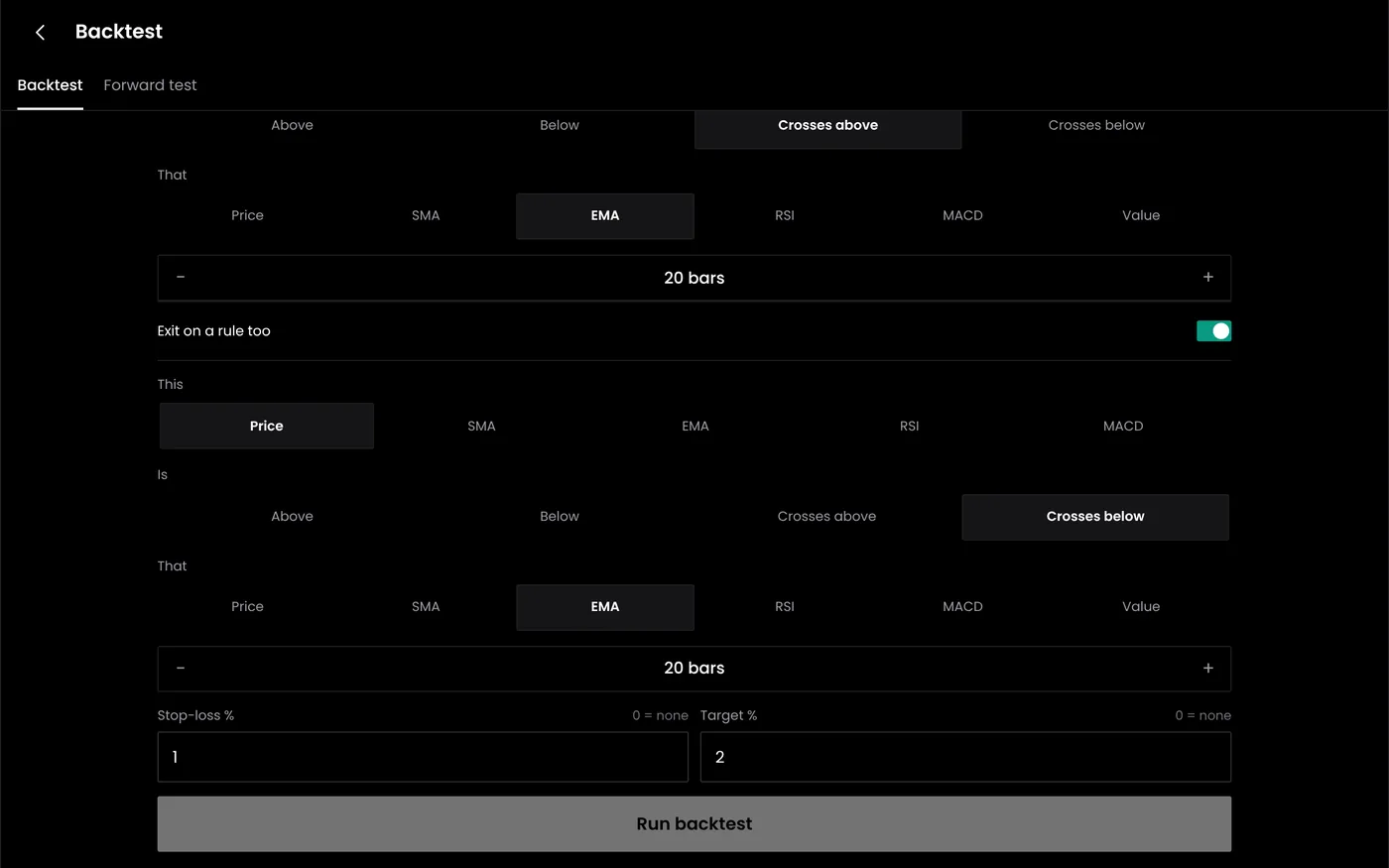
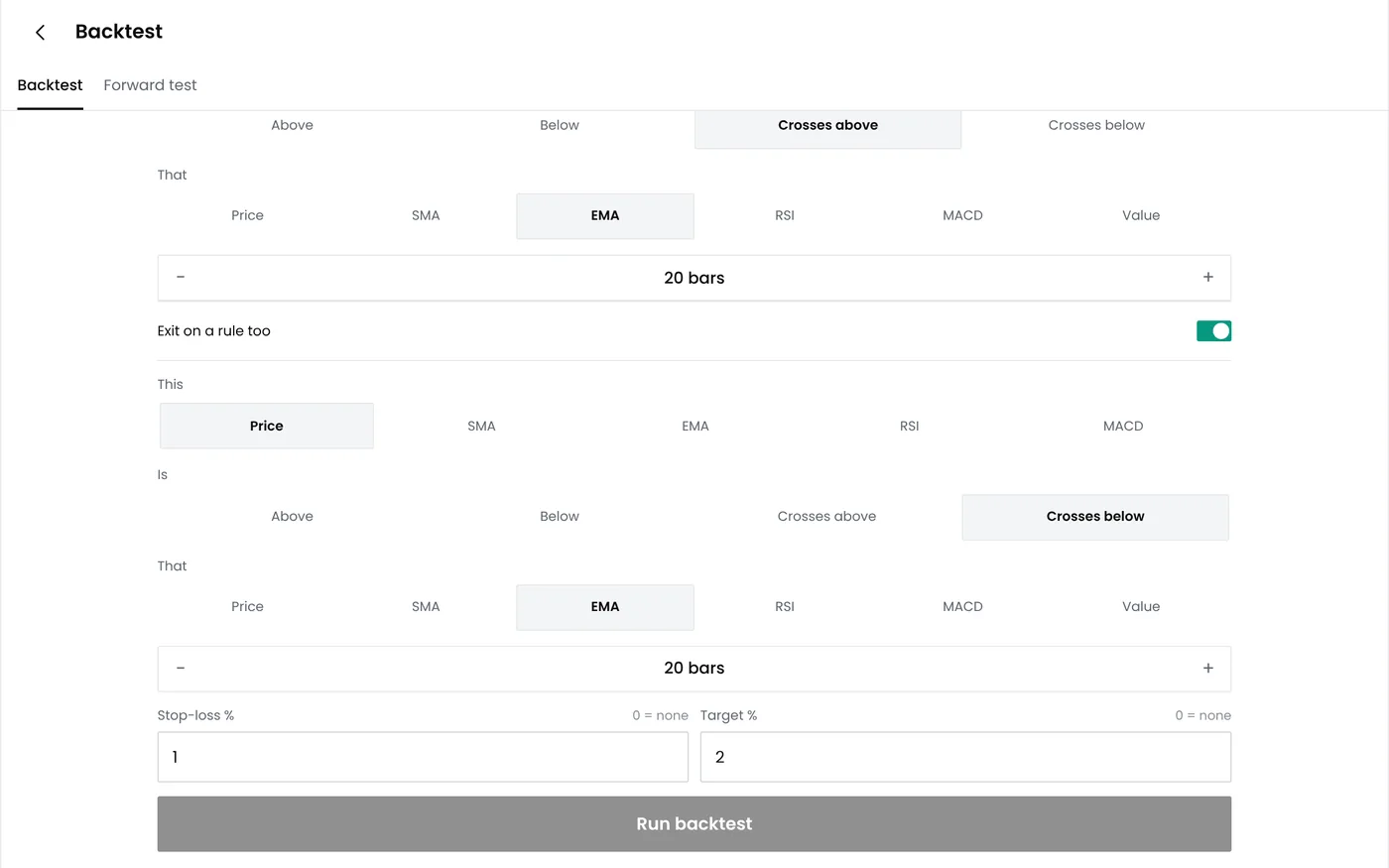
Run the rules over past days with charges and slippage switched on, and check the results by time of day: a rule that works in the first hour may lose money after lunch.
Step 3. Paper trade it
Run the strategy on live prices with virtual money for at least two weeks, and compare each fill with the backtest's assumption. Intraday fills in the first and last half hour can slip more than a model expects.
Step 4. Set the daily limit and deploy
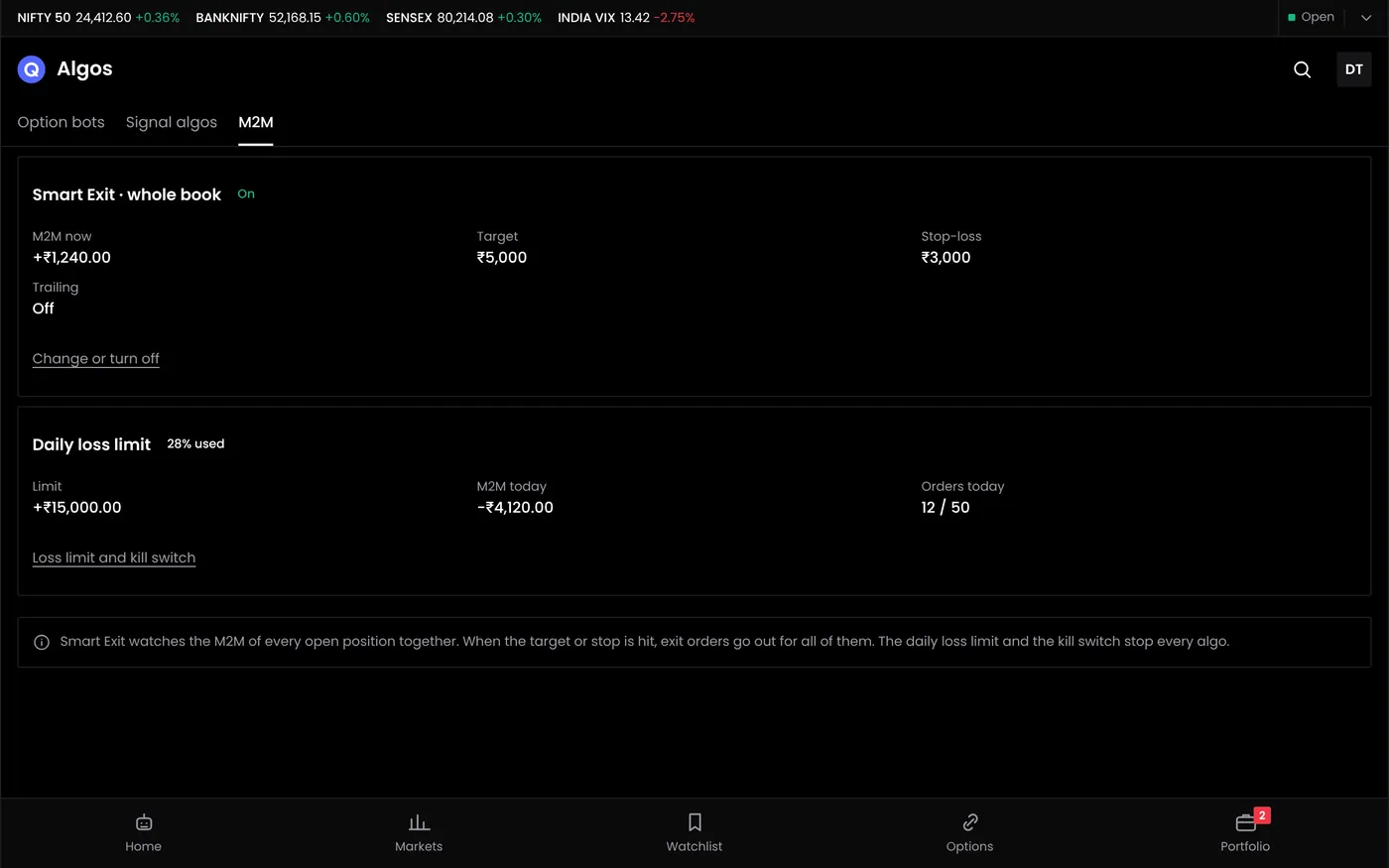
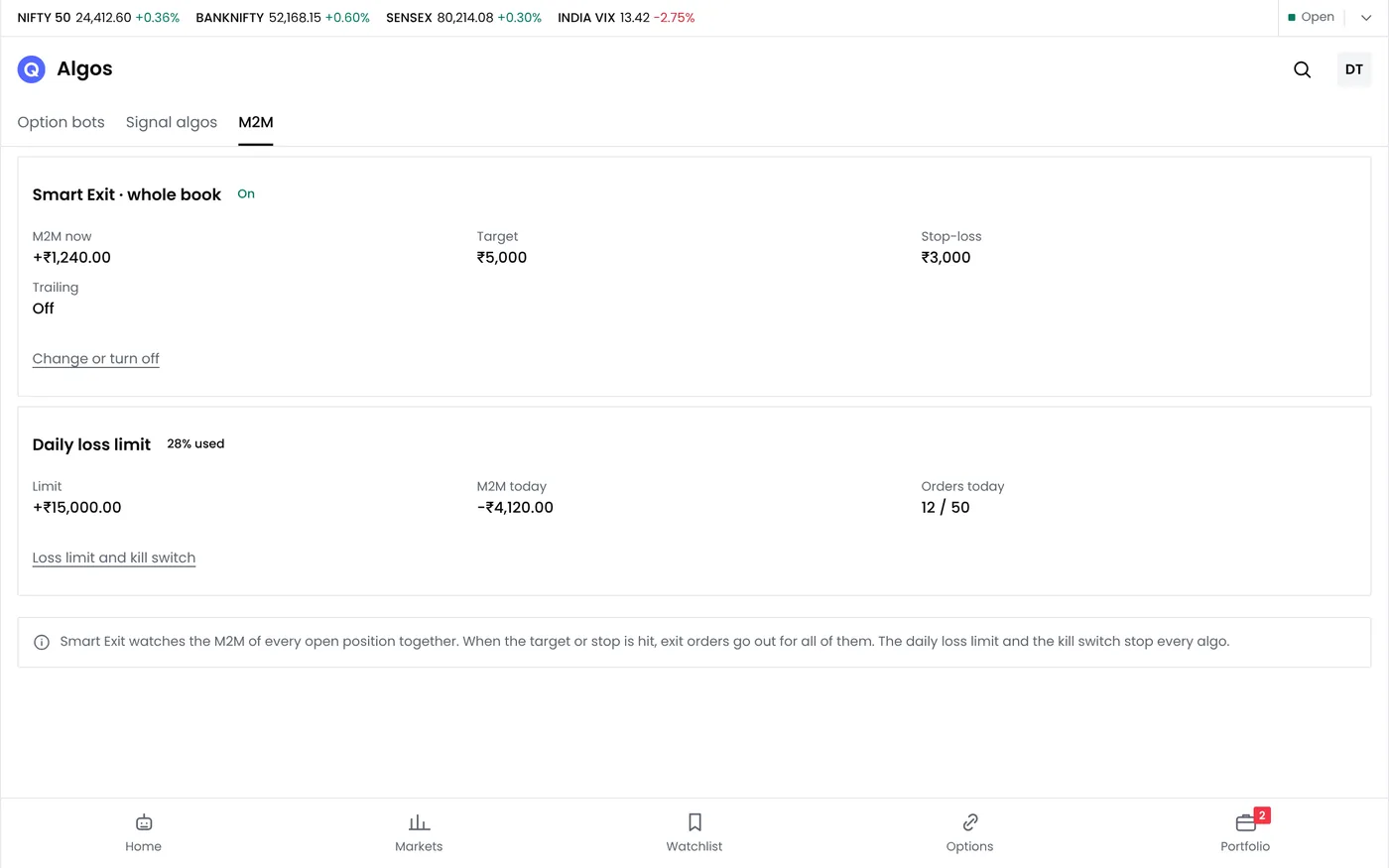
Set the daily MTM loss limit in the risk settings; it squares off every position when hit, including positions from other strategies. Then connect your broker, choose the size and deploy the strategy as an algo bot. The live trading terminal shows the orders and positions through the day, and a single Pause button stops every bot if the market does something the rules did not anticipate.
What intraday traders get wrong
- Trading the first five minutes. Spreads are wide and prices erratic. Most rule-based strategies wait for the opening range to form.
- Over-trading. More trades mean more costs. SEBI found 80% of very frequent traders losing; a strategy with three good setups a day beats one with fifteen marginal ones.
- Moving stops. A stop that is widened when the price approaches it is not a stop.
- Sizing by leverage. Five times leverage on shares means a 2% adverse move costs 10% of the margin. Size by the stop, not the margin.
- Ignoring the square-off. A position left open at 3:20 pm is closed at market price with a fee, and a stock in F&O cannot be traded continuously after 3:15 pm.
- Averaging a loser. Adding to a losing intraday position turns a planned small loss into an unplanned large one, with the clock against it.
- Chasing the day's loss back. The daily limit exists for the hour after a bad trade, when the urge to recover is strongest.
- Judging a strategy on a week. Intraday results are noisy; a strategy needs months of trades before its edge, if any, shows through the costs.
Pre-trade checklist
- The stock or contract is liquid, not in a ban period or under a surveillance measure, and is allowed for intraday at your broker.
- You know the margin the position needs and the leverage you are using.
- The size comes from the stop and your risk per trade, not from the margin available.
- The stop and the target are placed as exchange orders the moment the entry fills.
- The daily loss limit is set, and you will stop for the day when it is hit.
- The time exit is before your broker's square-off and before 3:15 pm for stocks in F&O.
- You know the charges on the round trip and the move needed to break even.
- The trade follows a written rule that has been tested, not a tip or a feeling.
Frequently asked questions
What are the market hours for intraday trading in India?
Shares trade from 9:15 am to 3:30 pm and F&O from 9:15 am to 3:40 pm, with a pre-open session from 9:00 to 9:08 am. Since 3 August 2026, stocks with F&O contracts stop continuous trading at 3:15 pm and close through an auction. Brokers square off intraday positions from about 3:10 pm, depending on the segment.
How much money do I need to start intraday trading?
Enough to hold the intended position with full margin and to absorb a run of losses. For shares, 20% of the trade value plus a buffer: ₹20,000 of margin holds ₹1,00,000 of shares. For one lot of Nifty futures, a few lakh rupees of margin. For a bought option, the premium plus a buffer. The useful question is how much you can risk per trade: at 1%, ₹1,00,000 of capital allows a ₹1,000 loss per trade.
Is intraday trading taxed differently?
Yes. Intraday profit in shares is speculative business income, with losses that can be set off only against speculative income and carried forward for four years. F&O profit is non-speculative business income, with losses carried forward for eight years. Both are taxed at your slab rate.
What happens if I forget to close an intraday position?
Your broker closes it at market price during its square-off window, usually from about 3:10 pm, and charges a square-off fee. A short position in shares that is not bought back the same day goes to auction, with a penalty.
Can I convert an intraday position to delivery?
Yes, before the square-off time, if the account holds the full value of the shares or the full margin for an F&O position. Brokers let you change the product type from the positions screen. A short sale in shares cannot be converted to delivery.
Is intraday trading allowed in all stocks?
No. Trade-to-trade stocks must be taken in delivery, stocks under surveillance measures carry 100% margin and usually no intraday leverage, and brokers may block intraday trading in illiquid stocks and in stocks in the F&O ban period. Liquid large-cap and F&O stocks are the usual universe.
Can I automate intraday trading?
Yes, through a SEBI-compliant platform connected to your broker. Under the framework for retail algorithmic trading, in full effect since 1 April 2026, each automated order runs through your own broker account, under the broker's controls. Entry rules, stops, the daily limit and the time exit are exact settings, which is what automation needs. Our guide to algo trading explains how it works.
Related guides and terms
- Options vs intraday trading, options trading and futures basics
- VWAP indicator for option trading, opening range breakout strategy, momentum breakout strategy, open high low strategy and gap trading strategy
- Scalping in option trading, RSI indicator strategy and hero zero option trading
- How to place stop loss order, trailing stop loss, order types and options risk management
- Tools: F&O margin calculator, brokerage calculator, position size calculator, Nifty pivot points, CPR calculator and stock scanner
- F&O taxation in India, SEBI rules for option trading and SEBI's F&O profitability studies
- Glossary: Square off meaning, leverage meaning, circuit limit meaning, bid ask spread meaning, slippage meaning, short selling meaning, liquidity meaning
Sources
- SEBI, Analysis of Intraday Trading by Individuals in Equity Cash Segment, PR No. 13/2024, 24 July 2024 (71% loss-makers in FY23, 80% among very frequent traders, 76% among traders under 30, costs of loss-makers)
- SEBI, Profitability of Individual Traders in the Equity Derivatives Segment (FY25–FY26), PR No. 50/2026, 20 August 2026
- SEBI circular SEBI/HO/MRD2/DCAP/CIR/P/2020/127: Peak margin reporting, 20 July 2020, in full effect from 1 September 2021
- SEBI circular SEBI/HO/MRD/TPD-1/P/CIR/2024/132: Measures to strengthen the equity index derivatives framework, 1 October 2024 (upfront collection of option premiums)
- SEBI circular on safer participation of retail investors in algorithmic trading, 4 February 2025, and the implementation timeline to 1 April 2026
- NSE circular of 30 May 2026 on the closing auction session and revised F&O trading hours from 3 August 2026
- Finance Act 2026: STT rates from 1 April 2026
- NSE: Market timings and holidays