
This guide explains how options work from the contract up: what a call and a put give their buyer and their seller, the parts of a contract and how to read a quote, what a premium is made of, what moves it, the payoff for each side, what the price implies about the odds, how options settle in India, and where margin, charges, tax and SEBI's rules come in. Every figure is a model price for Nifty at 25,000 with 12 days to expiry, implied volatility of 14% and a lot of 65, so the examples can be compared with each other.
Options trading at a glance
| Feature | What it means |
|---|---|
| The contract | A right to buy (call) or sell (put) an underlying at the strike price, until expiry |
| Who is involved | A buyer, who pays the premium and holds the right; a seller, who receives it and takes the obligation |
| Underlyings in India | Nifty 50, Bank Nifty, FinNifty, Sensex and about 200 NSE stocks |
| Price | The premium, quoted per unit and paid for whole lots: ₹280.50 × 65 = ₹18,233 for one at-the-money Nifty call |
| Style | European: exercised only at expiry, never early |
| Settlement | Index options in cash; stock options by delivery of shares if they finish in the money |
| Expiries | Weekly on Nifty (Tuesday) and Sensex (Thursday); monthly on Bank Nifty, FinNifty and stocks |
| Buyer's worst case | The premium |
| Seller's worst case | Far larger than the premium; no limit for a sold call |
| Capital | The premium for buyers; margin for sellers, often ₹1 lakh or more per lot of a sold Nifty option |
| Hours | 9:15 am to 3:40 pm for index and stock derivatives, since 3 August 2026 |
Key takeaways
- A call gains when the underlying rises, a put when it falls. The buyer pays for the right; the seller is paid for taking the other side.
- A premium has two parts. The 24,750 call at ₹431.51 holds ₹250 of intrinsic value, because Nifty is 250 points above its strike, and ₹181.51 of time value, which will be zero at expiry.
- Finishing in the money is not the same as making money. The 25,000 call bought at ₹280.50 loses ₹6,533 a lot if Nifty settles at 25,180; it needs 25,280.50 to break even.
- The premium implies the odds. In the model the 25,000 call has a 50% chance of finishing in the money and a 33% chance of finishing above its break-even; the market's one-standard-deviation move over 12 days is about 635 points.
- Options magnify moves. A 1% rise in Nifty lifts the at-the-money call about 55%; a 1% fall cuts it about 41%, and a day of no movement costs it about ₹850 a lot.
- Most individual traders lose. SEBI found that 87.7% of individual traders in equity derivatives made net losses in FY26, and options accounted for about 92% of the losses.
What an option is
An option is a derivative: its price depends on the price of something else, called the underlying. Where a share is a piece of a company and a future is a firm commitment to buy or sell at a set price, an option is a choice. The buyer pays a price, the premium, for the right to buy or sell the underlying at a fixed level, the strike price, at a fixed time, the expiry. If using that right would pay, the buyer uses it; if it would not, the buyer lets it lapse and loses only the premium.
The nearest everyday comparison is insurance. A premium buys cover against a particular event for a particular period. If the event happens, the policy pays out; if it does not, the premium is spent. The seller of an option is in the insurer's position: paid upfront, and on the hook if the event occurs.
If you want the options trading meaning in a single sentence: it is the trading of rights, not of the shares or the index themselves. Nobody who buys a Nifty call owns any part of Nifty; they own a claim whose value rises and falls with Nifty until a date, after which it is either paid out or worth nothing. In India these rights are standardised and traded on NSE and BSE, so every 25,000 Nifty call for a given expiry is the same contract whoever sells it, and either side can close the position by trading it back before expiry, which is what most traders do.
What a call and put option give you
There are two kinds of option, and each has a buyer and a seller, so there are four basic positions.
| Buyer (holder) | Seller (writer) | |
|---|---|---|
| Call | The right to buy the underlying at the strike. Profits when the market rises above the strike by more than the premium | Receives the premium. Must deliver the difference if the market finishes above the strike |
| Put | The right to sell the underlying at the strike. Profits when the market falls below the strike by more than the premium | Receives the premium. Must pay the difference if the market finishes below the strike |
A call buyer and a put seller both want the market to rise, but they are not the same trade. The call buyer pays ₹280.50 and gains without limit above the break-even; the put seller receives ₹227.10 and that is the most the trade can make, while the loss grows the further Nifty falls below 25,000. The same holds for a put buyer and a call seller on the way down. Which of the four positions a trader takes depends on the view, on how far and how fast the market is expected to move, and on how much loss is acceptable; our guide to option buying vs selling weighs the two sides in detail.
The parts of an option contract
| Term | Meaning | Nifty example |
|---|---|---|
| Underlying | The asset the option is based on | Nifty 50 index |
| Type | Call (CE) or put (PE) | Call |
| Strike price | The price at which the option can be exercised | 25,000 |
| Expiry | The last day of the contract, when it settles | The next Tuesday weekly expiry, 12 days away |
| Premium | The price of the option, per unit | ₹280.50 |
| Lot size | Units per contract | 65 for Nifty, from the January 2026 series |
| Contract value | Premium × lot size: what one lot costs to buy | ₹280.50 × 65 = ₹18,233 |
| Notional value | Strike × lot size: the exposure the contract controls | 25,000 × 65 = ₹16.25 lakh |
The example premium is a Black-Scholes model price for a 25,000 call with Nifty at 25,000, 12 days to expiry and implied volatility of 14%. Real premiums change every second, and the point of the option trading basics on this page is the relationships between the numbers rather than the numbers themselves: a lot of 65 means every rupee of premium is ₹65 and every index point beyond the strike is ₹65, whatever the level of the market.
Strikes come in fixed steps, 50 points apart near the money for Nifty and 100 points for Bank Nifty, and the exchange adds new strikes as the index moves. For a given expiry there are usually dozens of strikes on each side, so a trader chooses not only the direction but how far from the current level to position.
Reading an option symbol and quote
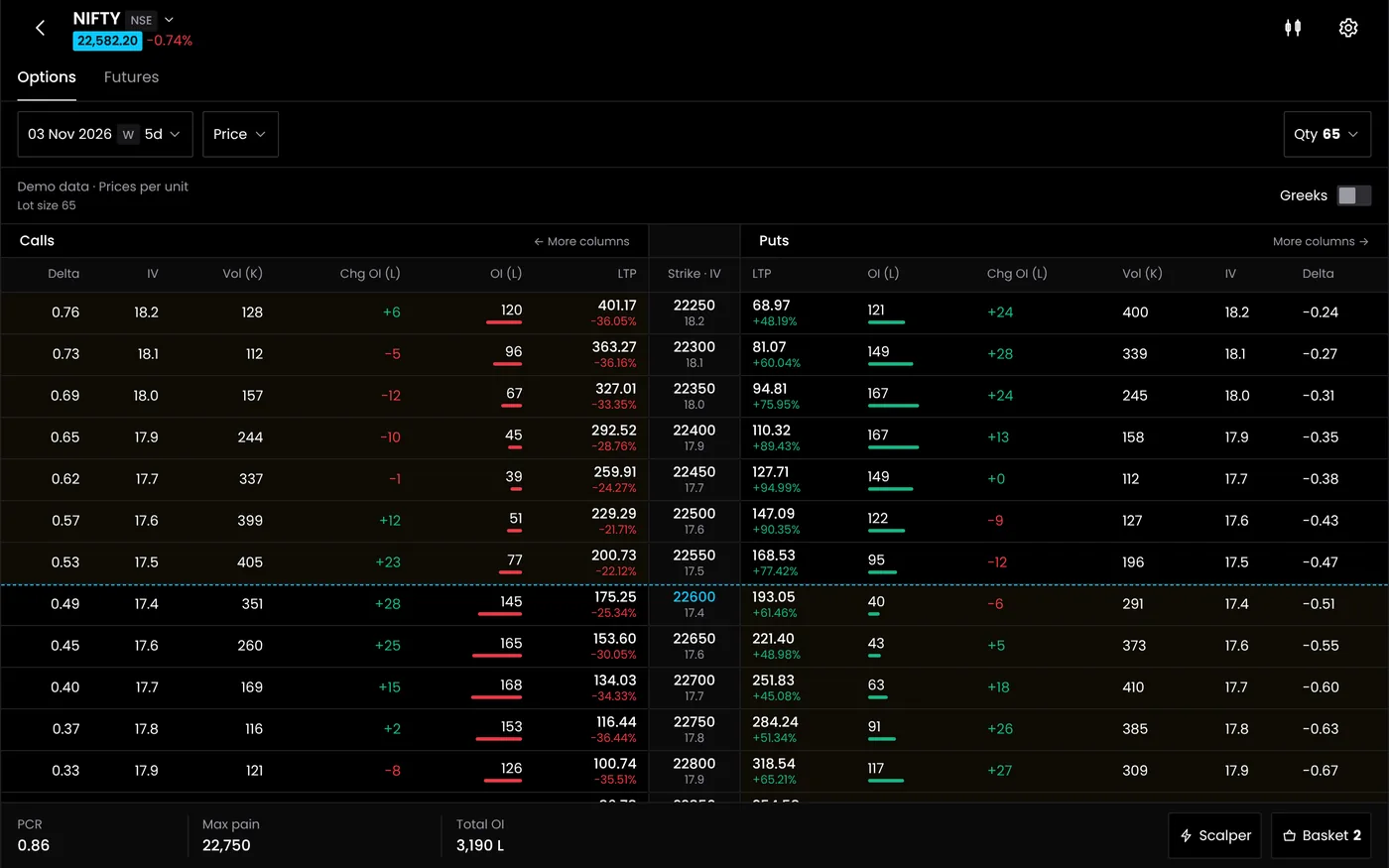
Brokers display an option as underlying, expiry, strike and type: NIFTY 28 OCT 25000 CE is the Nifty call at 25,000 expiring on 28 October, and 25000 PE is the put at the same strike. Alongside the symbol a quote shows:
- LTP: the last traded price per unit, ₹280.50 in the example.
- Bid and ask: the best price a buyer is currently offering and the best price a seller is asking. You buy at the ask and sell at the bid; the gap is a cost on every trade, and it widens on strikes far from the money and in fast markets.
- Change: the move in the premium since the previous close, in rupees and per cent. Because premiums are small relative to the index, these percentages are large.
- Volume: contracts traded today.
- Open interest (OI): contracts open at the moment, a measure of how many positions exist at that strike.
- IV: the implied volatility, the volatility the current premium implies.
The Nifty option chain lays these out for every strike of an expiry, with calls on one side and puts on the other. For the purposes of this page, two facts carry most of the weight: the premium you see is a per-unit price that has to be multiplied by the lot, and the bid-ask spread is part of the price.
Intrinsic value and time value
Every option premium has two parts:
- Intrinsic value is what the option would be worth if exercised now. For a call, it is the underlying price minus the strike, if positive. For a put, it is the strike minus the underlying price, if positive. It can never be negative.
- Time value is the rest of the premium: the value of the chance that the option will be worth more before expiry.
Time value is the part of the premium that the buyer is certain to lose if nothing happens, and the part the seller is certain to earn. It is paid for two things: time, during which the underlying may move, and volatility, which sets how far it is likely to move. More of either means more time value, which is why the same strike costs more with a month to expiry than with a week, and more before a budget or a central bank decision than on a quiet week.
Where time value is highest
Time value is largest for at-the-money options and shrinks for strikes further in or out of the money. Deep in-the-money options are mostly intrinsic value and move almost point for point with the index; far out-of-the-money options are all time value, but not much of it, because the chance they will ever have intrinsic value is small.
In the money, at the money and out of the money
| Call | Put | |
|---|---|---|
| In the money (ITM) | Strike below the market | Strike above the market |
| At the money (ATM) | Strike at or near the market | Strike at or near the market |
| Out of the money (OTM) | Strike above the market | Strike below the market |
With Nifty at 25,000, the 24,750 call and the 25,250 put are in the money, the 25,000 call and put are at the money, and the 25,250 call and the 24,750 put are out of the money. OTM options have no intrinsic value; their whole premium is time value. They are cheaper and move less for a given change in the index, and they are the options most likely to expire worthless. The glossary entry on ITM, ATM and OTM has the short version.
What moves an option's price
An option's premium depends on five things:
- The underlying price. Calls rise as it rises; puts rise as it falls. The at-the-money call moves about ₹0.54 for each point in Nifty, a sensitivity called delta.
- Time to expiry. More time means more time value. Options lose value as expiry approaches, a process called time decay or theta. In the model the at-the-money call loses about ₹13 a unit, or ₹850 a lot, between 12 and 11 days to expiry with nothing else changing.
- Implied volatility. When the market expects bigger moves, options become more expensive. A one-point rise in IV, from 14% to 15%, adds about ₹18 a unit, or ₹1,170 a lot, to the at-the-money call; a one-point fall takes the same away.
- Interest rates, to a small extent: higher rates make calls slightly dearer and puts slightly cheaper.
- Dividends, for stock options, since a dividend lowers the share price on the ex-date.
Time decay is not steady. With nothing else changing, an at-the-money option loses value slowly at first and quickly in the final days:
The sensitivity of the premium to each of these inputs is measured by the Greeks: delta for the underlying, theta for time, vega for volatility, gamma for the change in delta, and rho for interest rates. Our guide to option greeks explains each one with Nifty examples; for this page, it is enough to know that a bought option can lose money on a quiet day and on a fall in IV even when the index moves the right way.
The buyer's payoff
When you buy a call, your loss is limited to the premium and your profit grows as the market rises above the break-even. When you buy a put, the picture is reversed. Switch between the two below; the chart shows the payoff today and at expiry, with model prices for Nifty at 25,000 and 12 days to expiry.
Interactive payoff chart: change the spot, IV, lot size and days to expiry to see the curve, breakevens and Greeks.
The dashed line matters as much as the solid one. Before expiry an option still has time value, so a bought call is worth something even below the strike and the loss is smaller than at expiry. That gap between the two lines is what time decay eats each day.
The seller's payoff
Selling an option flips the buyer's payoff upside down. The seller's profit is capped at the premium received, and the loss grows as the market moves against the position. This is why selling naked options needs margin, stop losses and strict sizing.
Interactive payoff chart: change the spot, IV, lot size and days to expiry to see the curve, breakevens and Greeks.
One contract, two sides
Every option has a buyer and a seller, and at expiry the contract moves money from one to the other. The diagram shows the 25,000 call from both sides: the buyer pays ₹18,233 a lot and the seller receives it, and at every level of Nifty the buyer's profit is the seller's loss, rupee for rupee, before charges.

Four outcomes cover every case at expiry for a call bought at ₹280.50, one lot of 65:
| Nifty at expiry | The call is worth | Buyer's result | Seller's result |
|---|---|---|---|
| 25,000 or below | Nothing: it expires worthless | −₹18,233, the whole premium | +₹18,233 |
| 25,180 (in the money, below break-even) | 180, or ₹11,700 a lot | −₹6,533 | +₹6,533 |
| 25,280.50 (the break-even) | 280.50, or ₹18,233 | ₹0 before charges | ₹0 before charges |
| 25,600 (above break-even) | 600, or ₹39,000 a lot | +₹20,768 | −₹20,768 |
Two points follow. First, a call that finishes in the money can still lose money; the buyer needs the index above the strike by more than the premium. Second, the seller's gain in the first two rows is the buyer's loss, and the seller's loss in the last row has no ceiling, because Nifty can finish at any level. The rows are reversed for a put, with the break-even at the strike minus the premium: 24,772.90 for the 25,000 put bought at ₹227.10.
Buying vs selling options
| Option buyer | Option seller | |
|---|---|---|
| Pays or receives | Pays the premium | Receives the premium |
| Maximum loss | The premium paid | Can be far larger than the premium; no limit for a naked call |
| Maximum profit | Large; no limit for a call | The premium received |
| Time decay | Works against you | Works for you |
| Implied volatility | A fall hurts | A fall helps |
| Chance of profit | Below 50% for a single option at the money | Above 50% for a single option at the money |
| Margin | Not needed; the premium is paid upfront | Required, often several times the premium |
Buyers have limited risk and need the market to move. Sellers win more often but can suffer large losses in one move, which is why the two sides suit different temperaments and different capital.
What the premium implies about the odds
Because the premium is set by trading, it carries the market's estimate of how far the index is likely to move. The simplest reading uses implied volatility: an IV of 14% means an expected move of about 14% over a year, which scales with the square root of time.
In the model, Nifty has about a 68% chance of finishing within 635 points of 25,000 in 12 days, and a 32% chance of finishing further away. The same arithmetic prices every strike, and it gives each option a chance of paying off:
| Position, 12 days to expiry | Premium per lot | Chance of finishing in the money | Chance of finishing above the break-even |
|---|---|---|---|
| Buy the 25,000 call | ₹18,233 | 50% | 33% |
| Buy the 25,250 call | ₹10,924 | 38% | 26% |
| Buy the 25,500 call | ₹5,987 | 25% | 18% |
| Buy the 25,000 put | ₹14,762 | 50% | 36% |
| Sell the 24,750 put | ₹8,364 received | 65% chance it expires worthless | 72% chance of a profit |
The pattern explains much of options trading. Cheaper options are cheap because they are less likely to pay; the 25,500 call costs a third of the 25,000 call and has about half its chance of finishing above the break-even. Sold options win more often than bought ones, and are paid less when they win. None of these odds is a forecast. They assume IV is a fair estimate of the coming move, that the index moves smoothly and that nothing changes between now and expiry; real markets gap on news and IV itself changes. The model is a yardstick, and the option profit calculator applies it to any position.
Option prices across strikes
With Nifty at 25,000, 12 days to expiry and IV of 14%, model prices and deltas look like this:
| Strike | Call price | Call delta | Put price | Put delta |
|---|---|---|---|---|
| 24,500 | ₹617.66 | 0.81 | ₹65.36 | −0.19 |
| 24,750 | ₹431.51 | 0.69 | ₹128.67 | −0.31 |
| 25,000 | ₹280.48 | 0.54 | ₹227.11 | −0.46 |
| 25,250 | ₹168.06 | 0.38 | ₹364.16 | −0.62 |
| 25,500 | ₹92.11 | 0.25 | ₹537.67 | −0.75 |
Calls get cheaper as the strike rises; puts get cheaper as it falls. Delta, the change in the option's price for a one-point move in Nifty, falls as options move out of the money, and is also a rough guide to the chance that the option finishes in the money. The call is dearer than the put at the same strike because of the interest rate: a call plus cash is equivalent to a put plus the index, and the cash earns interest until expiry.
How option prices are set
Option prices are set by trading: buyers and sellers agree a price on the exchange, and the premium you see is the last price at which they did. Pricing models such as Black-Scholes give a theoretical value from the underlying price, strike, time to expiry, interest rate and volatility. Because every input except volatility is known, the market price can be turned around to show the volatility traders are assuming, which is the implied volatility. When demand for protection rises before an event, put prices and their IV rise with it; when the event passes, IV falls and so do premiums, a pattern known as IV crush. The Black-Scholes calculator shows how each input changes the price.
A call trade from start to finish
These figures use model prices with Nifty at 25,000, 12 days to expiry, IV of 14% and a lot of 65.
You buy one lot of the 25,000 call at ₹280.50, paying ₹18,233. Three days later, with 9 days left:
| Nifty after three days | Call price | P&L per lot |
|---|---|---|
| 25,200 | ₹360.49 | +₹5,200 |
| 25,000 | ₹239.68 | −₹2,654 |
| 24,800 | ₹147.48 | −₹8,646 |
If Nifty rises 200 points, you gain about ₹5,200. If it does not move, you still lose about ₹2,654 to time decay. If it falls 200 points, you lose more than you would have gained on the rise. This asymmetry, with time working against the buyer, is the core of option buying. You can close the trade at any of these points by selling the call back; you do not have to wait for expiry.
A put trade from start to finish
You buy one lot of the 25,000 put at ₹227.10, paying about ₹14,762. Three days later:
| Nifty after three days | Put price | P&L per lot |
|---|---|---|
| 24,800 | ₹307.45 | +₹5,223 |
| 25,000 | ₹199.64 | −₹1,785 |
| 25,200 | ₹120.46 | −₹6,932 |
The put behaves like a mirror of the call: it gains when Nifty falls and loses to time decay when Nifty does nothing. It decays a little more slowly than the call because it started with less time value.
What happens at expiry
Suppose you still hold the 25,000 call at expiry and Nifty's final settlement price is 25,180. The call settles at its intrinsic value of 180, or ₹11,700 per lot. You paid ₹18,233, so the trade loses ₹6,533, even though Nifty finished above the strike. The call only makes money at expiry if Nifty settles above 25,280.50, the strike plus the premium.
If Nifty settles at or below 25,000, the call expires worthless and the whole premium is lost; the seller of the call keeps it. Nothing needs to be done on either side. Index options are settled automatically by the exchange, and the money is credited or debited the next morning. Since 3 August 2026 the final settlement price of an index option is the index's official close, built from the closing auction prices of its constituent stocks, so the last minutes of expiry day decide where every open contract settles.
Leverage: small moves, large percentage changes
Options magnify percentage moves. In the model, if Nifty jumped 250 points, or 1%, straight after you bought the 25,000 call, the call would rise from ₹280.50 to about ₹434.13, a gain of about 55%. A 250-point fall would cut it to about ₹165.44, a loss of about 41%. A 1% move in the index produces a 40% to 55% change in the option.
That leverage is the appeal of options and the reason losses mount quickly. It comes from the notional value: the ₹18,233 premium controls a lot worth ₹16.25 lakh, so the premium is about 1.1% of the exposure. The glossary entry on leverage puts it alongside futures and margin trading.
Options vs futures: the same move, different results
Compare one lot of Nifty futures with one lot of the at-the-money call over one day:
| Nifty in one day | Futures P&L | ATM call P&L |
|---|---|---|
| Up 100 points | +₹6,500 | +₹2,851 |
| Unchanged | ₹0 | −₹850 |
| Down 100 points | −₹6,500 | −₹4,127 |
Futures move point for point with the index and have no time decay, but their losses are not limited, and a lot needs a margin of a few lakh rupees rather than a premium. The call loses less on a fall and more on a quiet day, and its total loss can never exceed the premium.
Options vs futures vs shares
| Shares | Futures | Options (buying) | |
|---|---|---|---|
| What you hold | Ownership | An obligation to buy or sell at a set price | A right to buy or sell |
| Upfront cost | Full value | Margin, a fraction of the value | The premium |
| Maximum loss | The full amount invested | Can exceed the margin | The premium |
| Time limit | None | Expiry | Expiry, with time decay |
| Income | Dividends | None | None for the buyer; premium for the seller |
Options give leverage with a limited loss for buyers, which is why they are popular. That leverage cuts both ways: small moves create large percentage gains and losses on the premium, and the time limit means a view that is right too late still loses. Traders choosing between options and a day's trading in the shares themselves will find the costs and capital compared in our guide to options vs intraday trading.
Five situations that surprise new option traders
These examples use model prices on Nifty with a lot of 65.
1. Right about direction, but too slow
You buy the 25,000 call for ₹280.50 expecting a rally. Three days later Nifty is still at 25,000. The call has fallen to about ₹239.68, a loss of about ₹2,654 per lot, even though nothing went wrong with your view. Time decay is the cost of waiting.
2. Right about direction, but volatility falls
Before a scheduled event, with IV at 20% and three days to expiry, the at-the-money call costs about ₹187.54. After the event, Nifty rises 200 points but IV falls to 13%. The call is worth about ₹234.75, a gain of only about 25% on a move that would normally pay far more. The premium was carrying the event, and once the event passed, that part of the price left.
3. Selling a put, then a gap down
You sell the 24,750 put for about ₹128.67, collecting ₹8,364, expecting Nifty to hold above 24,750. A negative surprise takes Nifty to 24,400 by expiry. The put settles at 350, so you lose about (350 − 128.67) × 65 = ₹14,386 per lot, about 1.7 times the premium you collected. The model gave the trade a 72% chance of profit; it is the size of the other 28% that catches sellers.
4. Holding a call into expiry just above the strike
The 25,000 call bought at ₹280.50 is worth only ₹180 if Nifty settles at 25,180, a loss of about ₹6,533 per lot despite finishing in the money. Above the strike is not the same as above the break-even.
5. Buying a cheap option on expiry day
With one day left, the 25,300 call costs about ₹4.25, or ₹276 per lot. It looks like a cheap lottery ticket. In the model, it has only about a 5% chance of finishing in the money at all. Most such options expire worthless, and the traders who sell them on expiry day are counting on it.
Index options and stock options in India
| Contract | Exchange | Lot size | Expiry | Settlement |
|---|---|---|---|---|
| Nifty 50 | NSE | 65 | Weekly on Tuesday; monthly on the last Tuesday | Cash |
| Bank Nifty | NSE | 30 | Monthly, last Tuesday | Cash |
| FinNifty | NSE | 60 | Monthly, last Tuesday | Cash |
| Sensex | BSE | 20 | Weekly on Thursday; monthly on the last Thursday | Cash |
| Stock options | NSE | Set per stock | Monthly, last Tuesday | Delivery of shares if in the money |
Lot sizes are from the January 2026 series and are revised periodically to keep the contract value near the exchange's minimum, so check the current specifications before trading. Index options are by far the most traded, with Nifty the most liquid of all. Stock options need extra care near expiry: because in-the-money positions lead to delivery, brokers raise margins in the final days and many close such positions early. Our guide to stock options trading covers the differences, and the index guides cover each contract: Nifty option trading, Bank Nifty, FinNifty option trading and Sensex option trading.
How options are settled in India
Indian options are European-style, which means they are exercised only at expiry. There is no early exercise and no early assignment, so a seller cannot be called on to deliver before expiry day, and the only ways a position ends are by trading it back or by settlement at expiry.
- Index options settle in cash. In-the-money options are settled at their intrinsic value against the final settlement price, and the money moves between buyers' and sellers' accounts. Out-of-the-money options expire worthless on both sides.
- Stock options that finish in the money are settled by physical delivery. A call buyer must pay for and receive the shares; a put buyer must deliver them, and the sellers take the other side. The physical settlement entry has a worked example.
Most traders close their options before expiry rather than holding them to settlement, which avoids both the delivery question and the final-hour swings in premium.
Weekly and monthly expiries, and the trading day
Since November 2024, each exchange can offer weekly options on only one benchmark index. Nifty 50 has weekly options on NSE, expiring every Tuesday, and Sensex has them on BSE, expiring every Thursday. Bank Nifty, FinNifty and stock options have monthly expiries. Weekly contracts carry less time value, so they are cheaper to buy and decay faster, which is why most intraday and short-term options trading happens in them; monthly contracts suit views that need weeks to play out and hedges. The F&O expiry calendar lists the dates, adjusted for holidays.
Index and stock derivatives trade from 9:15 am to 3:40 pm. Since 3 August 2026, F&O stocks stop continuous trading at 3:15 pm and a closing auction to about 3:35 pm sets their official close, which in turn sets the index close used to settle expiring options.
Margin, charges and tax in brief
Margin. Buyers pay the premium upfront and need no margin. Sellers deposit margin, made up of SPAN margin, which the exchange calculates from the worst likely one-day loss on the position, and an exposure margin on top. For a single sold Nifty option it is often ₹1 lakh or more a lot; a hedged position, such as a spread, needs much less because its maximum loss is capped. Since November 2024 short index options also attract an extra 2% extreme loss margin on expiry day. Check any position with the F&O margin calculator.
Charges. Each order pays brokerage, exchange transaction charges, the SEBI fee and GST; each sale of an option pays securities transaction tax at 0.15% of the premium, and each purchase pays stamp duty. At ₹20 brokerage per order, buying and later selling one lot of the 25,000 call costs about ₹90 in total, small next to the ₹18,233 premium, but charges add up for strategies that trade every day. The brokerage calculator itemises them for each broker.
Tax. Profits and losses from F&O trading are generally treated as non-speculative business income rather than capital gains, and a tax audit may be required above certain turnover levels. Keep records of every trade and confirm your position with a tax professional.
Options and SEBI's rules for retail traders
- Account activation: brokers enable the F&O segment only after checks, which include proof of income.
- Upfront premium: since November 2024, brokers collect option premiums from buyers upfront.
- Contract size: SEBI set a minimum value of ₹15 lakh for new index derivative contracts, so lot sizes are larger than they were.
- Weekly expiries: each exchange can offer weekly options on only one benchmark index.
- Expiry-day margin: short index options carry an extra 2% margin on expiry day, and the margin benefit for calendar spreads no longer applies on the day of the near expiry.
- Risk disclosure: brokers show a risk disclosure based on SEBI's studies, which found that most individual traders in equity derivatives lose money.
- Automation: rule-based options trading through a broker's API falls under SEBI's framework for retail algorithmic trading, in full effect since 1 April 2026.
Uses of options
- Speculation: buying calls or puts to profit from a move with a known maximum loss.
- Income: selling options to earn premium when the market is expected to stay in a range.
- Hedging: buying puts to protect a portfolio or a futures position, as in the protective put strategy; the hedging entry explains the idea.
- Combinations: joining two or more options into spreads, straddles, strangles and condors that fit a specific view on direction and volatility. Our guide to options trading strategies sets them out side by side.
The risks of options trading
SEBI's August 2026 study of individual traders in equity derivatives found that 87.7% made net losses in FY26, an average of about ₹1.17 lakh per losing trader, with options accounting for about 92% of the losses. The main reasons traders lose include buying options that expire worthless, selling options without stops, trading too often and ignoring costs.
Before trading, understand:
- Leverage: small moves in the index create large changes in premium, in both directions.
- Time decay: bought options lose value every day, faster as expiry nears.
- Volatility: a fall in IV can reduce an option's value even if the market moves your way.
- Unlimited loss: a sold call has no ceiling on its loss, and a sold put can lose many times the premium.
- Gaps: a stop loss cannot guarantee an exit price when the market opens far from the previous close.
- Liquidity: some strikes have wide bid-ask spreads, which is a cost on entry and on exit.
- Costs: brokerage, taxes and charges apply to every order.
Option trading for beginners covers the first months, from account activation to a first defined-risk trade.
Start your free trial
Connect your broker, build a strategy and test it on paper before a single live order goes out.
Analysing options in QuantPower
Everything on this page is visible on a live chain. QuantPower's options trading platform shows each strike's premium, bid and ask, open interest, IV and Greeks for Nifty, Bank Nifty and Sensex, with the expected move for the expiry. Any strike can be added to the strategy builder, which draws the payoff today and at expiry, shows the break-even, the maximum loss and the model chance of profit, and estimates the margin, before an order is placed. Rules that work can then be backtested and run as an algo bot on your own broker account.
Common misunderstandings about options
- "Options are cheap, so they are low risk." A cheap option can still lose its entire value, and most far out-of-the-money options do.
- "Selling options is safe because most expire worthless." Sellers win often but can lose many times the premium in one move.
- "If I am right about direction, I will make money." Time decay and falling IV can turn a correct view into a loss.
- "In the money means in profit." A call that finishes between the strike and the break-even still loses money.
- "I can be assigned at any time." Indian options are European; nothing happens until expiry.
- "Options are only for speculation." Many investors use puts to protect portfolios and calls to reduce the cost of a position.
Key terms
- Premium: the price of an option, per unit.
- Strike: the price at which the option can be exercised.
- Expiry: the last day of the contract.
- Lot size: the number of units in one contract.
- Intrinsic value: the value if exercised now.
- Time value: the rest of the premium.
- ATM, ITM, OTM: at, in and out of the money.
- Implied volatility: the volatility built into the option's price.
- Delta, theta, vega: the sensitivity of the premium to the index, to time and to volatility.
- Open interest: contracts currently open.
- Writer: the seller of an option.
- Exercise: using the right the option gives.
- Settlement price: the price used to settle contracts at expiry.
A short history of options in India
NSE introduced index options on Nifty in June 2001 and stock options a month later. For many years, monthly contracts dominated. Weekly Bank Nifty options arrived in 2016 and weekly Nifty options in 2019, and weekly contracts soon became the most traded options in the country, making India the largest options market in the world by number of contracts.
Two sets of rule changes shaped today's market. SEBI moved stock derivatives to physical settlement in phases from 2018, so in-the-money stock options held to expiry now lead to delivery of shares. Then, from November 2024, SEBI's measures to strengthen the index derivatives framework limited each exchange to one benchmark index with weekly options, raised the minimum contract value, required brokers to collect option premiums upfront and added extra margin on expiry day. Lot sizes and expiry weekdays have changed several times since, so always check the current contract specifications.
Frequently asked questions
What is options trading in simple words?
Buying or selling contracts that give the right to buy or sell an asset at a fixed price before a set date. Buyers pay a premium for that right; sellers receive it and take on the obligation. On Nifty, one such contract costs about ₹18,233 for an at-the-money call with 12 days to expiry.
What is the difference between a call and a put?
A call gains when the underlying rises above the strike; a put gains when it falls below it. Buying a call or selling a put is a bullish position; buying a put or selling a call is bearish.
Can I lose more than I invest in options?
As a buyer, no: the most you can lose is the premium. As a seller, yes: losses can far exceed the premium received, and a sold call has no upper limit, which is why sellers must deposit margin.
Do I need a demat account to trade options?
You need a trading account with the F&O segment enabled, which brokers activate after proof of income. A demat account is also needed in practice, because stock options held to expiry in the money are settled by delivery of shares.
Why are options so popular in India?
They need less capital per trade than futures or shares, offer weekly expiries on Nifty and Sensex, and limit the buyer's loss to the premium. That popularity is also why SEBI has tightened the rules on index derivatives since 2024.
Can options be used to protect investments?
Yes. Buying a put on an index or a stock limits the loss on a position you hold, in exchange for the premium. Investors use this as insurance before events or during uncertain periods, and a Nifty put hedges any holding that tracks the index.
What happens if I forget to close an option before expiry?
Index options settle automatically in cash at their intrinsic value, and out-of-the-money options simply expire. In-the-money stock options lead to delivery of shares, with large payment or delivery obligations, so check stock option positions before expiry.
Related guides and terms
- Options trading strategies, option trading for beginners and option buying vs selling
- Option greeks, stock options trading and options vs intraday trading
- Nifty option trading, Bank Nifty, FinNifty option trading and Sensex option trading
- Option buying strategies, option selling strategies and hero zero option trading
- Option chain, Nifty option chain, strike price selection and implied volatility crush
- Futures vs options, futures basics and derivatives meaning
- Tools: Option profit calculator, Black Scholes option pricing calculator, F&O margin calculator and brokerage calculator
- Glossary: Premium meaning, strike price meaning, expiry meaning, lot size meaning, ITM ATM OTM meaning, intrinsic value meaning, physical settlement meaning
Sources
- SEBI, Profitability of Individual Traders in the Equity Derivatives Segment (FY25–FY26), PR No. 50/2026, 20 August 2026
- SEBI circular SEBI/HO/MRD/TPD-1/P/CIR/2024/132: Measures to strengthen the equity index derivatives framework, 1 Oct 2024 (weekly expiries, contract size, upfront premium, expiry-day margin)
- SEBI circular on safer participation of retail investors in algorithmic trading, 4 Feb 2025, and the implementation timeline to 1 April 2026
- NSE: Equity derivatives contract specifications (lot sizes, strike scheme, expiry days and settlement)
- NSE circular of 30 May 2026 on the closing auction session and revised F&O trading hours from 3 August 2026
- Hull, J. C. Options, Futures, and Other Derivatives. Pearson
- Black, F. and Scholes, M. (1973). The Pricing of Options and Corporate Liabilities. Journal of Political Economy, 81(3), 637–654