
This guide covers FinNifty option trading from the contract up: what the index holds and the rules that changed it in 2025, what one lot costs and how far the index moves, how a monthly expiry shapes each strategy, four rule-based strategies with model numbers, a model month, the margin for sellers, sizing, costs, backtesting, and how to run the rules as an algo in QuantPower.
FinNifty option trading at a glance
| Feature | FinNifty options |
|---|---|
| Underlying | Nifty Financial Services index: 20 banks, NBFCs, insurers and other financial companies |
| Exchange | NSE |
| Lot size | 60 units, from the January 2026 series |
| Value of one point | ₹60 per lot |
| Contract value | About ₹15 lakh with the index at 25,000 |
| Expiry | Monthly only, on the last Tuesday of the month, or the previous trading day if that is a holiday |
| Trading hours | 9:15 am to 3:40 pm |
| Settlement | European, cash-settled at the index's official close, set by the closing auction |
| Margin for sellers | SPAN plus 2% exposure margin on each short lot, and another 2% on expiry day |
| Typical move in our model | About 252 points (1%) a day and 1,127 points (4.5%) a month, at 16% IV |
| Main risks | RBI policy and bank results, wide bid-ask spreads, expiry-day gamma, and overlap with Bank Nifty and Nifty |
Key takeaways
- Every point of premium is ₹60 a lot. With 27 days left, the at-the-money call costs about ₹496 in our model, or ₹29,732 a lot, and the put about ₹376, or ₹22,537.
- Monthly expiries mean about 12 expiry days a year. A rule that trades only on expiry day gets a dozen trades a year, so each one carries more weight in the results.
- Half of the at-the-money straddle's value is still there with 7 days left. Monthly sellers either stay for it and accept the highest gamma, or leave a week early and give it up.
- A hedged iron condor ties up about ₹81,000 a lot, most of it exposure margin. A naked short straddle needs roughly ₹1.6 to 2 lakh in our estimate, and its loss has no cap.
- FinNifty, Bank Nifty and Nifty share their largest stocks. Short options on all three add up to one large position in financial stocks.
- The settlement price now comes from a closing auction that starts at 3:15 pm, so expiry-day positions are usually closed by 3:10 pm.
How FinNifty options work
What the index holds
FinNifty tracks 20 financial companies: private and public sector banks, non-bank lenders, housing finance companies, insurers and other financial services firms. Banks still carry the largest weights, led by HDFC Bank and ICICI Bank, but the other companies make it broader than Bank Nifty, which holds only banks.
The index's shape changed in 2025. SEBI's circular of 29 May 2025 set new conditions for derivatives on indices other than the main benchmarks: at least 14 stocks, no stock above 20% of the index and no more than 45% in the top three. At the time, the largest stocks in Nifty Bank and FinNifty weighed as much as 29 to 33%. NSE adjusted FinNifty in a single step by the end of December 2025, while Bank Nifty moved in four steps to March 2026.
The result is an index that depends less on one or two banks than it used to. It also means that FinNifty price history from before 2026 comes from a more concentrated index, which matters for backtests.
The contract
One lot is 60 units, down from 65 since the January 2026 series; the first monthly expiry at the new size was 27 January 2026. Every point of premium or index movement is worth ₹60 a lot, and with the index at 25,000 a contract is worth ₹15 lakh. NSE reviews lot sizes periodically, so check the current figure before sizing a trade.
FinNifty options are European: they can only be exercised at expiry, and they settle in cash at the index's official closing value on expiry day. Since 3 August 2026 that closing value comes from the closing auction of the index stocks, which runs from 3:15 pm to about 3:35 pm, and the options trade until 3:40 pm. Expiry falls on the last Tuesday of the month, or the previous trading day if that Tuesday is a holiday. The Nifty expiry date calendar lists the dates.
Why there are no weekly FinNifty options
SEBI's circular of 1 October 2024 limited each exchange to weekly expiries on a single benchmark index from 20 November 2024. NSE kept Nifty 50, and FinNifty's weekly contracts ended in November 2024. NSE later moved its expiry day from Thursday to Tuesday, from September 2025.
So FinNifty has about 12 expiry days a year, and for most of its life the front contract has between one and four weeks left. Strategies that depend on weekly decay now trade Nifty or Sensex instead: see Nifty option trading and Sensex option trading.
Liquidity
FinNifty options trade far less than Nifty options. Volume gathers in the current month and in strikes near the money; next-month contracts and distant strikes can show wide gaps between the bid and the ask. A few habits follow from that:
- Use limit orders, and look at the bid and ask of every leg before entering.
- Expect stop-loss exits to fill further from the trigger than on Nifty, especially in a fast market.
- Treat model prices for distant strikes with care. An option that looks cheap on paper may not trade near that price.
The option chain shows the bid, the ask and the open interest at each strike.
How far FinNifty moves
The model's one-standard-deviation move over a number of trading days is the index level × implied volatility × √(days ÷ 252). With FinNifty at 25,000 and IV at 16%:
| Period | Move in points | Share of the index | Per lot |
|---|---|---|---|
| 1 trading day | 252 | 1.0% | ₹15,100 |
| 1 week (5 days) | 563 | 2.3% | ₹33,800 |
| 2 weeks (10 days) | 797 | 3.2% | ₹47,800 |
| 1 month (20 days) | 1,127 | 4.5% | ₹67,600 |
About a third of the time the move is bigger than this. Real moves have fatter tails than the model and cluster around events. Market data providers measure FinNifty's volatility at about 1.2 times Nifty's over recent periods, and it tends to be steadier than Bank Nifty because of its non-bank stocks.
What one lot costs: strikes with 27 days left
Model values with FinNifty at 25,000, 27 days to expiry, IV of 16% and an interest rate of 6.5%:
| Strike | Option | Model price | Per lot | Delta |
|---|---|---|---|---|
| 24,000 | Put | ₹80.69 | ₹4,841 | −0.14 |
| 24,250 | Put | ₹126.13 | ₹7,568 | −0.20 |
| 24,500 | Put | ₹188.75 | ₹11,325 | −0.28 |
| 25,000 | Put | ₹375.62 | ₹22,537 | −0.45 |
| 25,000 | Call | ₹495.54 | ₹29,732 | 0.55 |
| 25,500 | Call | ₹274.12 | ₹16,447 | 0.37 |
| 25,750 | Call | ₹195.38 | ₹11,723 | 0.29 |
| 26,000 | Call | ₹135.20 | ₹8,112 | 0.22 |
The at-the-money call costs about ₹120 more than the put because the model includes interest: with 27 days left, the futures price sits about 120 points above the index. Delta is how much the option moves for a 1-point move in FinNifty, and a 0.20-delta option is a common choice for a monthly seller's short strikes.
A FinNifty month and where each strategy trades

In the model, the at-the-money straddle for one lot is worth ₹53,236 with 28 days left, ₹46,061 with 21, ₹37,573 with 14, ₹26,544 with 7 and ₹10,025 on expiry morning, if FinNifty and IV stay where they are. The first week takes about ₹7,200 of that value and the last week about ₹26,500. That shape decides where each strategy sits in the month:
| Part of the cycle | What happens | Typical use |
|---|---|---|
| Week 1 (28 to 21 days) | A fresh contract: premium is highest and decays slowly | Monthly iron condor entries; hedges for the month |
| Weeks 2 and 3 (21 to 7 days) | Decay speeds up; in many months RBI policy or bank results fall here | Hold and manage; event spreads |
| Final week (7 to 1 days) | Half the straddle's value goes, with the highest gamma | Monthly sellers exit |
| Expiry day | Time value reaches zero by the close; settlement from the closing auction | Expiry-day iron fly, closed before 3:15 pm |
The RBI's Monetary Policy Committee meets six times a year, and the large banks report results in the weeks after each quarter ends, in January, April, July and October. Mark those dates for the month before entering any trade.
FinNifty option strategies for each market
| Your view | Strategy | When in the month | Main risk |
|---|---|---|---|
| Range-bound for the month | Monthly iron condor | Enter after the last expiry, exit a week before the next | A trend or a gap through a short strike |
| A quiet final session | Expiry-day iron fly | 1:15 to 3:10 pm on expiry day | A late move, when gamma is highest |
| Higher after an event | Bull call spread | One to three days around RBI policy or bank results | The news moves the index the other way |
| Lower after an event | Bear put spread | The same | The same |
| Protection for a portfolio of financial stocks | Bought FinNifty puts | Any time, rolled monthly | The cost, and a portfolio that does not track the index |
Strategy 1: The monthly iron condor
An iron condor strategy sells an out-of-the-money put and call and buys further-out options as wings, so the most it can lose is fixed at entry. On FinNifty it suits a month with no strong trend. Here is a rule set:
- Instrument: FinNifty options, current monthly expiry.
- Entry: 10:00 am on the first trading day after the previous expiry, if India VIX is below 20.
- Legs: sell the put and the call nearest to 0.20 delta, and buy wings 500 points further out. Place the wings first.
- Target: close when the position can be bought back for half the credit.
- Stops: close if the position's value reaches twice the credit, or if FinNifty closes beyond a short strike.
- Time exit: close everything 7 days before expiry.
With FinNifty at 25,000, 27 days to expiry and IV at 16%:
| Leg | Strike | Model price |
|---|---|---|
| Buy put | 23,750 | ₹49.27 |
| Sell put | 24,250 | ₹126.13 |
| Sell call | 26,000 | ₹135.20 |
| Buy call | 26,500 | ₹59.10 |
| Net credit | ₹152.96, or ₹9,177 a lot |
The most the position can lose is the wing width less the credit: (500 − 152.96) × 60 = ₹20,823. At expiry it breaks even at 24,097 and 26,153. Margin is about ₹81,000, so the credit is about 11% of the money blocked.
If FinNifty and IV stay unchanged, the position is worth ₹123.75 with 21 days left, ₹80.03 with 14 and ₹26.14 with 7. That is 83% of the credit earned with a week left, so in a quiet month the 50% target usually closes the trade first.
The risk is a fast move. If FinNifty fell 4% overnight to 24,000 with 26 days left and IV jumped to 22%, the position would be worth ₹274.24: a loss of ₹7,277, and the close below the 24,250 strike would end the trade. The twice-the-credit stop alone would wait for a fall of about 5.4% with IV at 19%, which is why the strike rule comes first. The short strangle strategy is the same trade without wings: a larger credit, no cap on the loss and much more margin.
Strategy 2: The expiry-day iron fly
On expiry day the remaining time value is small and falls fast. An iron fly strategy sells the at-the-money call and put and buys wings, collecting most of that value with a fixed maximum loss. The rules:
- Day: expiry day only, with no major event scheduled that day.
- Entry: 1:15 pm. Sell the at-the-money call and put, and buy wings 300 points away.
- Stop: close if the position's value reaches 1.5 times the credit.
- Time exit: 3:10 pm, before the closing auction starts at 3:15 pm.
- Frequency: one trade per expiry.
With FinNifty at 25,000 at 1:15 pm and IV at 16%, the model prices are ₹50.92 for the call and ₹49.32 for the put, and the wings cost ₹0.39 and ₹0.32. The net credit is ₹99.53, or ₹5,972 a lot. The most the position can lose is (300 − 99.53) × 60 = ₹12,028, and it breaks even at 24,900 and 25,100.
Margin is high for the size of the credit. Each short leg needs 2% exposure margin plus the extra 2% for expiry day, ₹60,000 a lot, so the two short legs need ₹1.2 lakh on top of the ₹12,028 maximum loss: roughly ₹1.32 lakh in total.
Outcomes at 3:10 pm in the model:
| FinNifty at 3:10 pm | Position value | P&L per lot, before charges |
|---|---|---|
| Unchanged at 25,000 | ₹38.58 | +₹3,657 |
| 40 points higher | ₹51.24 | +₹2,897 |
| 80 points higher | ₹82.20 | +₹1,039 |
| 150 points higher, with no stop | ₹150.25 | −₹3,043 |
The stop at ₹149.30 limits the loss to about ₹2,986 before slippage, and it is reached if FinNifty is about 146 points from the strike by 2:15 pm. The wings cost only ₹43 a lot, yet they cap the loss and keep the SPAN part of the margin small. Our guide to hero zero option trading covers the expiry session in full for Nifty and Sensex, where it comes every week.
Strategy 3: Event spreads around RBI policy and bank results
FinNifty reacts to interest rate decisions, liquidity measures, bank results and news on bad loans. A debit spread takes a view on direction with a known maximum loss, and it loses less than a single option when IV falls after the news. The rules:
- Events: RBI policy days and the results of the two largest banks.
- Direction: a bull call spread if FinNifty is above its 20-day average, a bear put spread if it is below, and no trade if it is within 0.5% of the average.
- Entry: the afternoon before the event. Buy the at-the-money option and sell one 500 points further out, in the current month with at least 10 days left.
- Exit: the close of the day after the event, or earlier at 60% of the maximum profit.
- Size: the debit is the most the trade can lose, so size from it.
With 13 days left and IV at 16%, buying the 25,000 call at ₹330.59 and selling the 25,500 call at ₹132.85 costs ₹197.73, or ₹11,864 a lot. The maximum profit is ₹18,136, and the breakeven at expiry is 25,198. Margin is about ₹42,000: the debit plus ₹30,000 of exposure margin on the short call.
Two days later, with IV down from 16% to 14% after the event:
| FinNifty after the event | Bull call spread | The 25,000 call alone |
|---|---|---|
| Unchanged | −₹778 | −₹3,791 |
| 1.5% higher | +₹6,235 | +₹10,903 |
| 1.5% lower | −₹6,638 | −₹13,135 |
The spread gives up part of the gain on a good move in exchange for a much smaller loss when the index stays still or turns.
Strategy 4: Hedging a portfolio of financial stocks
FinNifty puts can protect a portfolio that holds mostly banks, lenders and insurers. The number of lots is the portfolio value × its beta to FinNifty ÷ the contract value, so a ₹15 lakh portfolio with a beta of 1 needs one lot.
With 27 days left, the 24,000 put, 4% below the index, costs ₹80.69 in the model: ₹4,841, or 0.32% of the portfolio for four weeks. If FinNifty ended the month 10% lower at 22,500, the put would pay ₹90,000 against a portfolio loss of about ₹1.5 lakh. The first 4% of the fall and the premium are not covered.
Two cautions. Out-of-the-money puts usually trade at a higher IV than at-the-money options, so the real cost is often above the model price. And a portfolio that is not the index will not move exactly with it. Selling the 23,000 put against the bought put cuts the cost to ₹4,348 but caps the payout at ₹60,000.
A model month on one lot
Here is one month with the first three strategies, one lot each. Prices come from the model as FinNifty and IV change; it shows the mechanics, not a record of results.
| Day | FinNifty | IV | What happens | Model price | P&L before charges |
|---|---|---|---|---|---|
| Wed, 27 days left | 25,000 | 16% | Sell the 23,750 / 24,250 / 26,000 / 26,500 iron condor | Credit ₹152.96 | |
| Tue, 21 days | 25,150 | 15.5% | Hold; the condor is worth ₹118.50 | +₹2,068 open | |
| Tue, 14 days | 25,100 | 16.5% | IV rises ahead of the RBI policy; the condor is worth ₹86.30 | +₹4,000 open | |
| Wed, 13 days | 25,100 | 17% | FinNifty is above its 20-day average: buy the 25,100 / 25,600 bull call spread | Debit ₹200.49 | |
| Thu, 12 days (policy) | 24,850 | 15% | FinNifty falls 1% and IV drops; the condor reaches its target | Bought back at ₹76.48 | +₹4,589 |
| Fri, 11 days | 24,820 | 15% | The event rule closes the spread | Sold at ₹115.95 | −₹5,073 |
| Tue, expiry, 1:15 pm | 24,930 | 14.5% | Sell the 24,900 iron fly with 24,600 / 25,200 wings | Credit ₹93.60 | |
| Tue, 3:10 pm | 24,915 | 14.5% | Time exit | Bought back at ₹36.93 | +₹3,400 |
The month made ₹2,916 before charges. Charges came to about ₹567 (₹225 on the condor, ₹141 on the spread and ₹201 on the fly), leaving ₹2,349.
Three things stand out. The condor's profit came from time and from the fall in IV after the policy, not from a correct view of direction. The event spread lost 42% of its debit when the policy moved the index the other way; losses like this are part of the strategy, and the spread kept this one to a known amount. And charges took about a fifth of the gross profit, while margin peaked at about ₹1.32 lakh on expiry day.
FinNifty option selling margin
Buyers pay the premium in full and post no margin. Sellers post two amounts:
- SPAN margin covers the worst one-day loss across NSE Clearing's price and volatility scenarios. It changes every day with volatility.
- Exposure margin, which the exchange calls extreme loss margin, is 2% of the contract value on each short lot: about ₹30,000 at 25,000, using the previous day's close.
On expiry day, short index options expiring that day carry another 2% of contract value, or ₹30,000 more per short lot. It applies to positions carried into the day and to new ones sold during the day, and positions in the expiring contract also lose any calendar spread benefit that day.
For a naked short option, SPAN is the larger piece. For a fully hedged position such as an iron condor, SPAN falls to roughly the most the position can lose, so the exposure margin on the short legs becomes the larger part. Approximate figures per lot with FinNifty at 25,000:
| Position | What the margin is made of | Approximate margin |
|---|---|---|
| Naked short straddle | SPAN plus ₹60,000 exposure margin | ₹1.6 to 2 lakh (our estimate) |
| Iron condor, 500-point wings | Maximum loss of ₹20,823 plus ₹60,000 | About ₹81,000 |
| Iron fly on expiry day, 300-point wings | Maximum loss of ₹12,028 plus ₹1,20,000 | About ₹1.32 lakh |
| Bull call spread | Debit of ₹11,864 plus ₹30,000 on the short call | About ₹42,000 |
| Bought call or put | The premium only | The premium |
Margin is what the broker blocks, not what you can lose: the condor can lose ₹20,823, while the loss on a naked straddle has no cap. Check the live figure in your broker's calculator before each trade.
Risk controls for FinNifty options
- Size from the stop and the gap, not from the margin or the premium. A position should survive an overnight move of 4% without breaking the account's limits.
- Use stops and a fixed time exit. A stop is a trigger, not a price, and in FinNifty's thinner market the fill can land well past it.
- Check the event calendar for RBI policy, results from the largest banks, the Union Budget and major global news before each entry.
- Add up the overlap. Financial stocks make up more than a third of Nifty 50 and all of Bank Nifty. If you sell options on FinNifty, Bank Nifty and Nifty, add the deltas and vegas together and treat the total as one position. Our Bank Nifty guide covers the related contract.
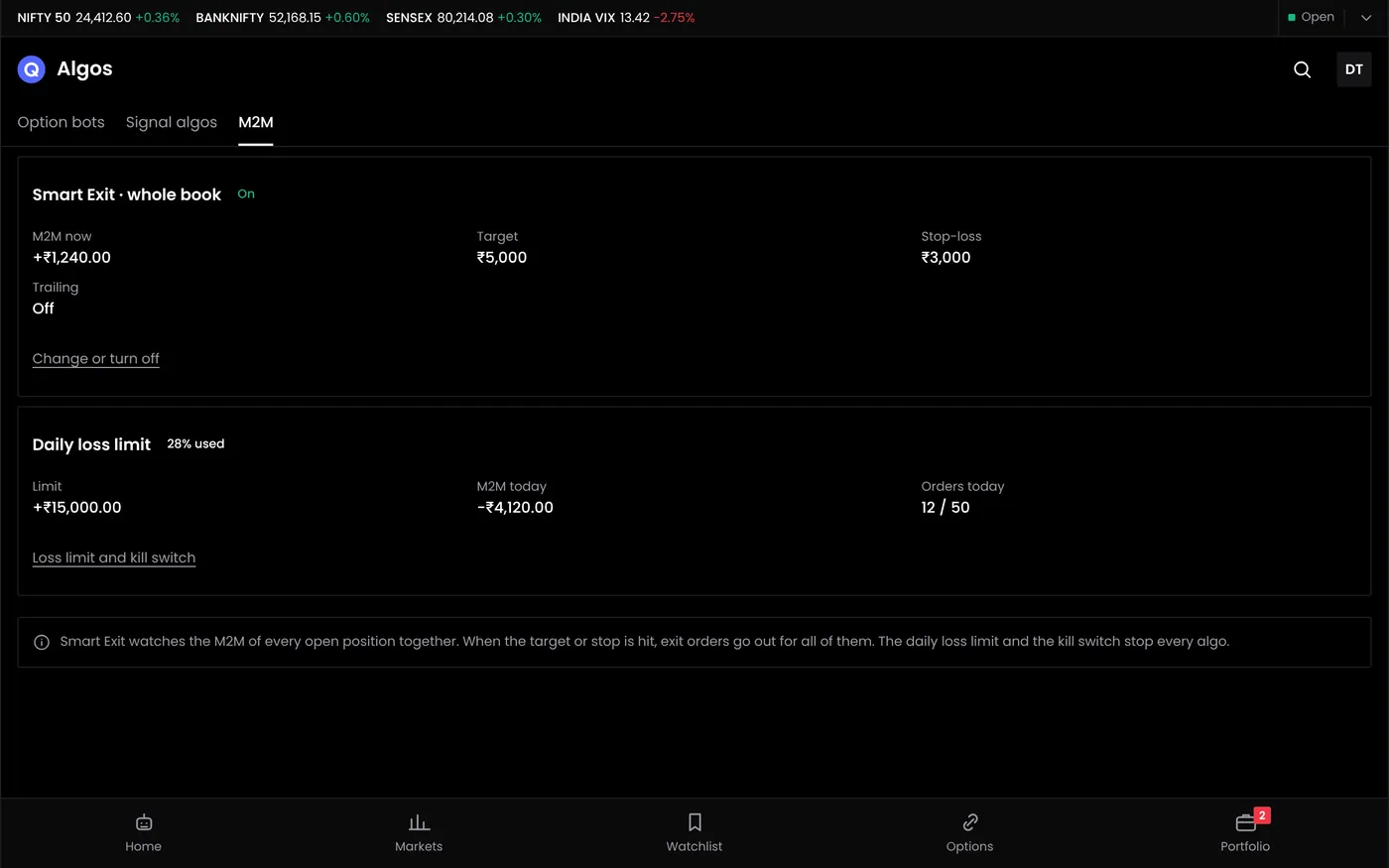
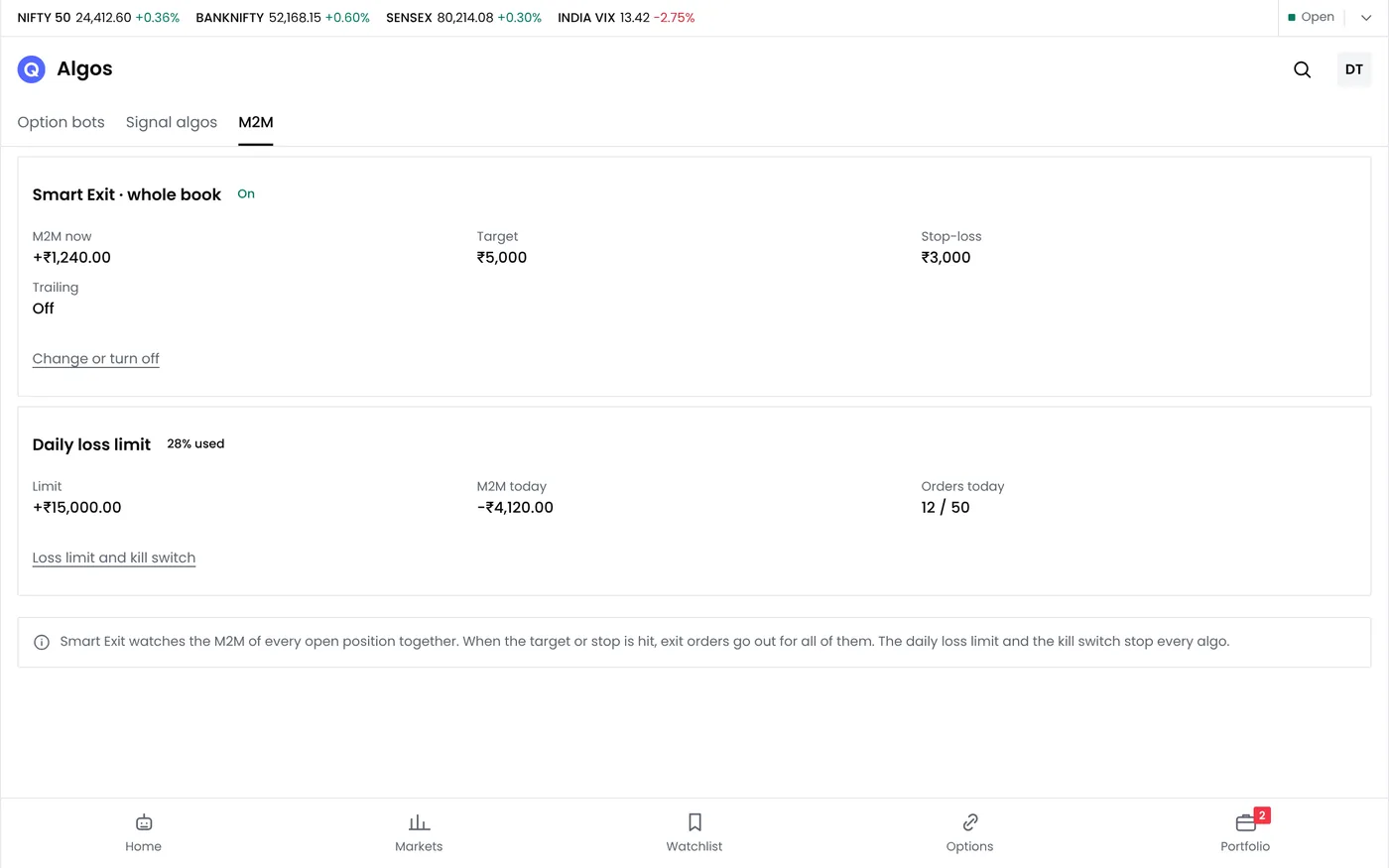
- Set an account limit. An MTM stop loss closes every position when the day's loss reaches a fixed amount.
Selling and buying options both carry real risk: SEBI's study of FY26 found that 87.7% of individual traders in equity derivatives made net losses.
Sizing a FinNifty position
Size from the loss you are prepared to take on one trade. Take an account of ₹10 lakh with a limit of 1% (₹10,000) per trade and 2% (₹20,000) per day:
| Strategy | Loss at the stop, with charges and slippage | Lots | Margin | Worst case |
|---|---|---|---|---|
| Monthly iron condor | About ₹9,700 | 1 | About ₹81,000 | ₹20,823, the maximum loss |
| Expiry-day iron fly | About ₹3,400 a lot | 2 | About ₹2.64 lakh | ₹24,056 for two lots |
| Event bull call spread | ₹11,864, the debit | 1, narrowed or with an exit at half the debit | About ₹42,000 | The debit |
The condor's worst case is about 2% of the account: the loss if a gap carries FinNifty through a wing before any rule can act. The two iron flies block about a quarter of the account for one afternoon. The spread's debit is slightly above the per-trade limit, so this account would narrow it to 400 points or exit if it loses half its value.
Costs per round trip
Each order pays brokerage (₹20 here), exchange transaction charges, the SEBI fee and GST; each sale pays STT at 0.15% of the premium; each purchase pays stamp duty.
| Trade, one lot | Orders | Charges | Share of the credit or debit |
|---|---|---|---|
| Monthly iron condor | 8 | About ₹225 | 2.5% of ₹9,177 |
| Expiry-day iron fly | 8 | About ₹201 | 3.4% of ₹5,972 |
| Event bull call spread | 4 | About ₹140 to ₹175 | About 1.3% of ₹11,864 |
On four-leg trades, brokerage is most of the cost: ₹160 of the condor's ₹225. STT is small because it falls on the premium, not on the contract value. Use the brokerage calculator for your broker's rates.
Backtesting a FinNifty strategy
- Expect few trades. Twelve expiries a year means three years give 36 monthly cycles, and an expiry-day rule gets 36 trades. One unusual month can change the result.
- Separate the eras. FinNifty had weekly expiries until November 2024, its expiry weekday has changed since, and the lot size moved from 65 to 60 in January 2026. Test monthly-only rules on data from December 2024 and treat earlier results as background.
- Allow for the 2025 rebalancing. The 20% and 45% caps changed how the index is built from December 2025.
- Model the settlement correctly. Since 3 August 2026 the closing auction sets the settlement price and options trade until 3:40 pm. Before that, the close came from the last 30 minutes' average price and trading ended at 3:30 pm.
- Use option prices, with wide spreads. Test on historical option prices rather than estimates from the index, add slippage to every stop and allow for higher costs than on Nifty.
- Tag the event days. Mark RBI policy and bank results days and compare the results on those days with the rest.
Our guides on how to backtest trading strategies and avoiding overfitting cover the method, and the backtesting engine runs the tests with costs and slippage.
Setting up a FinNifty algo strategy in QuantPower
Each rule maps to a setting. Using the monthly iron condor as the example:
| Rule | Example setting |
|---|---|
| Instrument | FinNifty options, current monthly expiry |
| Entry | First trading day after the previous expiry, 10:00 am |
| Filter | India VIX below 20 |
| Legs | Sell the 0.20-delta put and call; buy wings 500 points further out |
| Order sequence | Wings first, then the short legs |
| Target | 50% of the entry credit |
| Stop | Twice the entry credit, or a FinNifty close beyond a short strike |
| Time exit | 7 days before expiry |
| Account limit | Daily MTM loss limit |
Step 1. Build the structure
In the strategy builder, choose FinNifty monthly options and add the four legs, with the short strikes chosen by delta and the wings set 500 points away. The builder shows the payoff, the credit and the Greeks before you save.
Step 2. Set the entry, exits and filters
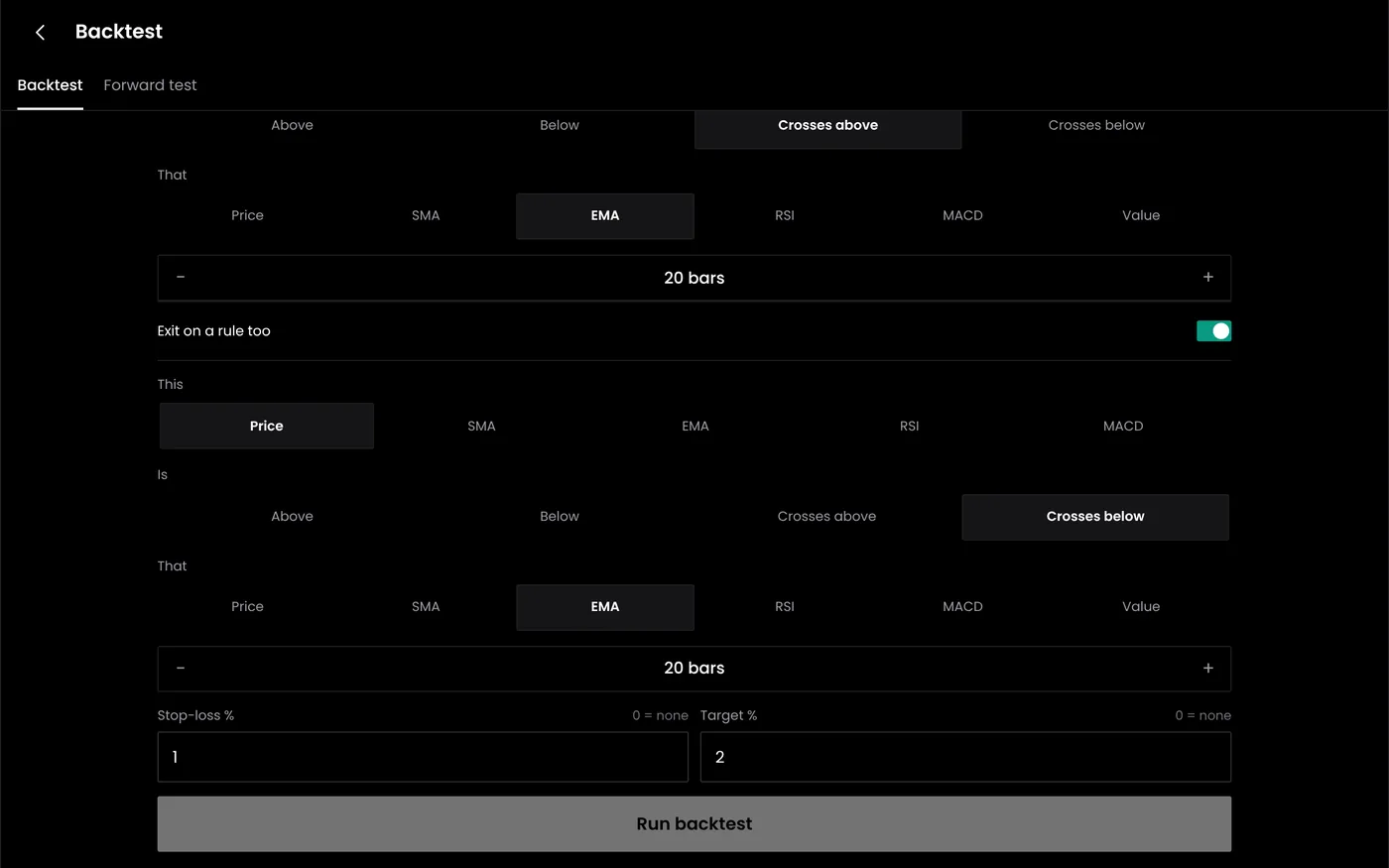
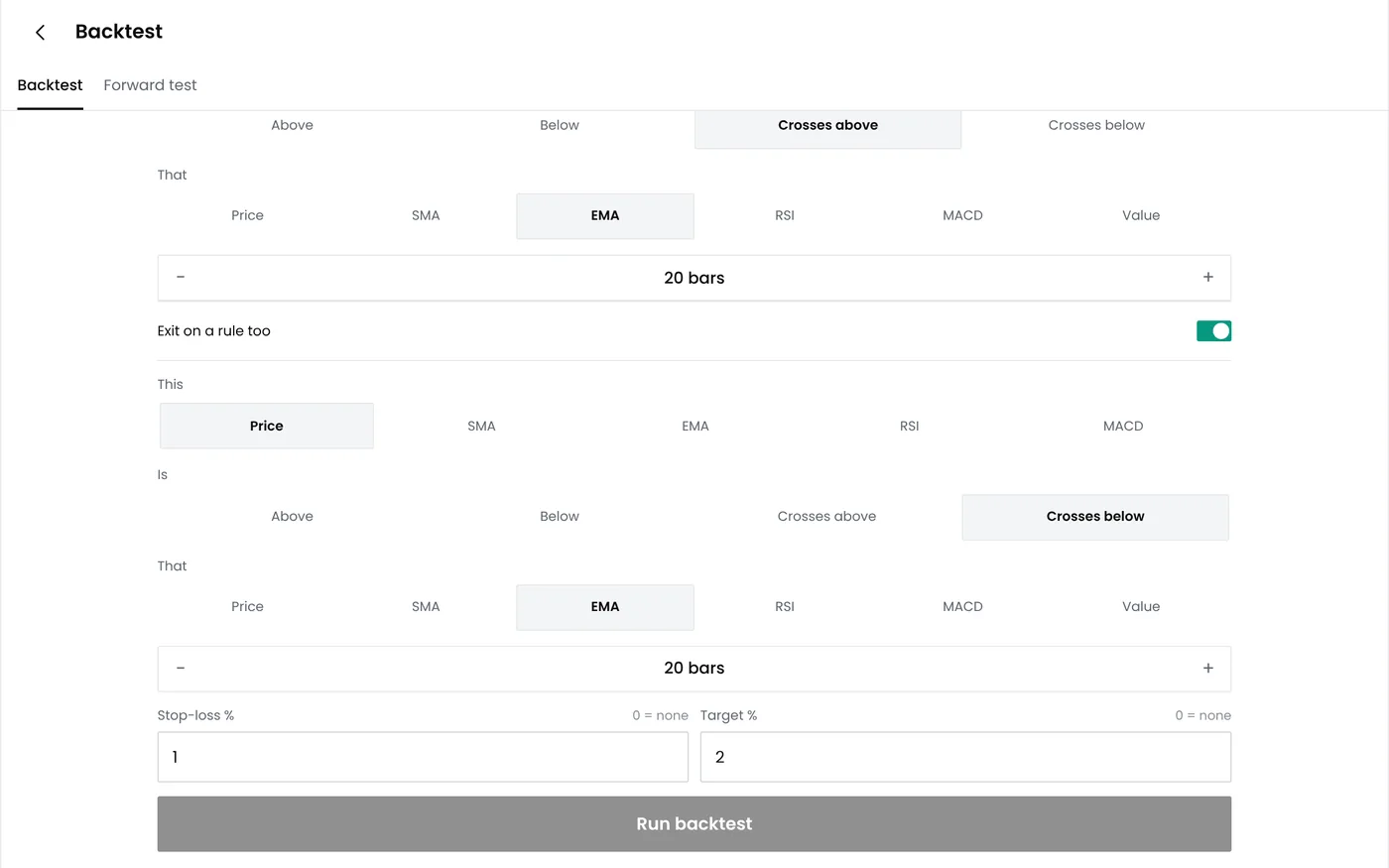
Add the entry day and time, the VIX filter, the 50% target, both stops and the time exit. For the expiry-day iron fly, set the strategy to run on expiry day only, from 1:15 pm, with the 3:10 pm exit.
Step 3. Backtest it
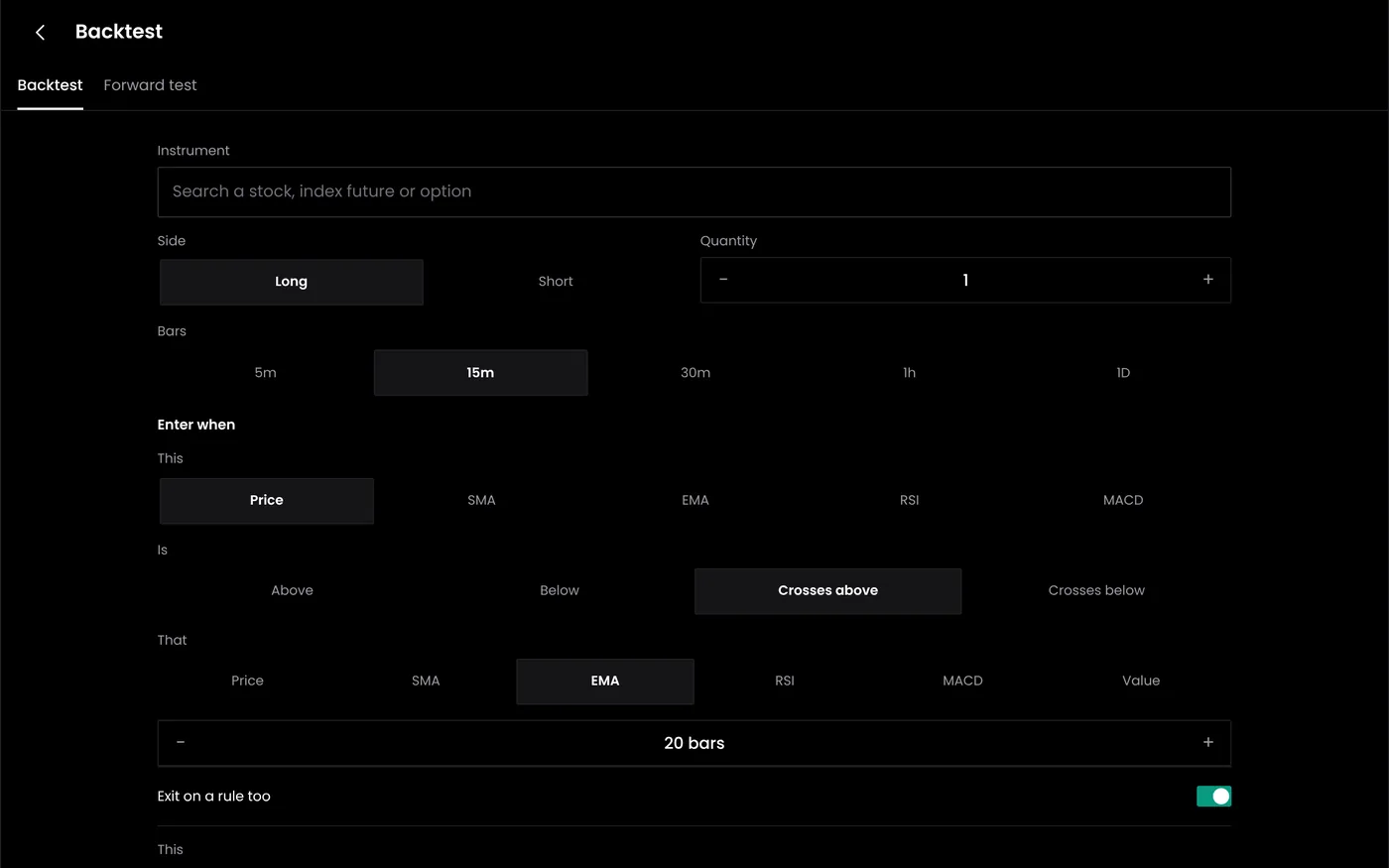
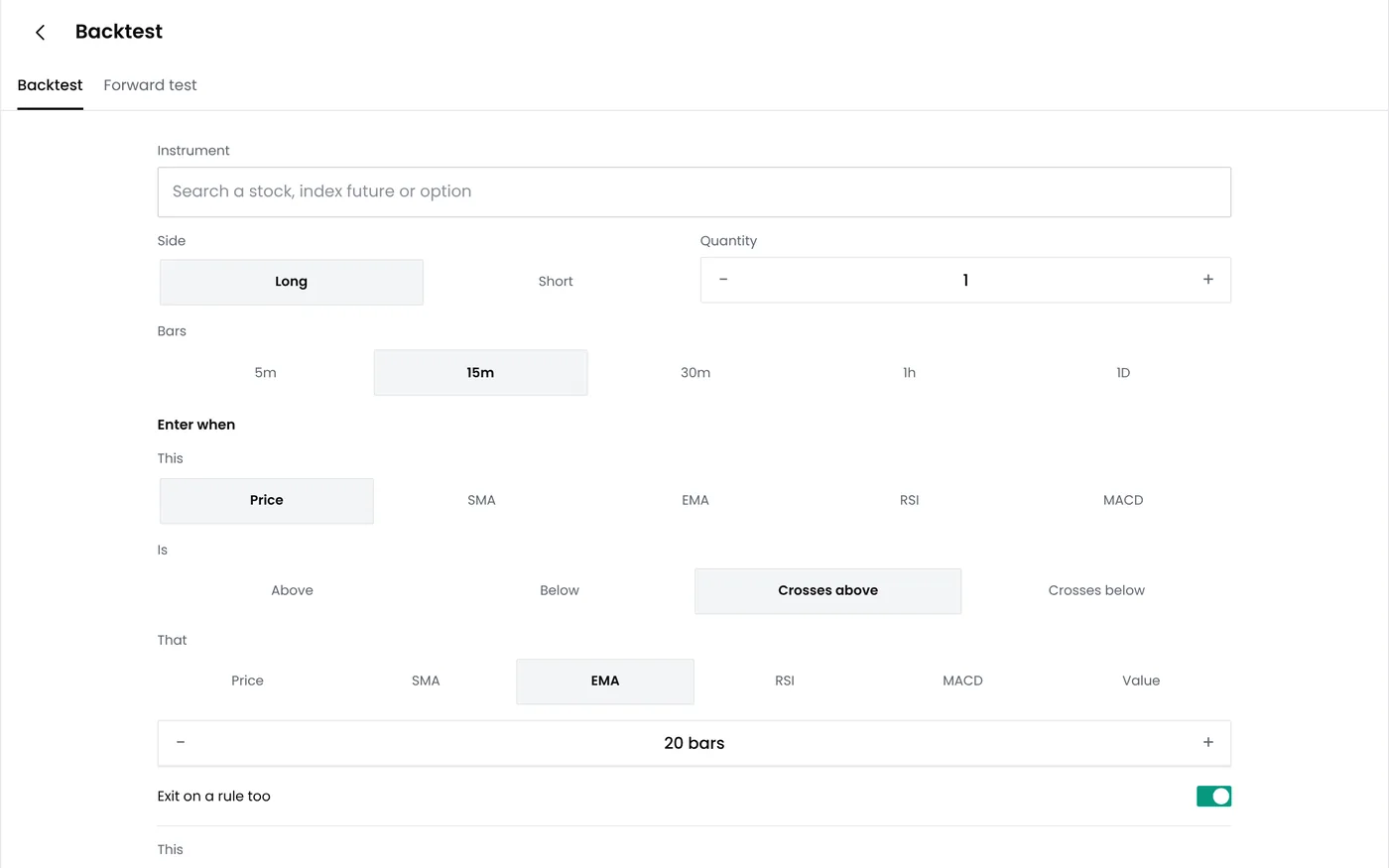
Run the rules over past monthly expiries with charges and slippage on, and check event months separately. Change one setting at a time, such as the delta, the wing width or the target, and see how many trades each change affects.
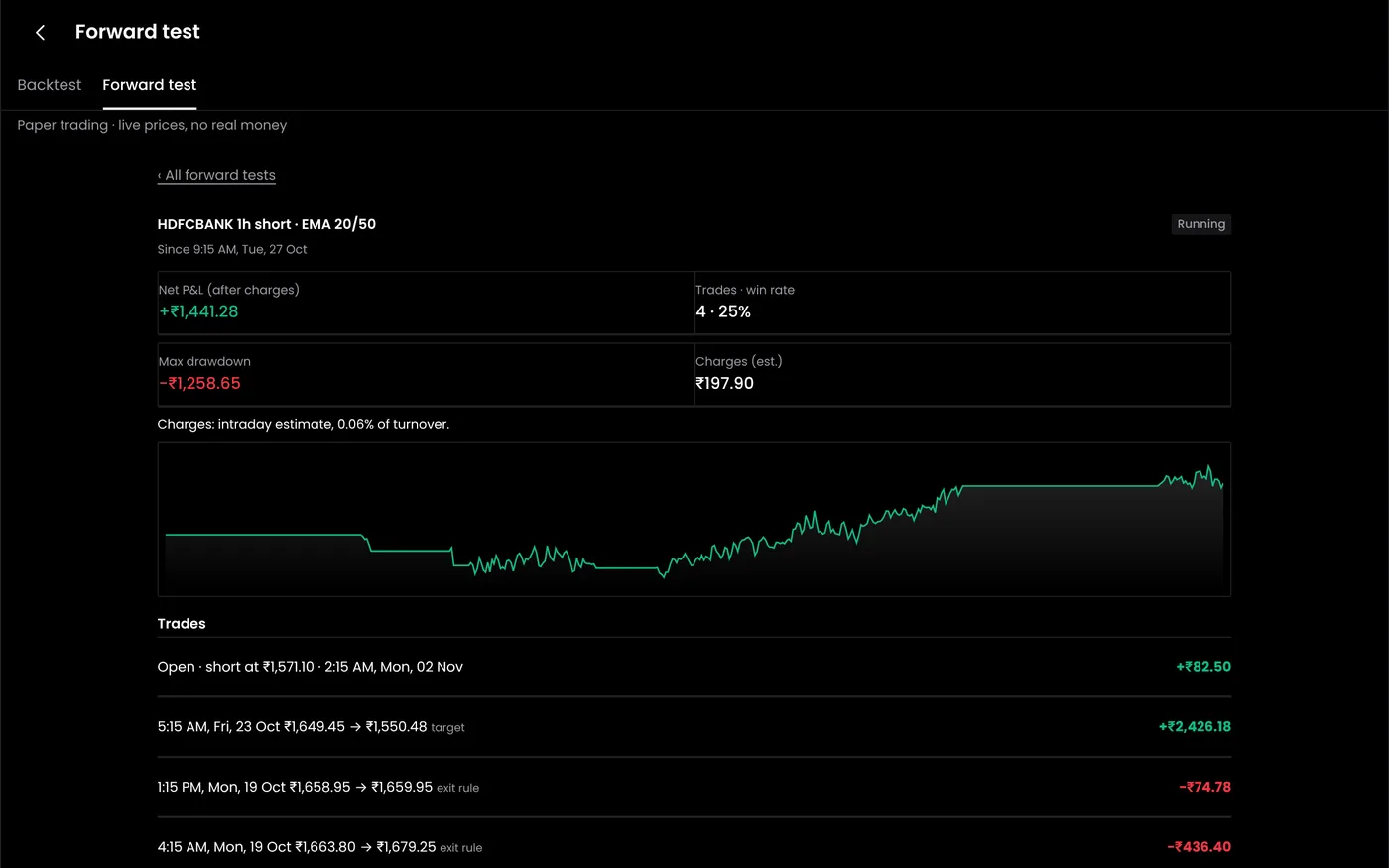
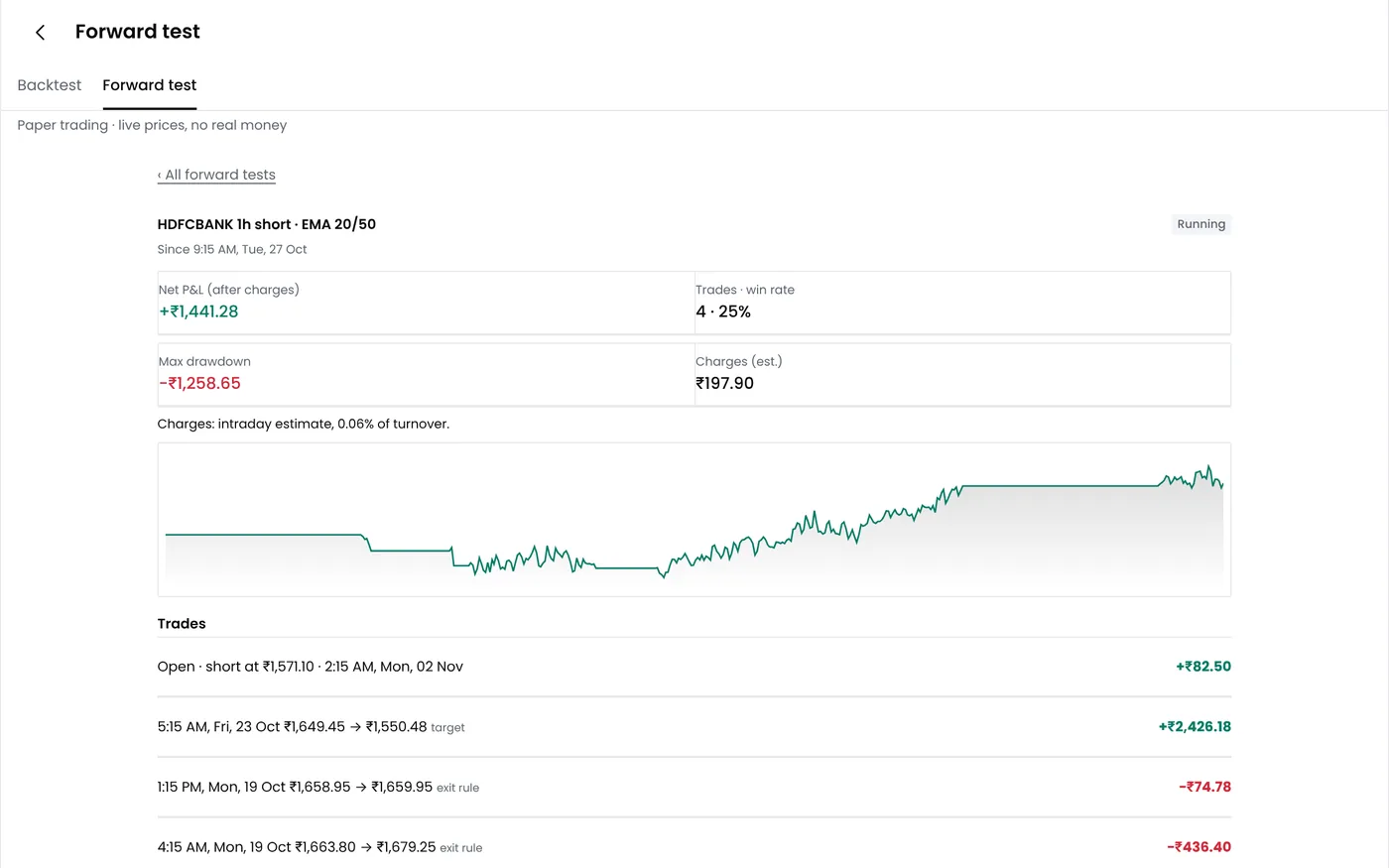
Step 4. Paper trade it
Run the strategy on live prices with virtual money for at least two expiries. Compare each fill with the price the backtest assumed; four-leg orders in FinNifty can slip more than the model suggests.
Step 5. Set the account limit
Set the daily MTM loss limit in the risk settings before going live. It closes every position when it is hit, including those from other strategies.
Step 6. Deploy and monitor
Connect your broker, choose the strategy and the number of lots, confirm the limits and deploy. The bot places the wings before the short legs and watches the target, the stops and the time exit. A market alert can flag RBI policy days, and if your signals come from TradingView charts, signal trading turns the alerts into orders. Orders go through your connected broker under the requirements applicable to your strategy and account; a named example is not a claim of strategy approval.
Measuring a FinNifty strategy
| Measure | What to look for |
|---|---|
| Net profit after charges | Positive across most rolling 12-month periods, not just in total |
| Average win and average loss | For sellers, one average loss should not wipe out several months of wins |
| Return on margin | Profit as a share of the margin blocked, month by month |
| Maximum drawdown | In rupees and in months, and whether you could sit through it |
| Event months against quiet months | Whether the strategy depends on calm months only |
| Slippage against the model | Fills on stops and on distant strikes compared with the backtest |
A trade journal helps track these month by month.
Common FinNifty option trading mistakes
- Trading it like a weekly contract, with expiry-day habits that now get one chance a month.
- Holding a naked short straddle into RBI policy or the results of a large bank.
- Selling distant strikes with market orders in a thin market, and exiting through wide spreads.
- Selling options on FinNifty, Bank Nifty and Nifty at once without adding up the combined position.
- Forgetting the extra 2% margin on expiry day and running short of margin.
- Holding past 3:15 pm into the closing auction without meaning to.
- Sizing with the old lot size of 65, or testing rules on weekly-era data without adjusting.
Pre-trade checklist
- You know the current lot size (60) and the expiry date of the contract.
- The event calendar for the month is checked: RBI policy, results from the largest banks and the Budget.
- India VIX and the option's IV are within the range your rules allow.
- Margin is available for the trade, including the extra 2% if you will hold short options on expiry day.
- The bid and ask of every leg are close enough to trade.
- The target, stops and time exit are set, along with the account's daily loss limit.
- The combined position across FinNifty, Bank Nifty and Nifty fits within your limits.
Start your free trial
Connect your broker, build a strategy and test it on paper before a single live order goes out.
Frequently asked questions
How do I start FinNifty option trading?
Activate the F&O segment with your broker, learn the contract (60 units, monthly expiry on the last Tuesday) and start with defined-risk trades such as spreads or an iron condor. Test the rules on past data and paper trade them through at least two expiries before using real money.
Does FinNifty still have weekly expiry?
No. FinNifty's weekly options ended in November 2024, when SEBI limited each exchange to one weekly benchmark index. FinNifty options now expire monthly, on the last Tuesday of the month.
What is the FinNifty lot size?
60 units, from the January 2026 series; it was 65 before. Each point is worth ₹60 a lot, so a contract at 25,000 is worth ₹15 lakh. NSE reviews lot sizes periodically.
When does FinNifty expire?
On the last Tuesday of the month, or the previous trading day if that Tuesday is a holiday. The settlement price is the index's official close, set by the closing auction of its stocks from 3:15 pm, and the options trade until 3:40 pm.
How much margin do I need to sell FinNifty options?
It depends on the position. Each short lot carries exposure margin of 2% of the contract value, about ₹30,000 at 25,000, plus SPAN. A hedged iron condor needs about ₹81,000 a lot and a naked short straddle roughly ₹1.6 to 2 lakh in our estimate. On expiry day each short lot needs another ₹30,000.
Is FinNifty the same as Bank Nifty?
No. FinNifty holds 20 financial companies, including lenders, insurers and other financial firms as well as banks, while Bank Nifty holds only banks. FinNifty's lot is 60 units against Bank Nifty's 30. Both have monthly expiries only, and they often move together.
Is FinNifty or Nifty better for option selling?
It depends on how you trade. Nifty is more liquid and has weekly expiries, so spreads are tighter and there are more expiries to trade. FinNifty pays larger premiums for the same distance because it is more volatile, but it moves more, has wider spreads and expires only once a month, so it suits fewer, smaller trades.
Can I automate FinNifty option trading?
Yes. A strategy built in QuantPower runs as a bot on your own broker account, and each order goes through your broker's API under SEBI's rules for retail algo trading. Set the entry, the stops, the time exit and the daily loss limit before deploying.
Related guides and terms
- Nifty option trading, Bank Nifty and Sensex option trading
- Hero zero option trading and the Nifty expiry date
- Iron condor strategy, iron fly strategy, short strangle strategy and short straddle strategy
- Bull call spread, bear put spread and option buying strategies
- Option greeks, implied volatility crush, theta meaning and gamma meaning
- F&O margin calculator, hedge margin benefit and brokerage calculator
Sources
- NSE: Equity derivatives contract specifications (lot size, expiry, settlement)
- NSE circular FAOP70616, October 2025: revision of the market lot of index derivatives (FinNifty from 65 to 60; first revised monthly expiry 27 January 2026)
- SEBI circular SEBI/HO/MRD/TPD-1/P/CIR/2024/132: Measures to strengthen the equity index derivatives framework, 1 Oct 2024 (one weekly benchmark per exchange and an additional 2% extreme loss margin on expiry day, from 20 November 2024)
- SEBI circular SEBI/HO/MRD/TPD-1/P/CIR/2025/79, 29 May 2025: eligibility criteria for derivatives on non-benchmark indices (at least 14 constituents, top stock at most 20%, top three at most 45%)
- NSE circular of 30 May 2026: equity derivatives trading until 3:40 pm from 3 August 2026, alongside the closing auction session in the cash market
- NSE Indices: Nifty Financial Services (constituents and methodology)
- SEBI, Profitability of Individual Traders in the Equity Derivatives Segment (FY25–FY26), PR No. 50/2026, 20 August 2026
- Tickertape, Nifty Financial Services index data, accessed 14 October 2026 (volatility relative to Nifty)